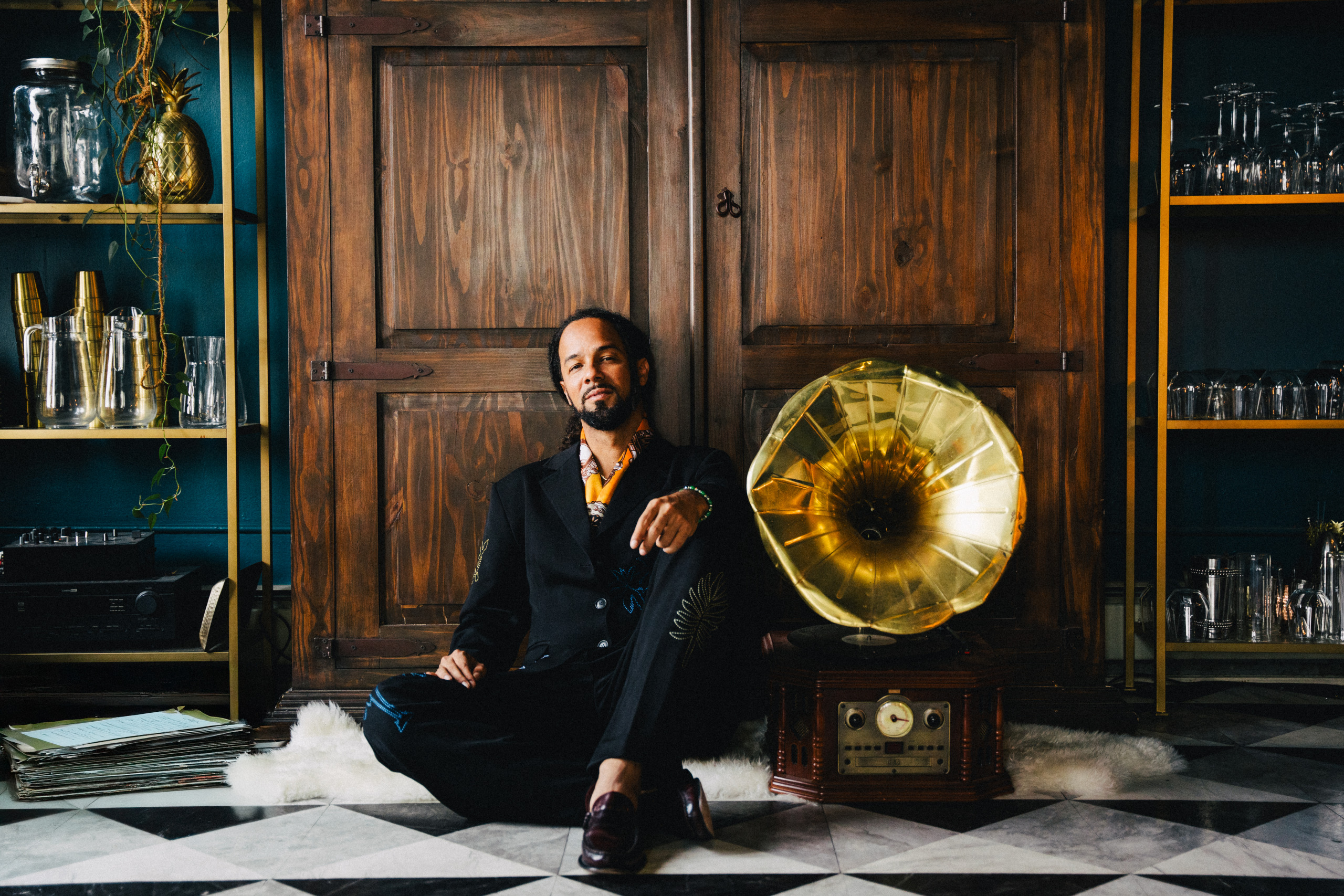
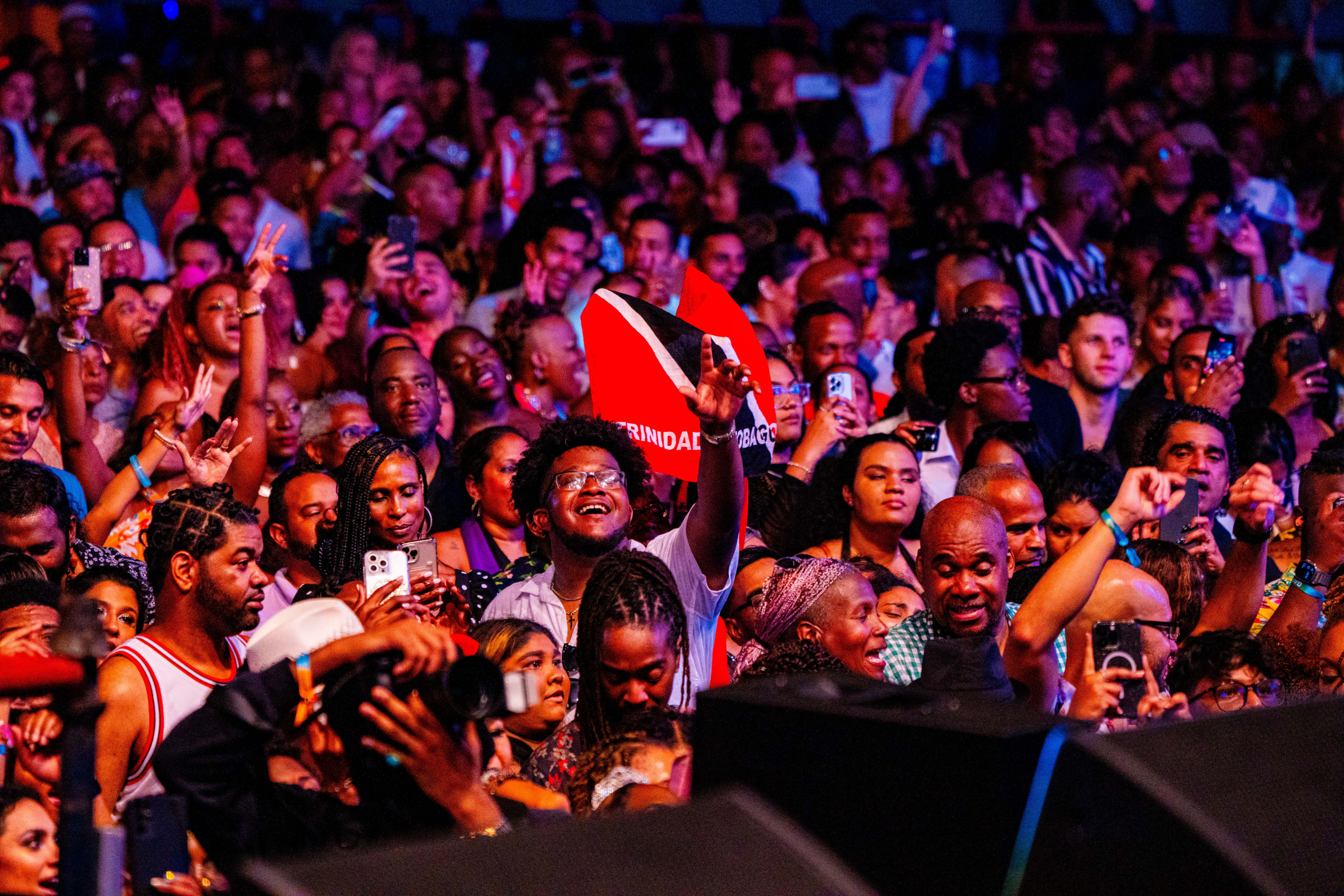
Last month, on a below-freezing night in New York City, Kees Dieffenthaller was kneeling down on the stage of the Unity Festival at Jazz at Lincoln Center. In a sharply fitted tux, with his now signature locks pulled back, he appeared to be taking a brief reprieve from his headlining set, singing his soca hits for the last 20 years. The audience honored the silence. Then in a flash, Kes flashed his megawatt smile and began belting “And I feeeeeeeeel like… I jus a million dollars.” Then a sea of Trinidad and Tobago’s red, black, and white striped flags flew into the air as longtime fans took over the song, gleefully responding, “Everybody watching meh, wearing a million colors!”
“Wotless” has been a massive crowd pleaser for Kes the Band since the song won 2011’s International Groovy Soca Monarch title, 15 years ago this month. It’s sure to ignite an even greater response when Kes (the now shortened moniker for the band and lead singer) performs it tomorrow at the IzWe Festival in Trinidad’s Port of Spain.
Kes has come a long way from his days traversing the Caribbean before breaking globally with songs “Hello,” “Savannah Grass,” and “Stage Gone Bad” with fellow Trinidadian artist Iwer George. (The later won 2020’s International Power Soca Monarch and Carnival Road March competitions.)
A week after headlining Unity Festival, Kes talked to EBONY about gearing up for the 2026 Carnival season, the legacy of soca beyond the bacchanal and revelry, and why the even in the darkest of times, one should always dance.
(This interview has been condensed and edited).
EBONY: This year Trinidad and Tobago’s Carnival is February 16-17. Once Carnival is over, and you take the last lap, what do you do to instantly decompress?
KES: Disappear. I just disappear. I go deep in the bush. I just sleep, eat, and not listen to anything. You have to clear your palette, and I take that time very, very seriously. You replenish. Even though during Carnival, I’m fairly healthy, but it does still take a toll on you.
Before the main carnival, you host your own fete on the island: IzWe Festival. How do you say it?
KES: Iz We [smile] We don’t say it’s us. We don’t say it’s us. It’s we. We together. We together as one. It’s we rhythm. And that’s very much the way we speak. “Izwe” in Zimbabwe means country or land. So, there’s actually other meanings there. But at the same time IzWe, it’s us. It’s who we are. This is who we are.
How did it start?
KES: IzWe really came out during COVID, actually. We did an annual show in Trinidad called “Tuesday on the Rocks.” And “Tuesday on the Rocks” was based off a song, and yes, it fell on a Tuesday and all of the vibe of it. But we wanted to expand the reach of what that was because that just kind of locked us into a day and one song and us alone, because it really wasn’t just about us.

So IzWe became, as it is now a festival, where yes, we are the headliners, but we have a band stage, and we have different garden and vendors. We’ve built a whole ecosystem, and we felt that a name like IzWe made sense. We could attach anything to IzWd? Is we what? Is we vibe? Is we food? Anything. So we felt like we wanted to do that because it really spoke about us and our sound and everything.
Speaking of your sound, how did you connect to soca because I’ve read you grew up singing rock, R&B and classical.
KES: I always loved soca and obviously it’s my culture, but as a kid, I kind of was everywhere. I wasn’t just about calypso. In school, I’d do calypso competitions but I still didn’t know how I would fit.
A few artists came around, David Rudder, Ataklan, the Mighty Shadow. These guys had different takes on calypso. David Rudder had a style where he would apply folk to calypso and blues. I felt like that was a real avenue for me to discover soca, but I also loved R&B. So I was like, “How am I going to get a little more R&B into what I’m doing here?”
At first, it was just about feeling what was my sound going to feel like. But then it was about learning the history and what this is all about. Who am I standing upon? What is this genre? Where did it come from? I realized that deeply, calypso music is a mother genre just as jazz, and just as all of these genres that came up post-emancipation. “Kaiso” came out of celebration of emancipation into the early 1900s and became one of the earliest songs to be recorded. “Mango Vert” [by Lovey’s Trinidad Calypso String Band] was recorded in 1912.
We’re talking about a genre that really has its roots very deep in the Western music as we know it. Then I found its roots in reggae. It’s Lynn Tate coming from Trinidad to do sessions with the ska musicians and playing a part in some of the sounds of reggae. And then when Sly & Robbie would come Trinidad, a lot of people would come to Trinidad, hear the bassline on the pan, and get ideas for dub.
All of these things, of course, is controversial and people would fight for this. But at the end of the day, we were around, and we were the sound of the Caribbean. I stand on the shoulders of these masters who came before me.
What our gift to the world is, is storytelling with melody, with love, making music and art out of the pressures of life and really giving it back to you in a way that you’re almost addictive, in a way that is almost taps into the very essence of our humanity, in a sense of something that makes you laugh or something that makes you think or something that just makes you give up, free yourself and remind yourself that I’m a human.
At the Unity Festival, where you were celebrating 20 years, you said it had taken you 10 years to get to New York. That feels so strange because outside of the Caribbean, New York is the largest concentration of West Indians. I would think soca fans here would want to see you. What was the delay?
KES: It’s an industry, there are cycles, and there are prosperity, times of prosperity and also slim times, slim pickings. We tend to arrive at the party when it was over in every point in our lives with the band. The first time I reached Capital Records, the next two, three weeks, it closed down and it became something else. And the execs that we saw got fired. They loved us, but then they were fired. So, it just always happens when we arrive on the scene, things need to start over. And in the ’90s, soca was on fire, touring was on fire, people were all over the place. The economy was quite different.
When we stepped into the 2000s, that’s when we decided to come out. Everything was decimated. The industry was decimated, and the touring kind of came to nothing. [Promoters] really didn’t have capital to really bring bands from Trinidad to New York. It just was a luxury at this point. So a lot of artists were just kind of hustling out there. And I felt like it didn’t have a situation that made sense for us to really be a part of as a band. Then that just really took 10 years.
Well, you wouldn’t know that the delay had an impact on you. Every time I see you, you’re jubilant. You’re always smiling, but it must be heavy at times to bridge those gaps. And you literally have had to build stages. You’ve created your own festival and have massive hits that shut down parties. Can you talk about the weight of that, having 20 years in the business, but you’re still breaking through.
KES: So is this therapy? [laughs] Oh my God… It’s all of it. It’s exactly that. It is a lot of work. It is that if it’s not there, we have to build it. That kind of stems from how we grew up. We grew up in the late ’70s, ’80s where do it yourself was the name of the game. We wanted form a band. We didn’t have a drum kit. My brother builds a drum kit with buckets. And we need a stage, so we trying to build a stage. You know what I mean?
Nothing’s changed in our ways because I actually feel really anxious when things are not growing or when I’m in the same loop. I call it a loop and I was like, “I need to break this loop.” Breaking the loop, I know what it requires. It may mean jumping off from this safe lily pad over to another lily pad and risking everything to fall in the middle.
However, this is what I’m here for. This is life. Listen, I’m having this time of my life. I’m not doing this because I’ve been safe. I’m doing this because I took a bet on myself. I’m doing this because we walked the lonely roads, we went the other way while everybody went that way.
Last question, the news headlines in Trinidad speak of upticks in crimes and other public safety concerns that can turn off travelers. What do you say to people who fear the violence there? Should they ignore it for the sake of Carnival? How do you tell people to balance the good with the bad?
KES: This is the dichotomy that is Trinidad. We’ve been through world wars. We’ve been through plagues. There was the polio epidemic. There was COVID. We are going to party nonetheless because that’s life. At the end of the day, we smile, we laugh, we cry. If things were ready to get really bad and really hard, should we party less? Should we celebrate life less? Maybe we celebrate more. Maybe we try to bring more energy. Maybe we try to bring more love.
Actually, pressure is what is brings sweet music. Pressure is what makes juice. So for me, keep dancing. Keep dancing. Keep dancing because that is the last frontier, that’s the last front, your humanity.
IzWe Festival takes place on February 10 in Port of Spain, Trinidad.