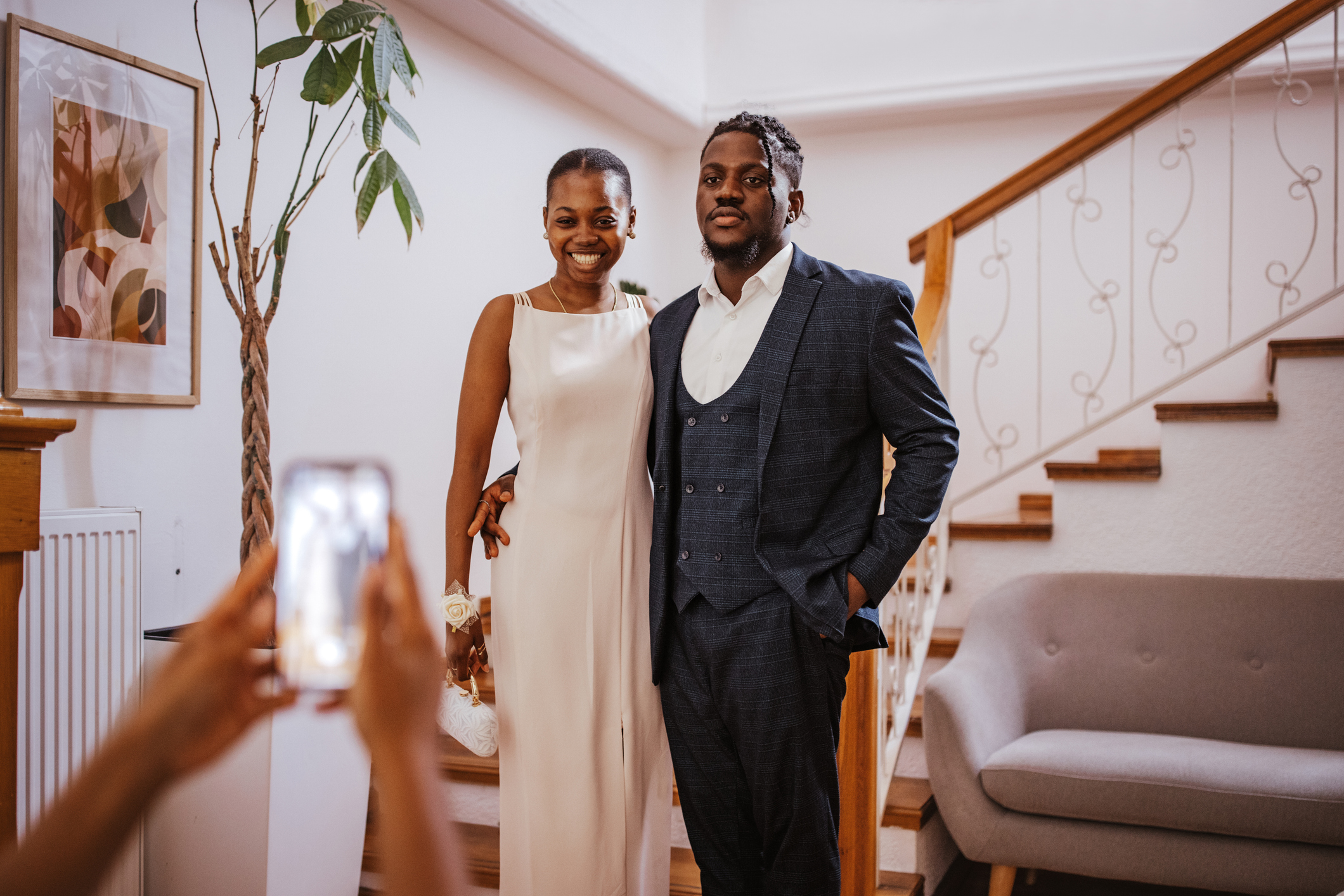
The conversation resurfaces every prom season, but this year it reignited mid-April when a white woman on the internet dismissed Black prom send-offs as “hood prom baby mama culture,” arguing that this is the closest some girls will get to being a bride, so their families go all out. It was racist, lazy and wrong on its face, but it moved fast, the way these narratives always do, pulling in the same recycled talking points about excess irresponsibility and what Black families should or shouldn’t be doing with their money.
The clips at the center of the outrage are familiar. A teen steps out of a luxury car, a driveway turns into a red carpet, music is playing, cameras are up, and family and neighbors gather to watch the send-off. What reads as a celebration to the people present gets recoded online as spectacle in the worst way, something to mock or audit. The shift from witnessing to policing happens almost instantly, as if joy needs clearance before it can be public.
What’s actually happening is far less scandalous. Black families are marking a transition with intention. Prom is not just a dance, it’s a visual checkpoint between childhood and whatever comes next, and for many households, it’s one of the few moments that feels entirely theirs to define. The scale varies, but the instinct is consistent: make it feel significant, make it feel memorable, make it feel like something worth stepping into.
There’s a tendency to counter this by pointing to Black debutante balls and cotillions as proof that formal rites of passage already exist within the community, but that framing misses the reality. Those traditions are real but they represent a relatively small slice of Black students. Prom is the more democratic milestone, the one that cuts across class geography and background. It becomes the stage where polish pride and presentation show up in full, not reserved for a select few but accessible to many.
@laiitherula it’s coronation day! #debutante #cotillionball #blackgirls ♬ original sound – Audrey Friedrich
Other cultures are afforded the space to do exactly this without interrogation. Quinceañeras come with custom gowns, choreographed dances and banquet halls booked months in advance. Bar Mitzvahs and Bat Mitzvahs can stretch into multi-event productions. In affluent communities, Sweet Sixteens double as social debuts with designer wardrobes and full production value. These are framed as meaningful cultural even aspirational. They are rarely framed as irresponsible.
Black prom send-offs, by contrast, are filtered through suspicion. If it looks expensive, the assumption is that it must be reckless. If it’s Black, the assumption is that it must be compensatory. The idea that families might plan, save and choose to invest in this moment doesn’t seem to land. Not all Black families are struggling, and even the ones who are still make deliberate decisions about where celebration fits into their lives. The refusal to acknowledge that range is part of the problem.
There’s also a strange moral pivot that shows up in these conversations where people argue that students with bad grades shouldn’t be “rewarded” with prom as if that’s how access works in the first place. Schools already set the rules. Students who aren’t on track to graduate or who don’t meet behavioral standards often aren’t allowed to attend. The argument collapses under even a basic understanding of how prom functions but it keeps circulating because it supports the larger narrative people want to tell.
What’s really being policed is visibility. Black celebration that is big, stylish and unapologetic disrupts a long-standing expectation that it should be contained or tied to struggle. Prom send-offs reject that framing. They are communal, expressive and visually intentional with an understanding that how you show up matters. The tailoring is sharp, the dresses are considered and the entrances are planned. Nothing about it is accidental.
That sensibility isn’t new. Black communities have long treated presentation as a form of language, from church steps to family gatherings to any space where showing up well is both an aesthetic and cultural practice. Prom is simply a contemporary extension of that tradition, a space where young people translate what they’ve learned about style, pride and presence into a moment that belongs to them.
@m.mylaaaaaaa I didn’t walk in…I got carried in

main character energy only. #Prom2026 #CarriedIn #BigEntrance when Beyoncé said “okay, ladies now let’s get in our formation.” I took that personally
#Formation #PromVibes
The internet flattens all of this into a clip and a caption, stripping away context in favor of something easier to judge. The same critiques cycle every year with little variation, rarely interrogated for what they reveal about the people making them. It’s easier to question the spending than to interrogate why Black joy, when it is visible and expansive, continues to make people uncomfortable.
So the issue isn’t that Black families go all out for prom. The issue is that when they do it gets read through a lens that assumes excess irresponsibility or imitation instead of intention. Until that lens shifts, the conversation will keep missing the point and Black prom will keep doing what it has always done: showing up fully on its own terms.