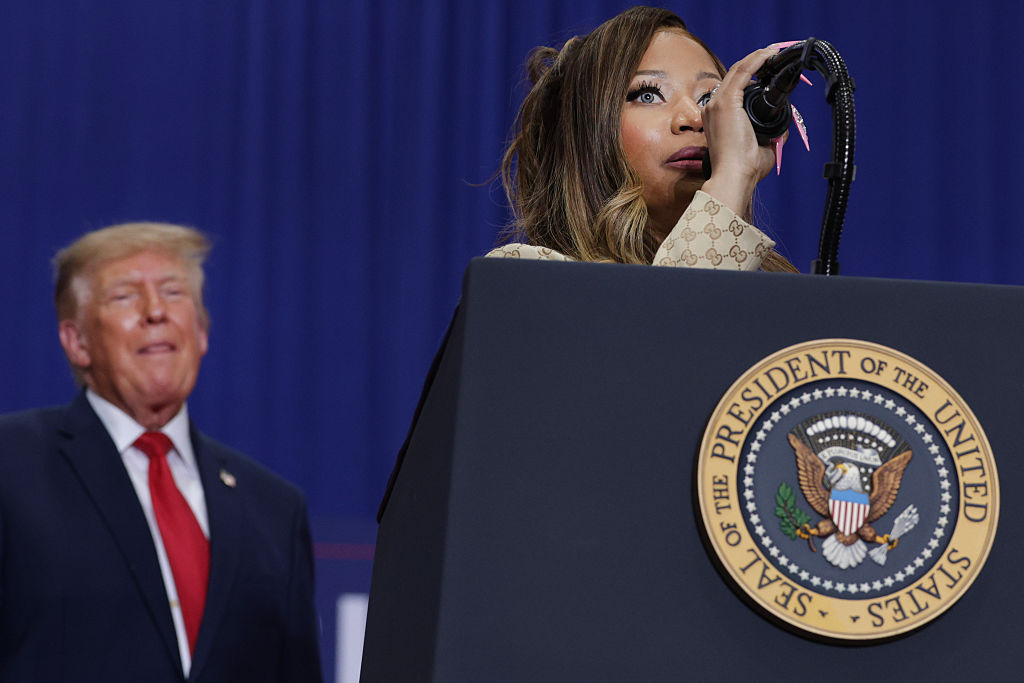
Nicki Minaj built an empire demanding respect, only to find herself smiling as President Donald Trump publicly admired her backside before a laughing crowd. The self-proclaimed Queen of Rap, who spent nearly two decades refusing to be diminished, was suddenly spinning for presidential approval. Quite the coronation.
The spectacle at a Michigan midterm rally was embarrassing enough, but the implications extend well beyond Trump’s wandering commentary on women’s bodies. Minaj’s enthusiastic embrace of MAGA raises troubling questions about Black cultural influence, political exploitation, and the price of being welcomed into spaces where respect appears optional.
For a woman whose success was sustained by Black women, queer audiences, and immigrant communities, lending her influence to a movement whose policies have targeted many of those same people reveals a contradiction far more disturbing than the spectacle itself.
The Culture That Built the Queen
Before the MAGA makeover and Air Force One photo ops, Onika Tanya Maraj was a Trinidadian immigrant girl from Queens who turned mixtapes into a global empire. Her rise was extraordinary in an industry that historically treats women in rap as disposable. Black women championed her lyrical brilliance, queer audiences embraced her unapologetic self-expression, and immigrant communities recognized their own struggles in her journey.
In 2018, Minaj condemned Trump’s separation of migrant families, recalling her own arrival in America without legal authorization at five years old. She understood the trauma of children facing separation from their parents. Fast-forward to 2026, and she’s enthusiastically campaigning for the man whose administration implemented those policies. Somewhere between Queens and Air Force One, her immigration story seems to have been conveniently rewritten.
Political evolution is understandable, but Minaj’s transformation requires a level of historical amnesia worthy of investigation. Minaj hasn’t simply changed her politics. She appears to have developed a remarkable ability to recognize injustice when it resembles her own past, then overlook it once she’s granted access to the people perpetuating it. The little girl who once needed America to make room for her has become a superstar applauding those deciding who else gets to stay.
When the President Makes You the Entertainment
During the Michigan rally, Trump made remarks about women’s bodies before announcing that he had seen “one hell of a beautiful a**” and identifying Minaj. The crowd laughed, and Trump followed up by saying he hoped she wasn’t offended.
Minaj later joined him onstage, led supporters in a “We love Trump” chant, and joked about supporting another presidential run, despite the constitutional prohibition against a third elected term. Earlier, aboard Air Force One, she praised Trump’s leadership, dismissed unfavorable polling, and reportedly repeated his false claim that he had won three presidential elections.
White House communications director Steven Cheung subsequently joked that the administration might have found its next press secretary.
But the implications aren’t particularly funny. When celebrity influence becomes a vehicle for political misinformation, fans risk mistaking cultural credibility for political expertise. However, delivering a platinum verse does not qualify someone to deliver public policy.
Meanwhile, Minaj lends Trump cultural credibility while he reduces her to a body part before a laughing crowd. The arrangement is politically convenient, though considerably less flattering for the woman who once demanded to be treated like royalty.
And the spectacle of Black women being publicly objectified for the amusement of powerful people has a history worth remembering.
Sarah Baartman and the Politics of the Black Body
In 1810, Sarah Baartman, a Khoikhoi woman from present-day South Africa, was taken to London with promises of financial opportunity. Instead, she became a human exhibition, with paying Europeans gathering to gawk at her body, particularly her butt. Her exploitation became both entertainment and profit, while scientists used her anatomy to advance racist theories of African inferiority. Even after she died in 1815, her remains were dissected and displayed in France for generations before finally returning to South Africa in 2002.
Baartman was subjected to colonial exploitation with little power over her circumstances. Minaj, a wealthy global superstar, has considerably more agency. Their experiences are not equivalent, but the historical pattern of turning Black women’s bodies into public entertainment remains disturbingly recognizable.
At Trump’s rally, the President made Minaj’s backside the attraction, the crowd supplied the laughter, and she seemingly accepted the attention as admiration. Two centuries later, the spectacle remains familiar, even if the woman at its center can walk away.
The Political Pawn Problem
Minaj is hardly the first Black public figure to become politically useful to Trump’s MAGA movement. Candace Owens, Kodak Black, Amber Rose, Floyd Mayweather Jr., Congressman Byron Donalds, and the ever-controversial Brandon Tatum have all contributed, in different ways, to its image of Black support. Their motivations differ, but their visibility serves a convenient purpose: suggesting that a few Black endorsements should settle questions about the movement’s racial politics. Who knew racial accountability could be resolved with a celebrity roll call?
The “Pink Print” artist offers something particularly valuable. Her influence reaches millions who may never tune in to a conservative commentator or attend a Republican rally. For an administration courting Black voters, her endorsement is political currency. Whether that currency buys her meaningful policy influence or merely makes her useful to the administration remains questionable.
Her personal circumstances make the arrangement even harder to understand. In 2024, Minaj acknowledged she was not an American citizen. Earlier this year, she posted a Trump Gold Card while suggesting she was finalizing her citizenship paperwork, though the White House later called it a memento. Today, she still isn’t an American citizen.
The contradictions extend to criminal justice. Her husband, Kenneth Petty, is a registered sex offender with convictions for attempted rape and manslaughter. When he faced sentencing in 2022 for failing to register in California, Minaj requested leniency, citing the impact incarceration would have on their son. Her brother, Jelani Maraj, was convicted of sexually assaulting his 11-year-old stepdaughter. At sentencing, his attorney read a letter in which Minaj described him affectionately.
That is what makes her political allegiance so troubling. Her celebrity grants her privileges unavailable to families navigating the very systems she now champions. Yet proximity to the presidency hardly proves political influence, especially when her most visible contribution seems to be validating an administration whose policies contradict her lived experience.
Diagnosing the Sickness of the Soul
Perhaps the most disturbing aspect of Minaj’s transformation is the desperation for institutional acceptance it appears to reveal. Toni Morrison once observed, “The function, the very serious function of racism is distraction. It keeps you from doing your work.” And few distractions are more seductive than being welcomed by the very power structures that have historically marginalized people who look like you.
Minaj’s political evolution suggests something deeper than ideological disagreement. It’s painstakingly similar to a moral disorientation in which the desire for validation becomes so consuming that one’s own history, convictions, and community become expendable. This is a woman who built an empire on Black cultural influence, championed her immigrant experience, and demanded respect from an industry notorious for denying it to women.
When proximity to power becomes more important than interrogating how that power operates, recognition starts masquerading as liberation. Minaj seems so preoccupied with being chosen that she has stopped questioning why she is being chosen. The irony is almost impressive: a woman who spent her career refusing to be anybody’s accessory has become politically useful as one.
What has this grand political elevation earned her? A public assessment of her backside, an arena full of laughter, and a hypothetical job offer as press secretary.
The Crown Comes With Accountability
The consequences of Minaj’s political transformation cannot be measured solely by what she gains. We must also examine what her endorsement legitimizes and who it could affect. When someone commands an audience of millions, personal convictions inevitably carry public consequences.
Minaj’s place in hip-hop history is secure. Political disagreement cannot erase her influence, accomplishments, and contributions to women in rap. But cultural legacy is not immunity from scrutiny, and admiration should never require intellectual surrender.
She has every right to her political convictions, just as the communities that championed her have every right to challenge them. Loyalty to an artist does not demand loyalty to their politics, particularly when those politics conflict with the values and experiences that made their artistry resonate.
Nicki Minaj spent nearly two decades convincing the world she deserved a crown. Watching her trade the dignity that made it meaningful for presidential approval is quite the fall from grace. The crown hasn’t just slipped. At this point, it’s been dragged across the political floor, stepped on, and reduced to costume jewelry. And the saddest part is that she still seems convinced she’s being treated like royalty.