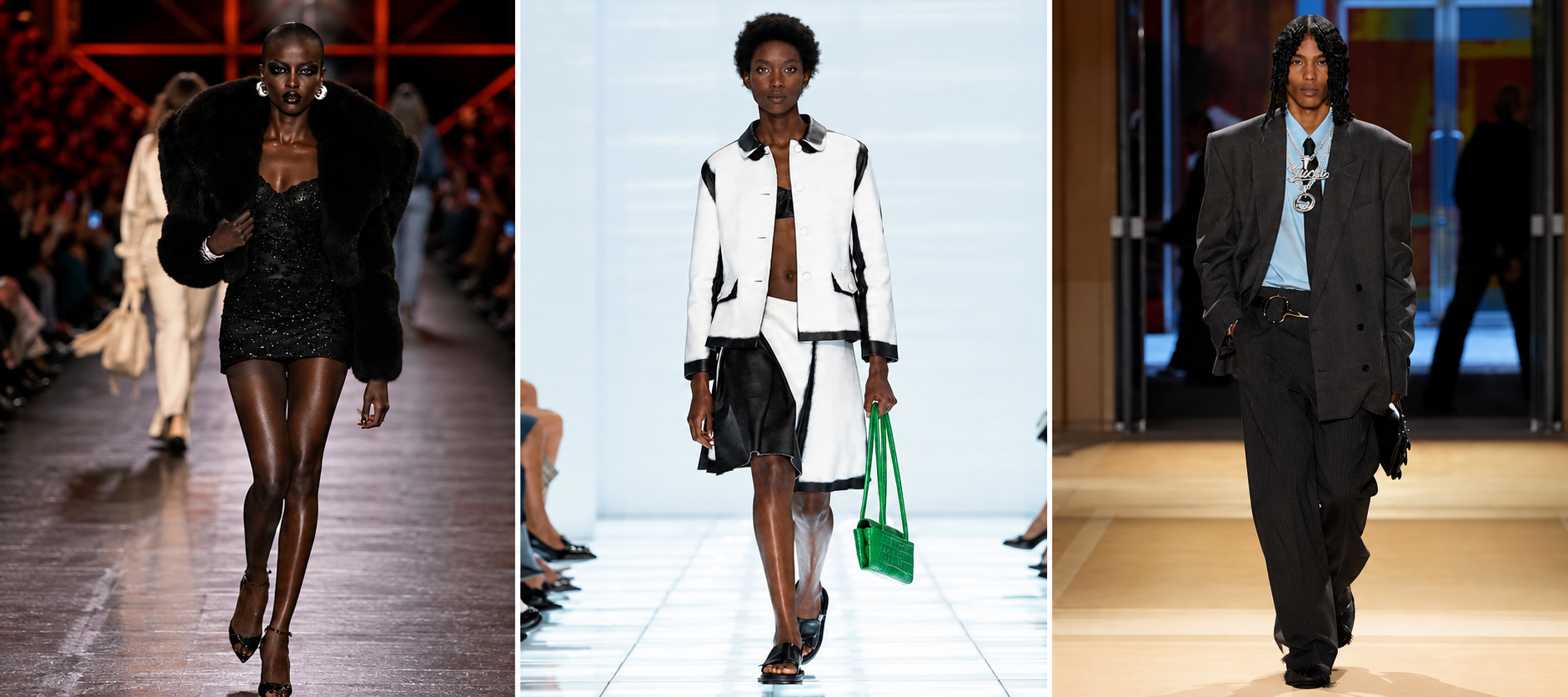
Milan Fashion Week Spring/Summer 2027 gave us plenty to talk about, but the strongest collections weren’t interested in simply delivering pretty clothes. Across the week, designers questioned how we dress, why we hold onto certain house codes and what happens when those codes are pulled apart and put back together again. From Prada turning the skirt into an entire exercise in possibility and Giorgio Armani quietly evolving its language of elegance, to Jil Sander disrupting the uniform, MM6 Maison Margiela rewriting the rules of how clothes should be worn, Etro lightening up its bohemian signatures and Diesel sending Glenn Martens off with one final fashion rager, Milan proved that reinvention doesn’t always require starting over.
Prada
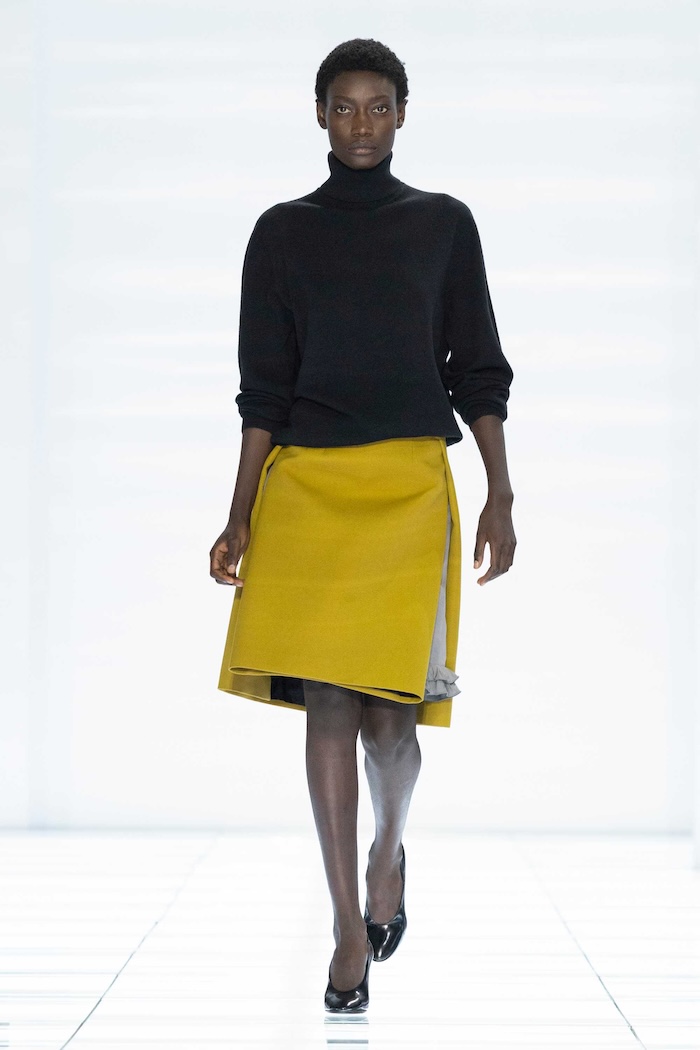
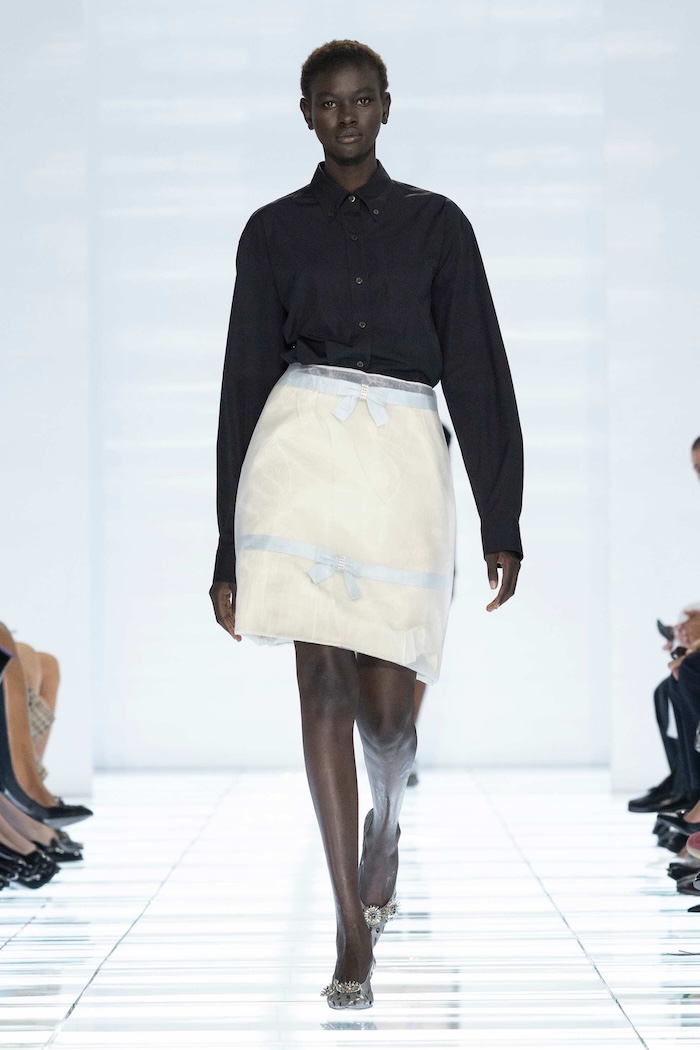
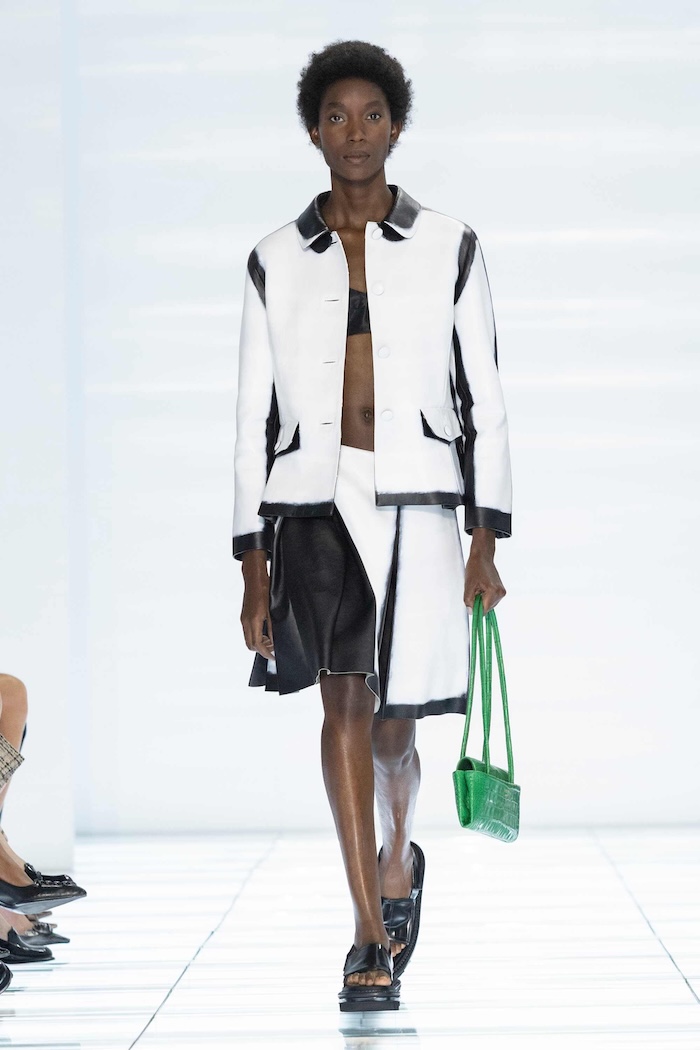
Miuccia Prada and Raf Simons took one of fashion’s most familiar garments for Prada Spring/Summer 2027 and asked a deceptively simple question: how many lives can a skirt actually have? The answer, judging by the runway, is plenty. Working within a deliberately restricted silhouette, the designers turned limitation into experimentation, pushing the skirt through layers of color, texture, proportion and function without losing the clarity that makes Prada feel like Prada. A mustard wrap skirt opened to reveal a sliver of gray ruffle underneath, while another appeared almost wrapped in translucent packaging, complete with delicate bows. Crinoline escaped from beneath clothing to become part of the clothes themselves; Velcro became both fastening and foundation for crystal embroidery; oversized snaps became jewelry. Even the most industrial materials were asked to behave differently, with Re-Nylon and ciré worked into pleats and cotton manipulated until it resembled leather or suede. It was less about reinventing the skirt than refusing to accept that we already know everything it can be.
That tension between the ordinary and the strange is where the collection got good. A black turtleneck suddenly made a sharply constructed yellow skirt feel almost bourgeois, until its exposed layers disrupted the picture. A straightforward black shirt met a sheer, lingerie-like skirt, while a cropped white jacket and mismatched black-and-white bottom played with the idea of a classic skirt suit after someone had taken a marker to its edges. Prada has always understood that clothes become more interesting when seemingly wrong things are placed together, and Spring/Summer 2027 leaned heavily into that friction: practical against precious, modest against exposed, synthetic against delicate. Sweaters, shirts and bra tops changed the personality of the skirts beneath them, proving that the collection’s narrow focus wasn’t really narrow at all. Prada didn’t need to invent a new garment this season. Instead, it reminded us that sometimes the most radical thing fashion can do is look at something we’ve worn forever and admit we may have been wearing it with too little imagination.
Gucci
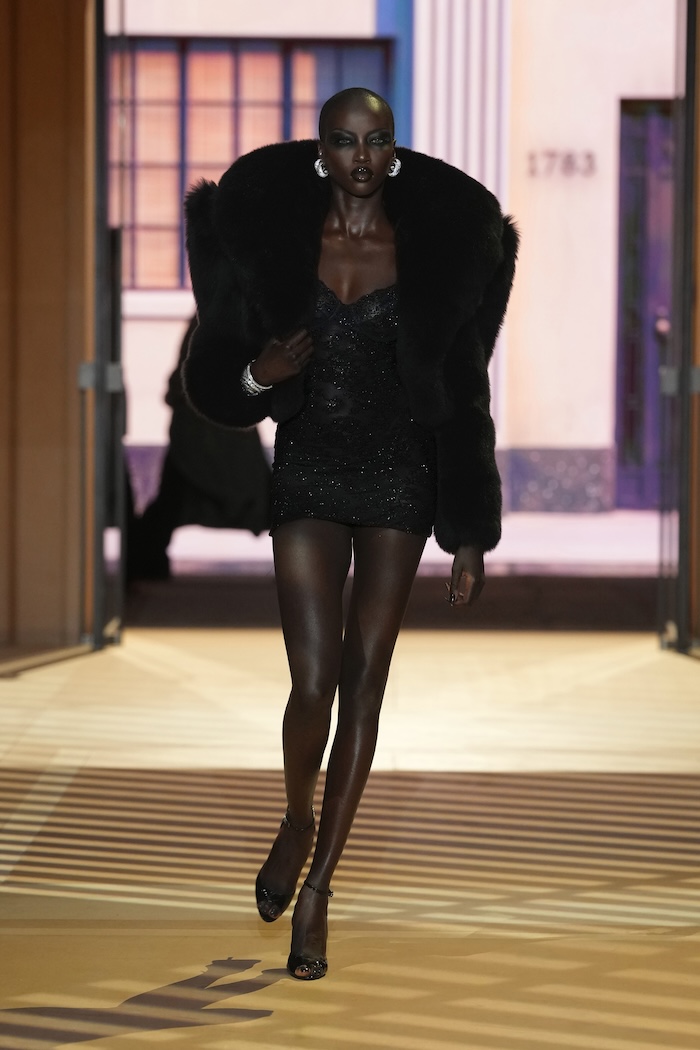
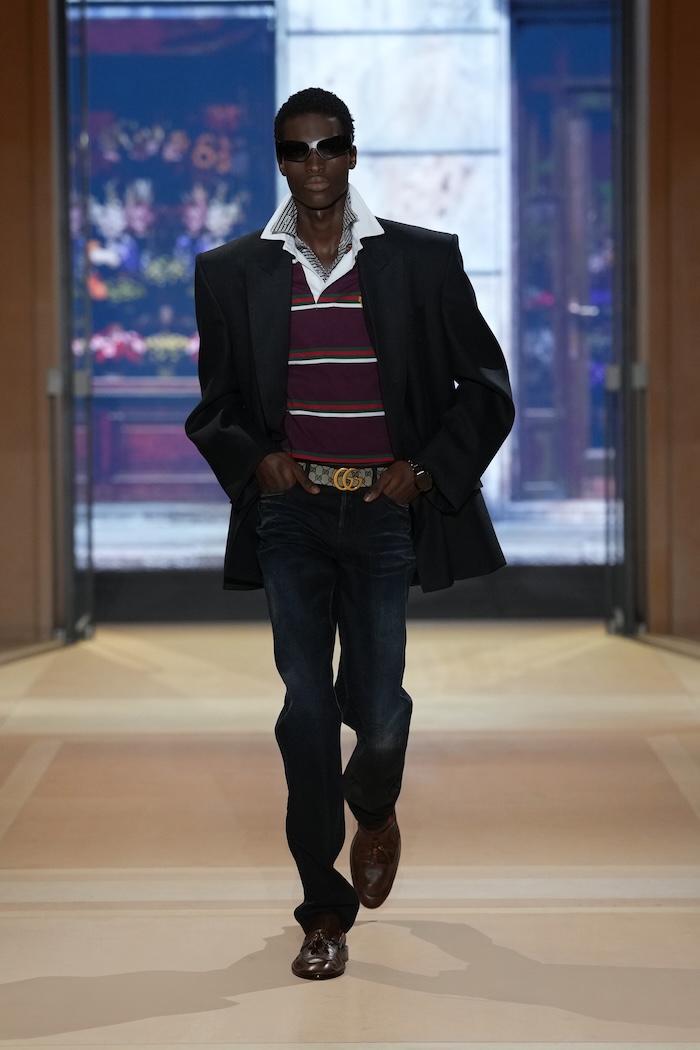
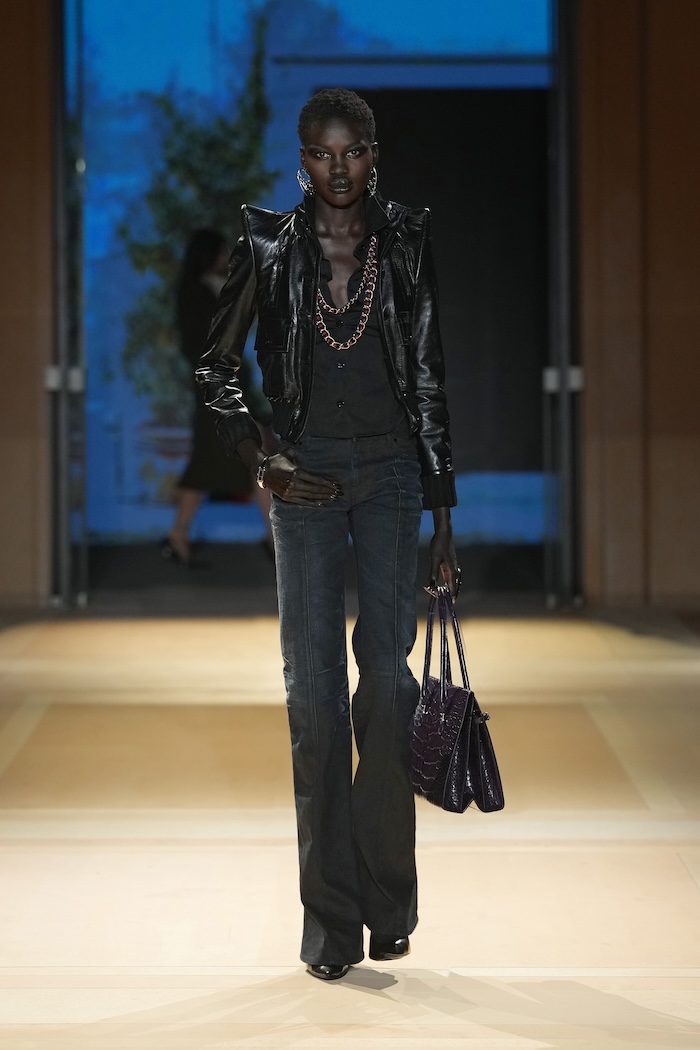
Demna’s Gucci is starting to make its intentions clear, and subtlety isn’t necessarily part of the plan. Instead of forcing the house into one neatly packaged identity, the collection leans into the different personalities that have always made Gucci interesting: the rebellious aristocrat, the unapologetic snob, the eccentric and the fashion obsessive who knows exactly when they’re being watched. Menswear opened with cropped trousers and sockless loafers before moving into sharp tailoring, exaggerated pagoda shoulders, puffed outerwear and slender, slouchy denim. One of the strongest looks layered an oversized black blazer over a striped rugby shirt and dark jeans, finished with a Gucci belt and loafers. It was prep school, corporate office and downtown cool all happening at once. Womenswear took those same bourgeois codes and gave them considerably sharper claws. Equestrian references met severe tailoring, leather, tartan, checked wool and masculine shirting, while sculpted shoulders gave even familiar pieces an almost confrontational presence. A fitted black leather jacket with flared denim felt particularly convincing, proving Demna doesn’t need to reinvent every Gucci code when he can simply make it feel a little more dangerous.
The glamour arrived when lingerie began peeking from beneath enormous shearling coats and eveningwear became increasingly fluid, sexy and unapologetically dramatic. A black mini dress swallowed by an oversized black coat, finished with silver jewelry, sheer hosiery and heels, was diva dressing without feeling trapped in nostalgia. Accessories pulled Gucci’s history even closer, with Horsebits appearing oversized, miniature and multiplied, bamboo reimagined through flexible leather handles and familiar signatures like the GG Marmont and Ophidia returning alongside newer bags and an angular update to the house loafer. That push and pull between old money and new attitude is where Demna’s Gucci feels most interesting. Gucci has always existed somewhere between horse country and the nightclub, restraint and excess, good taste and the delicious possibility of going a little too far. By bringing the collection back to the story of The Savoy, where Guccio Gucci encountered people from entirely different worlds, Demna seems less interested in defining who the Gucci customer is than expanding who they can become. In his world, the aristocrat, prepster, femme fatale, eccentric and fashion kid can all walk through the same door, and they might even leave wearing each other’s clothes.
Emporio Armani


Time did the heavy lifting at Emporio Armani for Spring 2027, but not in the way you might expect. With Traces of Time, Silvana Armani and Leo Dell’Orco explored what happens when clothing is allowed to look as though it has actually lived a little. Salt crystals, acid washes, cold dyeing and trompe-l’œil treatments gave fabrics an imperfect beauty, creating surfaces that appeared faded, weathered and softened rather than overly precious. That idea came through beautifully in an all-white menswear look, where a fluid trench floated over relaxed trousers, shirting and a loosely knotted tie, turning traditional tailoring into something almost weightless. Elsewhere, washed denim was transformed into a long double-breasted coat worn with matching trousers and a tonal shirt and tie. The effect was less Canadian tuxedo and more Italian intellectual who has somehow made head-to-toe denim feel sophisticated. Linen, seersucker, mottled velvet and translucent organza continued that conversation, proving that age, or at least the appearance of it, can give clothes character rather than take anything away.
That ease carried into womenswear, where Armani’s familiar conversation between masculine and feminine became especially compelling. A soft gray three-piece suit, cut with wide trousers and layered tailoring, had the authority of traditional suiting without any of its stiffness, while an enormous chocolate-brown bag and ruched leather shoes kept the look grounded in real-world dressing. Across both wardrobes, jackets loosened, trousers widened and lightweight silks, viscose and jersey moved around the body instead of fighting against it. Masculine and feminine codes passed back and forth so naturally that assigning them to either side almost felt beside the point. Emporio Armani has long understood that quiet clothes don’t have to be boring clothes, and Traces of Time pushed that philosophy somewhere more tactile. These were garments made interesting by their wrinkles, washes, irregularities and apparent histories, as if the best thing you could do to an Armani piece was actually wear it.
Marni
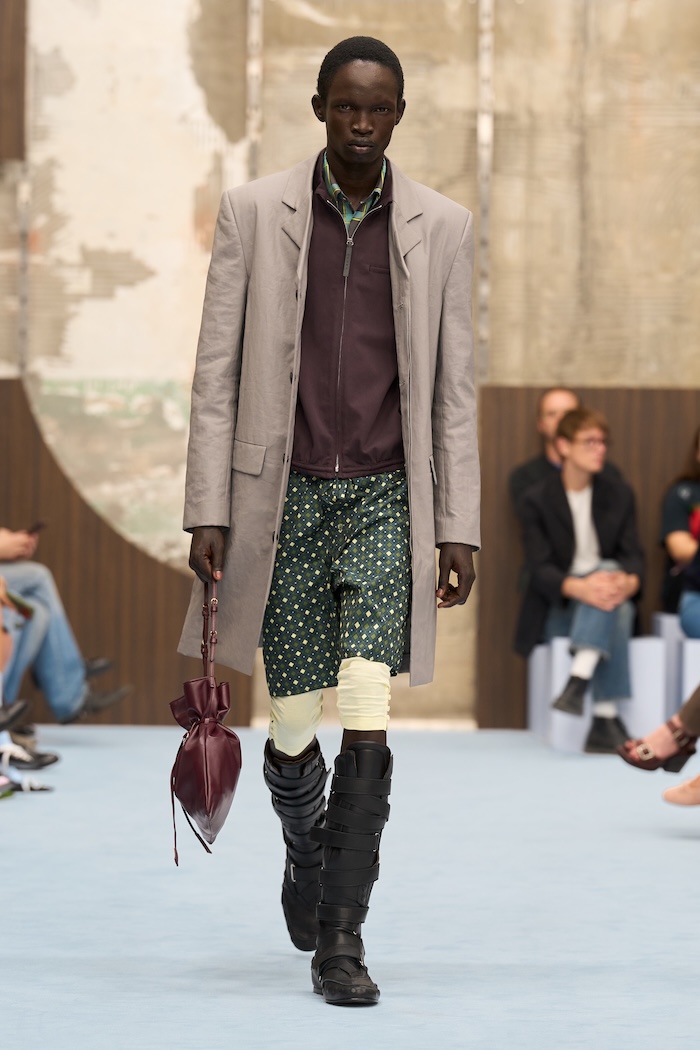
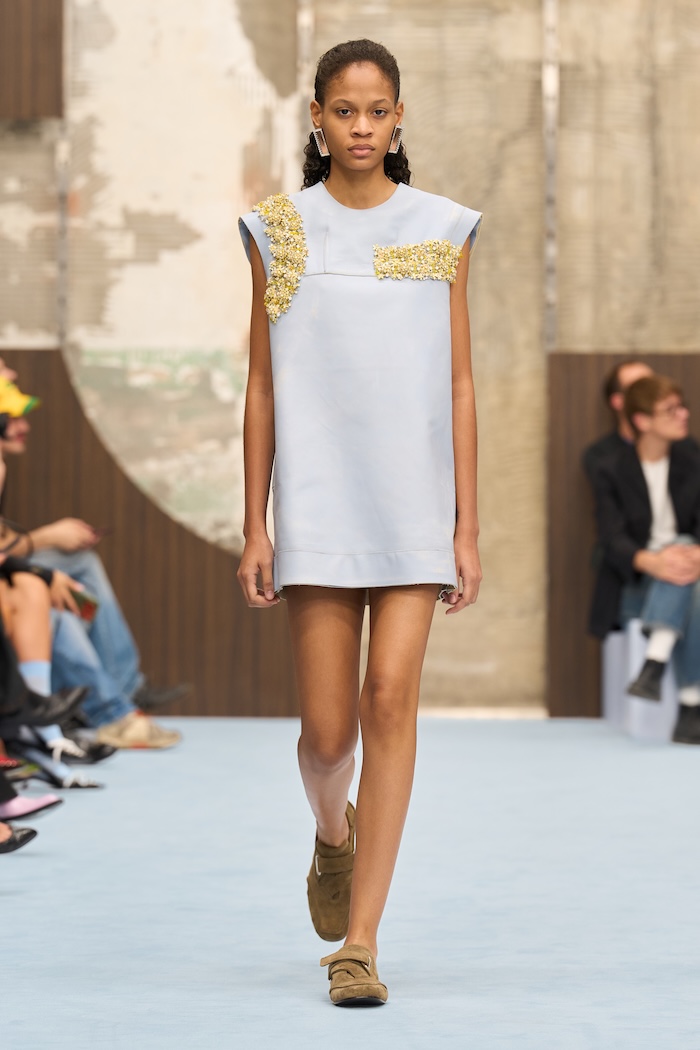
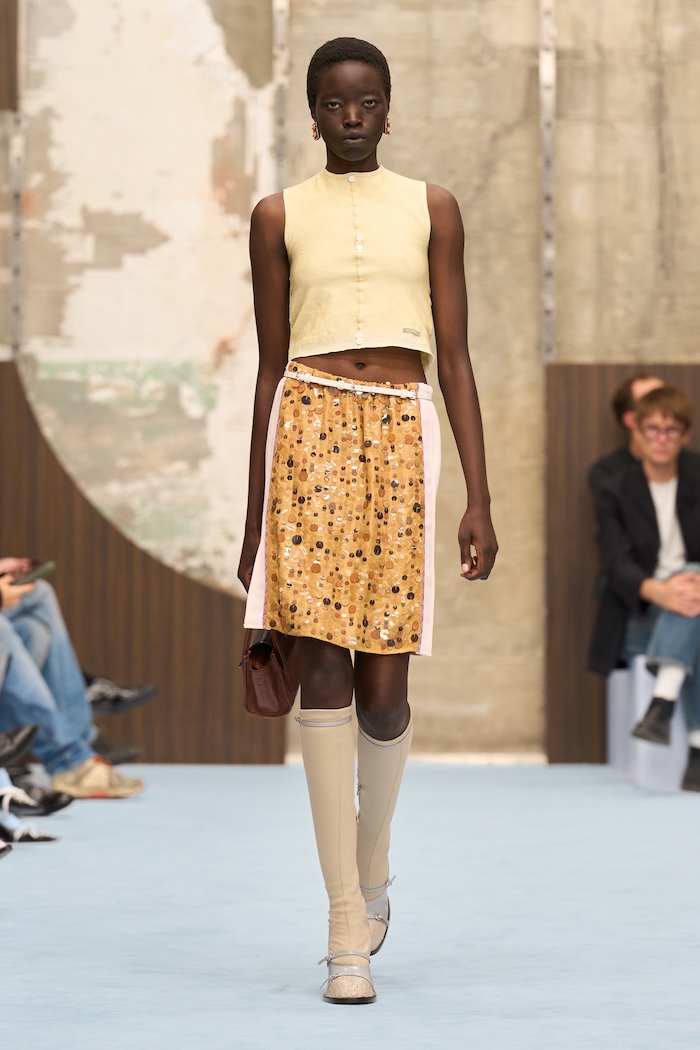
Marni has never been particularly interested in giving us clothes that behave, and for Spring 2027, that instinct became an exercise in taking things apart to figure out what might come next. The collection played with presence and absence, exposing linings, cutting into familiar silhouettes and turning construction details into decoration. A cropped yellow knit and embellished skirt captured that tension beautifully: sweet and almost prim from the waist up, then wonderfully strange below, with scattered embellishment, exposed layering and knee-high socks giving the look the energy of someone who got dressed according to instinct rather than rules. Elsewhere, a powder-blue shift dress became a canvas for clusters of embroidery that looked as though they had been lifted from another garment and casually reapplied. That unfinished, found-object quality was intentional. Buttons became oversized, seams demanded attention, cutouts exposed skin and underwear details moved from beneath the clothes to become part of their architecture. Marni wasn’t interested in hiding how something was made. The making was the point.
The collection became even more interesting when those ideas collided with the everyday wardrobe. Menswear twisted tailoring, sportswear and utility together, with one look layering a taupe coat over a burgundy zip-up and patterned shorts before finishing everything with cream leggings and enormous strapped boots. On paper, it sounds like too much. On the runway, that awkwardness was exactly what made it feel Marni. Femininity received the same treatment, moving between pretty, peculiar and purposefully off-kilter without settling into any one identity. Blonde, brown, black and washed-out tones grounded all of that experimentation, allowing the textures, exposed construction and unusual proportions to do the talking. For all the collection’s conceptual language about cutting away the past to reveal the future, its most convincing message was actually much simpler: clothes change because people do. Our tastes shift, our bodies change, our identities expand and the pieces we love pick up evidence of all of it. Spring 2027 made room for that evolution, proving once again that Marni is at its best when getting dressed feels less like following instructions and more like figuring yourself out in real time.
Etro
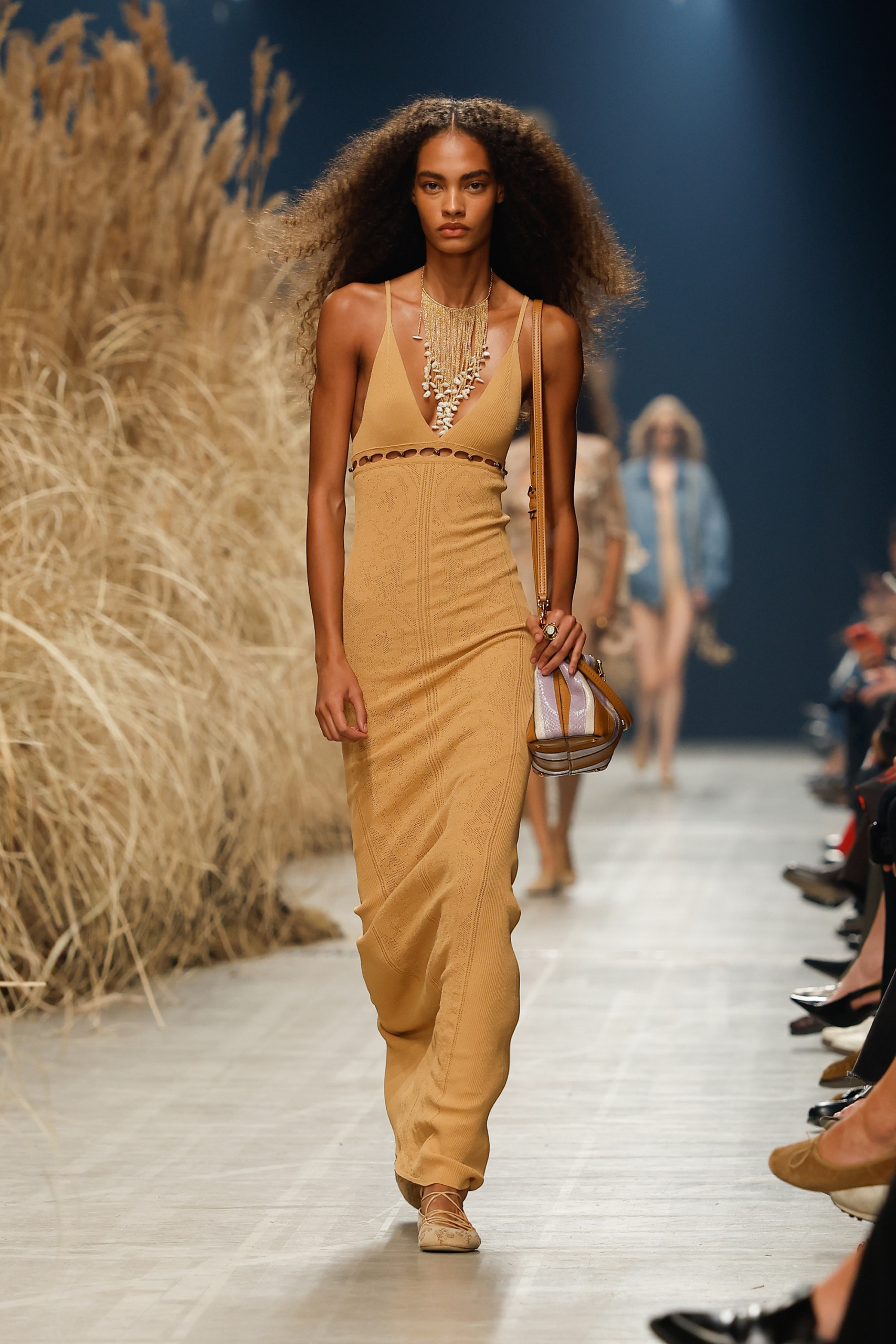
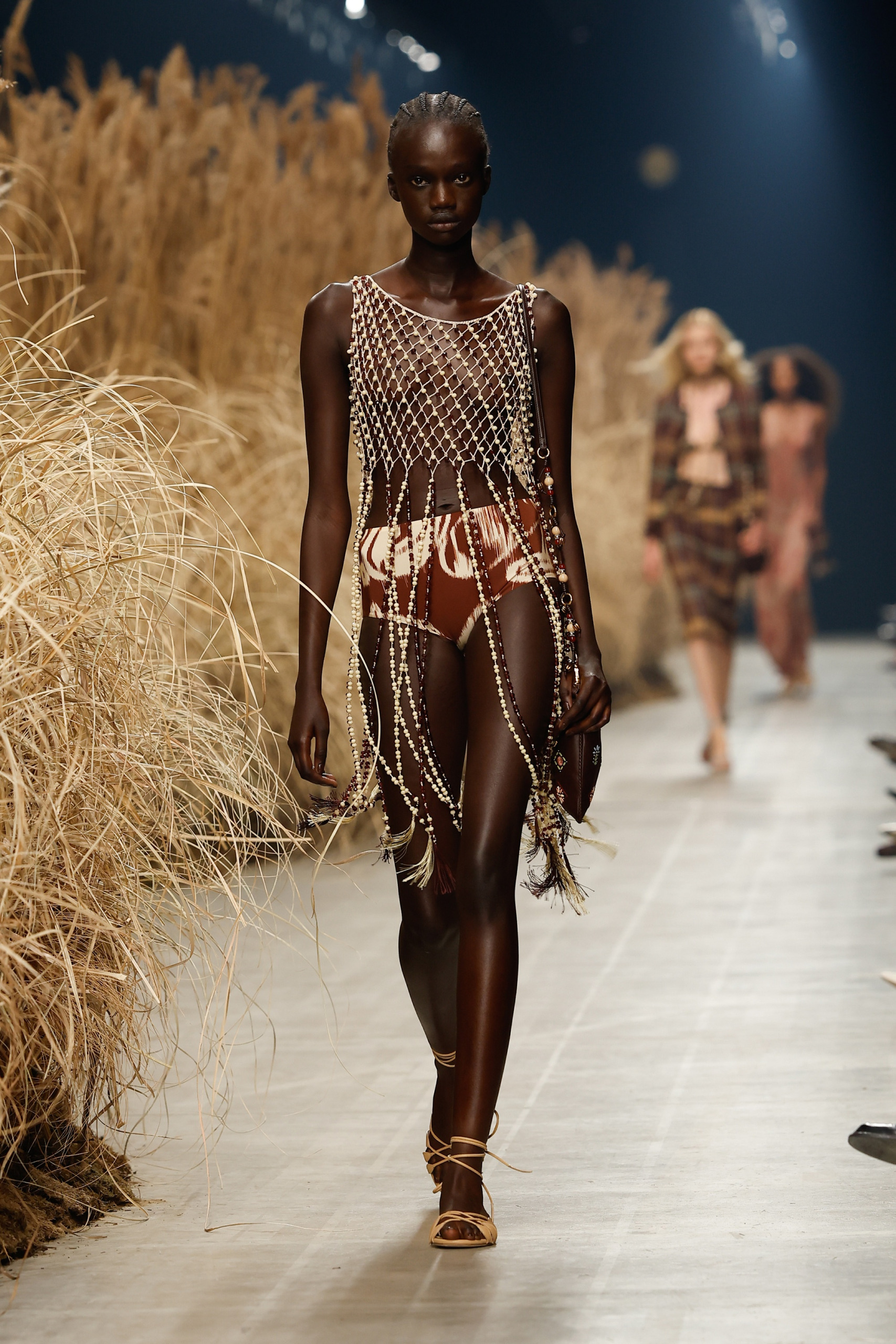
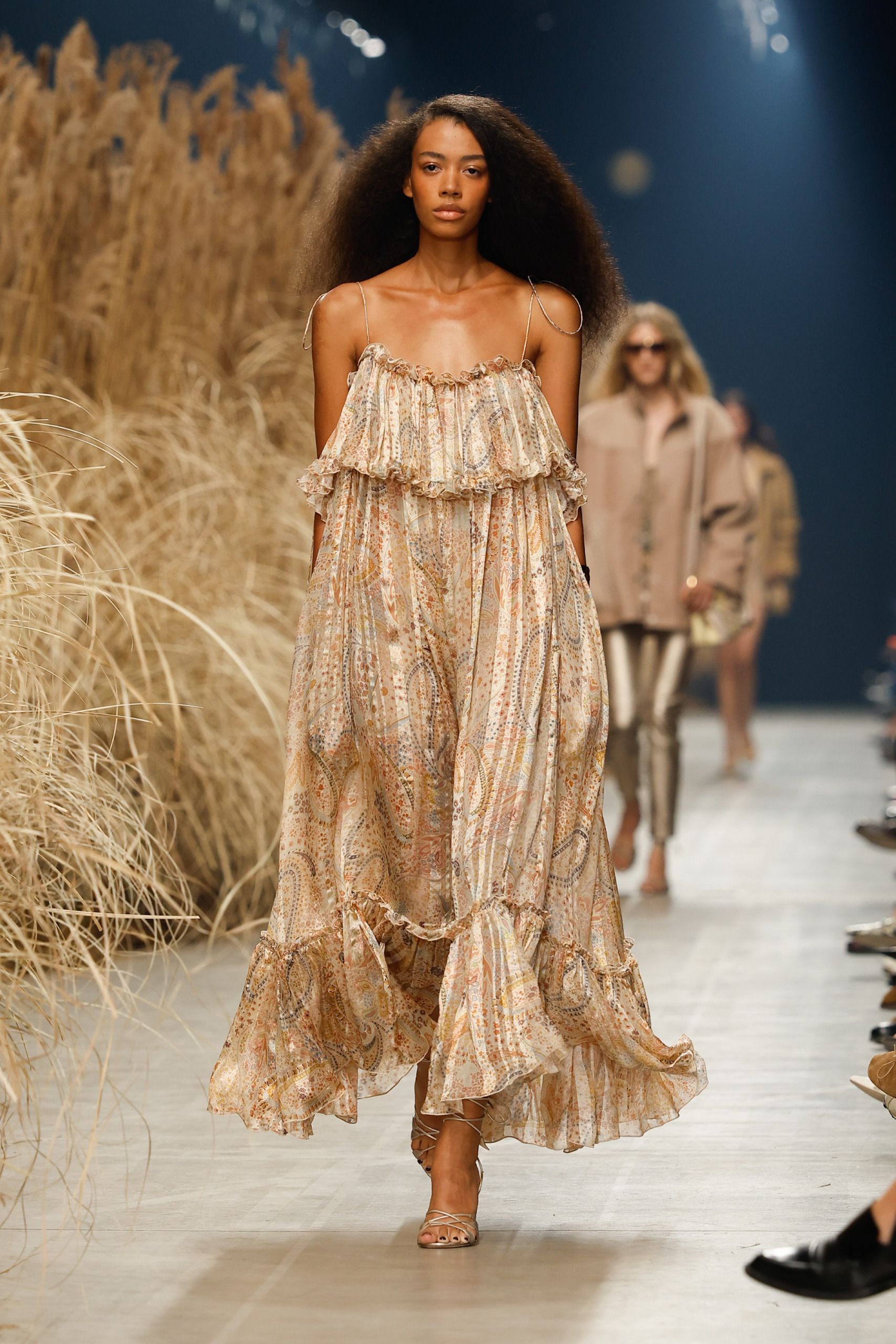
Known for its way around Bohemia, Etro, for Spring 2027, the house let a little more air in. The collection felt like getting dressed for the kind of summer day you never want to end, when the sun is doing half the styling for you and everything looks better slightly undone. Signature Paisleys were faded, blurred and sunbleached until they almost disappeared, while nude tones, sandy browns, yellows and flashes of deeper color followed the changing light from morning into night. The strongest moments came when ETRO resisted the urge to overcomplicate things. A body-skimming tan knit dress, punctuated with subtle cutouts and layered with jewelry, made bohemian dressing feel sensual rather than costume-y. Elsewhere, barely-there netting, beads and fringe were layered over printed briefs, creating a look that moved somewhere between beach dressing and pure fantasy. Nothing felt overly precious, even when the craftsmanship clearly was.
That looseness continued through the collection’s sweeping dresses, transparencies, fringe and softened prints, with silhouettes that seemed designed to catch a breeze. One billowing paisley dress floated away from the body in tiers of sheer fabric and ruffles, offering the kind of easy drama ETRO does particularly well. But the collection wasn’t simply an exercise in romantic summer dressing. Sharp tailoring, lean trousers, suede, denim and lightweight outerwear periodically interrupted all that movement, giving the eye somewhere to land before everything became fluid again. Gladiator sandals, ballerina flats and slouchy bags kept the clothes grounded, while the house’s familiar codes were treated less like precious artifacts and more like ingredients to be faded, patched, layered and played with. ETRO didn’t abandon its bohemian identity for Spring 2027. It simply took some of the weight off, proving that sometimes moving a house forward doesn’t require changing everything. Sometimes you just have to let the sun in.
MM6 Maison Margiela
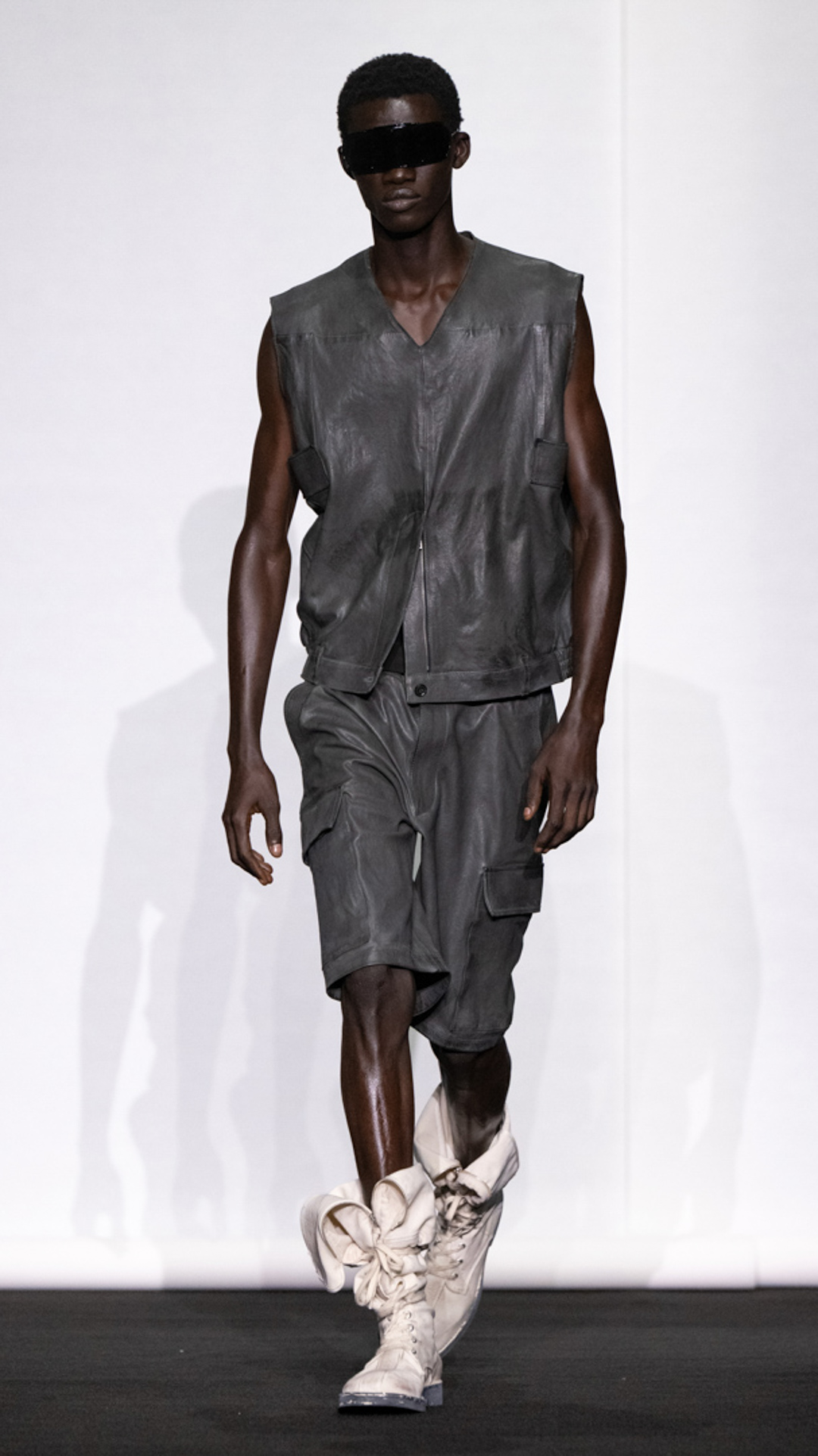
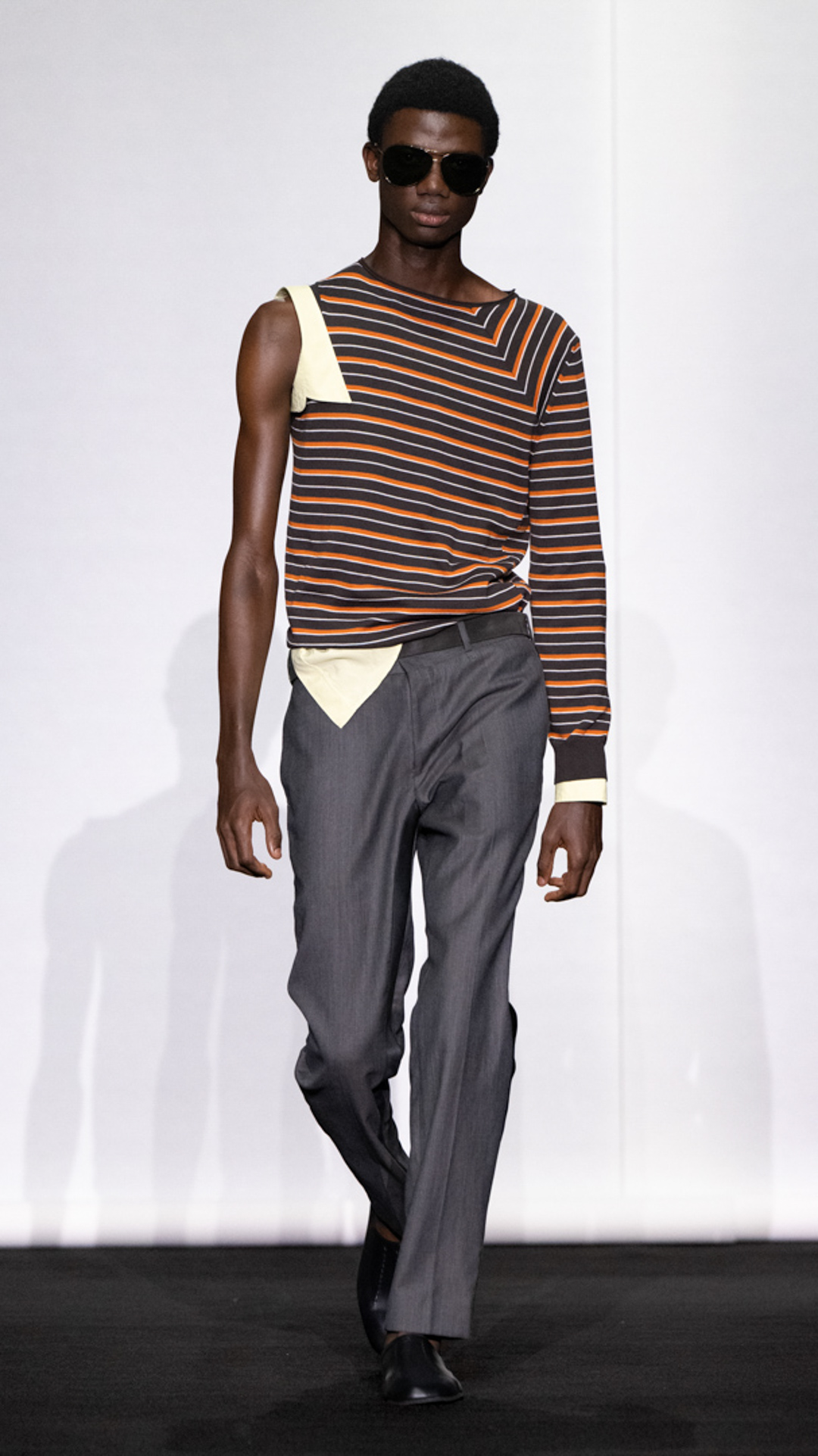
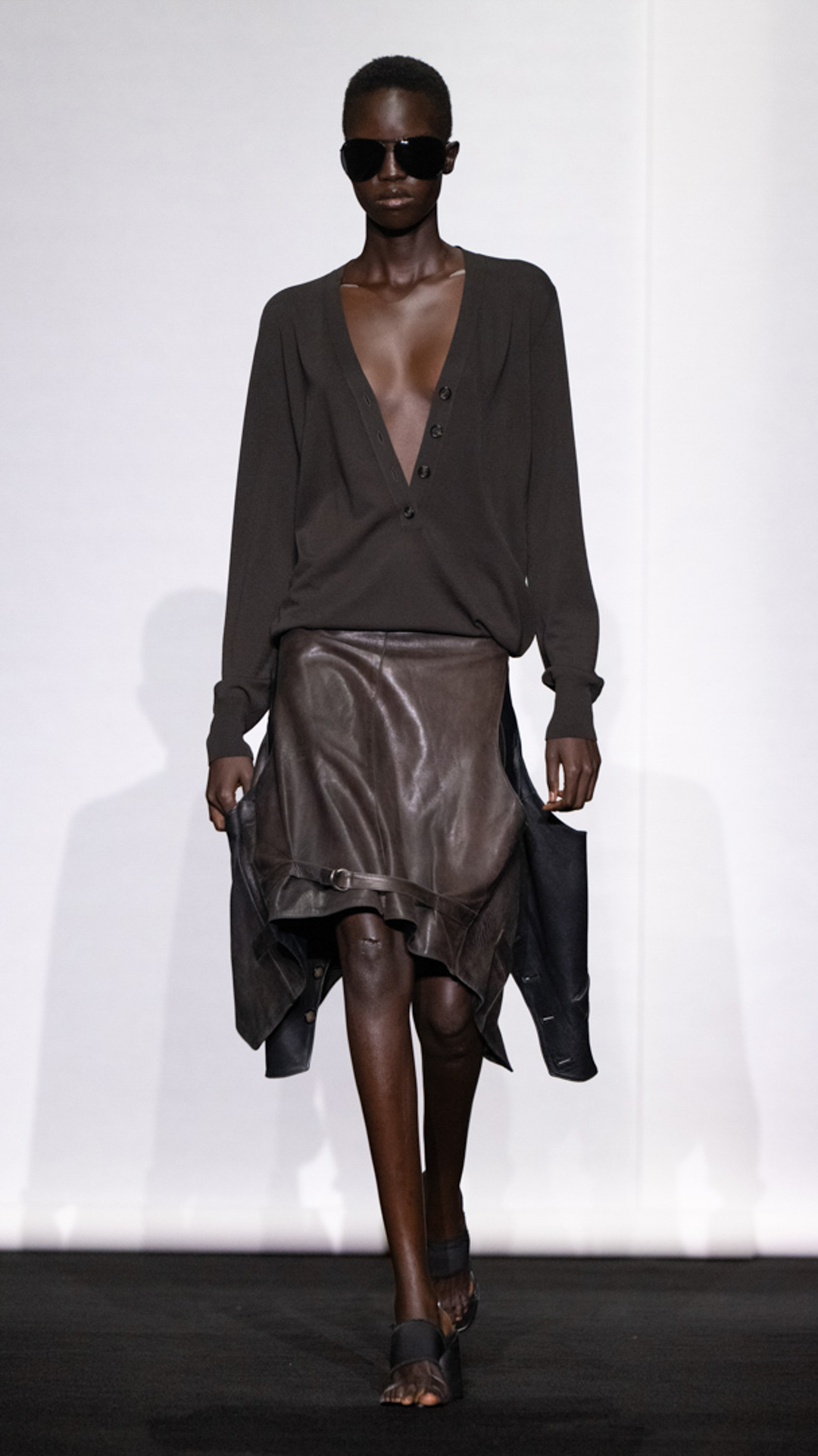
MM6 Maison Margiela took one of fashion’s most basic assumptions for Spring 2027 and asked a very Margiela question: who said you have to wear it like that? Instead of reinventing the wardrobe, the collection messed with the instructions, shifting familiar garments around the body until everyday clothes suddenly felt unfamiliar again. Womenswear saw shirts migrate toward the hips, skirts pulled upward into dresses and V-neck tops reconsidered as bottoms, while menswear moved collars and button plackets away from where we expect to find them. That disruption came through in a striped one-sleeve top layered over a contrasting tank and paired with straightforward gray trousers. Nothing about the individual pieces was particularly outrageous, but their proportions and placement made you look twice. Even the most utilitarian pieces were given the treatment, with leather biker references, cargo shorts, tailoring and T-shirts twisted through off-center construction, reduced closures and shrunken or exaggerated proportions. MM6 wasn’t trying to make normal clothes unrecognizable. It was showing us how quickly “normal” changes when you move one thing a few inches to the left.
That experimentation worked best when it still felt wearable. A charcoal leather vest and matching cargo shorts had the ease of something you could actually throw on, until oversized boots with dramatically folded uppers pushed the look into stranger territory. A womenswear look pairing an oversized plunging cardigan with an asymmetrical leather skirt was equally convincing, taking pieces we already understand and letting the styling do the disruption. Accessories continued the joke: gloves became bags and shoes, belts borrowed the proportions of doll accessories and the Soft Bauletto could collapse against the body like another layer of clothing. Even Havaianas got pulled into the experiment, with the humble flip-flop manipulated through MM6’s obsession with the number six. Beneath all the conceptual play was a surprisingly democratic proposition about personal style. Clothes don’t necessarily need a prescribed destination on the body, and getting dressed doesn’t have to mean following the manufacturer’s directions. Sometimes the best look starts when you wear the thing “wrong” and realize it might actually look better that way.
Off-White

Off-White™ was built on the idea of questioning everything, so more than a decade into its life, turning that question back onto the brand itself feels appropriate. With 10×10: Icons Reimagined, the house handed 10 recognizable Off-White™ codes to 10 creatives and essentially told them to do what Virgil Abloh encouraged an entire generation to do: take what exists, interrogate it and make it your own. The lineup reads like a cross-section of contemporary culture, with Renell Medrano reconsidering eyewear through ideas of visibility and perspective, Scott Mescudi bringing the Out Of Office sneaker back toward sport and movement, Ava Nirui treating the T-shirt as a vehicle for identity and community, and Guillermo Andrade approaching denim as an archive of memory. Veneda Carter explored absence and the body through the Meteor, while Yuta Hosokawa dismantled and rebuilt the hoodie. Raul Lopez played with the Jitney’s proportions, Stéphane Ashpool reconsidered the varsity jacket, Bafic explored the space between black and white, and A$AP Nast took on perhaps the most abstract assignment of all, using the clock to ask whether time is something we measure or something we simply experience.
What makes the project interesting is that Off-White™ isn’t treating its archive like a museum where everything must remain behind glass. In Milan, IMAGINARY PALACE brings these experiments together across 10 individual rooms, showing not only the finished objects but the references, materials and thought processes that got them there. That distinction matters. Abloh’s influence was never limited to quotation marks, zip ties or diagonal stripes; part of his legacy was permission, particularly for a generation of Black and brown creatives who weren’t always invited into fashion’s most protected rooms, to question who made the rules in the first place. 10×10 feels strongest when viewed through that lens. Rather than asking a new generation to preserve Off-White™ exactly as it was, the project allows them to pull it apart, add themselves to it and imagine what it could become. For a brand born from “Question Everything,” perhaps the most faithful way to protect the legacy is to make sure nobody stops asking questions.
Giorgio Armani

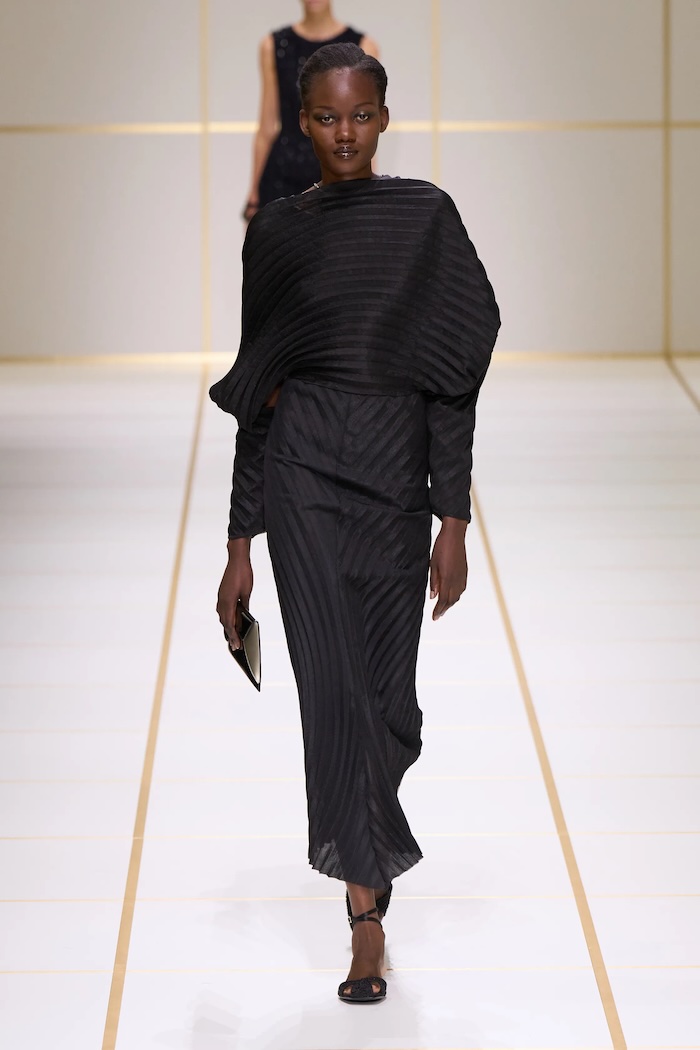
Giorgio Armani Spring/Summer 2027 is a reminder that evolution does not require abandoning the codes that made people pay attention in the first place. Under Silvana Armani, the house is shifting its proportions and attitude while keeping that unmistakable Armani ease intact. Menswear-inspired jackets are elongated and relaxed, trousers fall with an almost liquid movement, and tailoring has enough structure to command a room without ever looking stiff. One of the strongest looks pairs an ivory blazer with a fluid, micro-patterned jumpsuit cinched at the waist, the kind of clothes that could move from an afternoon meeting straight into cocktails without requiring a costume change. Elsewhere, a subtle nod to the 1980s comes through sharper shoulders, graphic lines and flashes of metallic shine, but thankfully, this isn’t Armani playing dress-up in its own archives. The references have been loosened, polished and pushed forward, allowing the woman inside the clothes to remain the most interesting part of the equation.
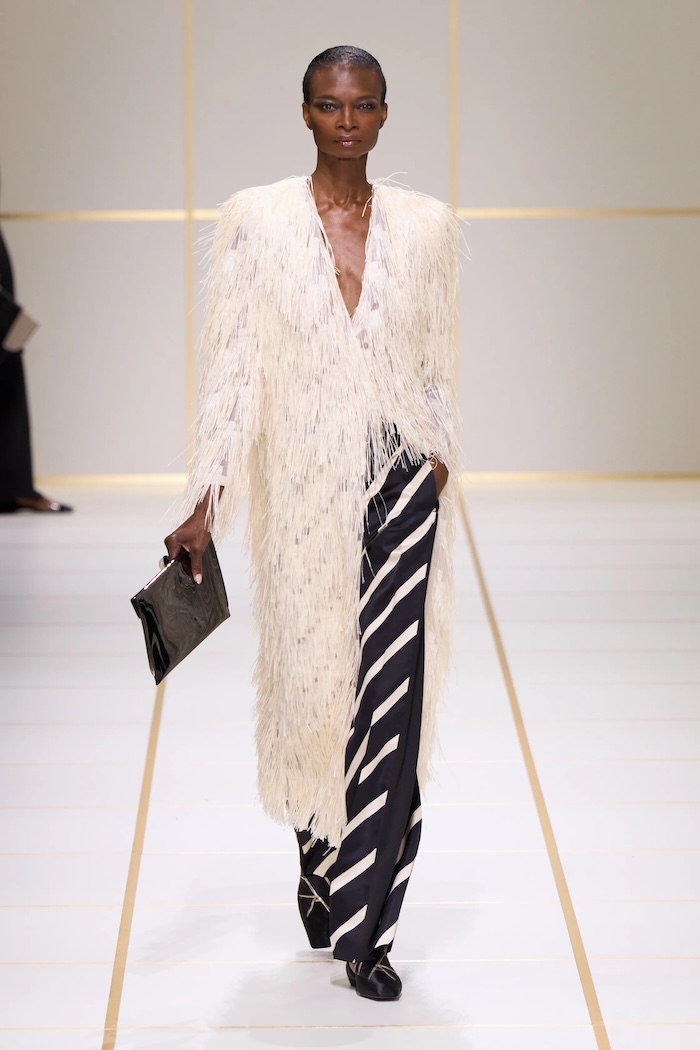
That restraint makes the collection’s more dramatic moments hit harder. Ivory, black and gold dominate the palette, creating a visual language where texture has nowhere to hide. A feathery ivory coat floats over graphic black-and-white trousers, giving us glamour without the expected evening gown, while a sculptural black pleated ensemble wraps and folds around the body with enough movement to make monochrome feel anything but basic. Cotton enters the conversation alongside reflective surfaces, metallic glimmers and fluid fabrics, blurring those increasingly irrelevant rules about what belongs to day and what belongs to night. Small clutches, loafers, sandals and neoprene boots finish the looks without fighting for attention. The butterfly motif may serve as the collection’s official metaphor for metamorphosis, but the clothes make the point more convincingly: Armani can change shape without losing itself. For Spring 2027, Silvana isn’t trying to rewrite the house language overnight. She’s proving that knowing exactly who you are gives you much more freedom to become something new.
Jil Sander


Simone Bellotti’s Spring/Summer 2027 collection for Jil Sander starts with the uniform and then asks what happens when all that control begins to crack. The house’s familiar precision is still here, but Bellotti makes it feel less precious, taking tailoring apart just enough to expose something more human underneath. A lean gray suit looks almost corporate at first glance, until the elongated jacket, softened waist and cropped trousers disturb its expected proportions. Elsewhere, an oversized gray coat swells around the body while a flash of electric blue underneath breaks through the collection’s otherwise restrained palette. That tension between discipline and disruption drives the season. Shoulders shift, folds twist, volumes expand and familiar silhouettes feel slightly off-kilter, as if someone got dressed perfectly and then decided perfection was a little boring. Bellotti isn’t rejecting Jil Sander minimalism; he’s making it less obedient.
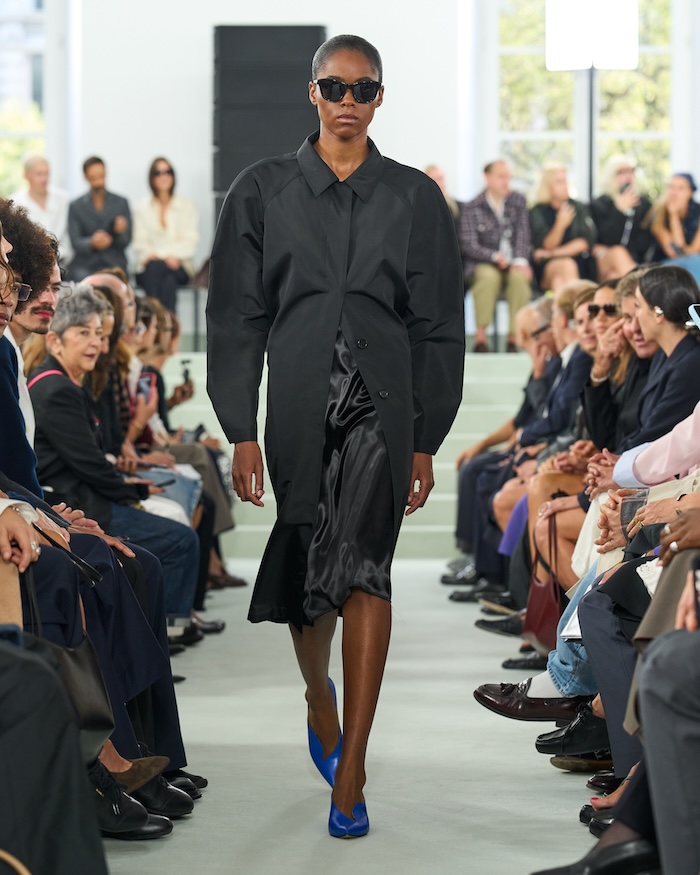
The strongest moments come when that severity gets interrupted by something sensual or unexpected. A black coat twists around the body and opens to reveal a glossy satin skirt underneath, finished with electric-blue heels that immediately change the attitude of the look. Knitwear crumples, dresses wrinkle and balloon away from the body, and tailoring moves between protection and exposure. Even the accessories participate in the push and pull: geometric bags soften and collapse, while pointed shoes stretch the silhouette into something sharper and slightly stranger. Bellotti describes creating a collection as a form of therapy, taking things apart to decide what deserves to remain, and that idea feels especially fitting here. Jil Sander Spring 2027 isn’t about destroying the uniform; it’s about letting the person wearing it mess it up a little. The clothes still carry authority, but now they also have vulnerability, instinct and, perhaps most importantly, personality.
Diesel
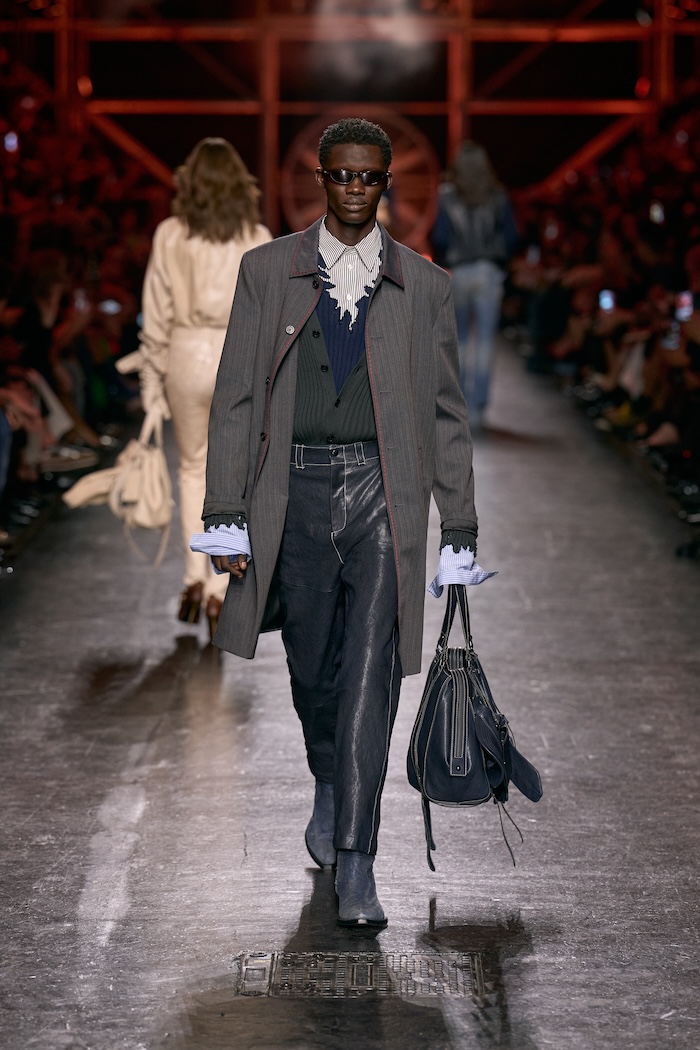
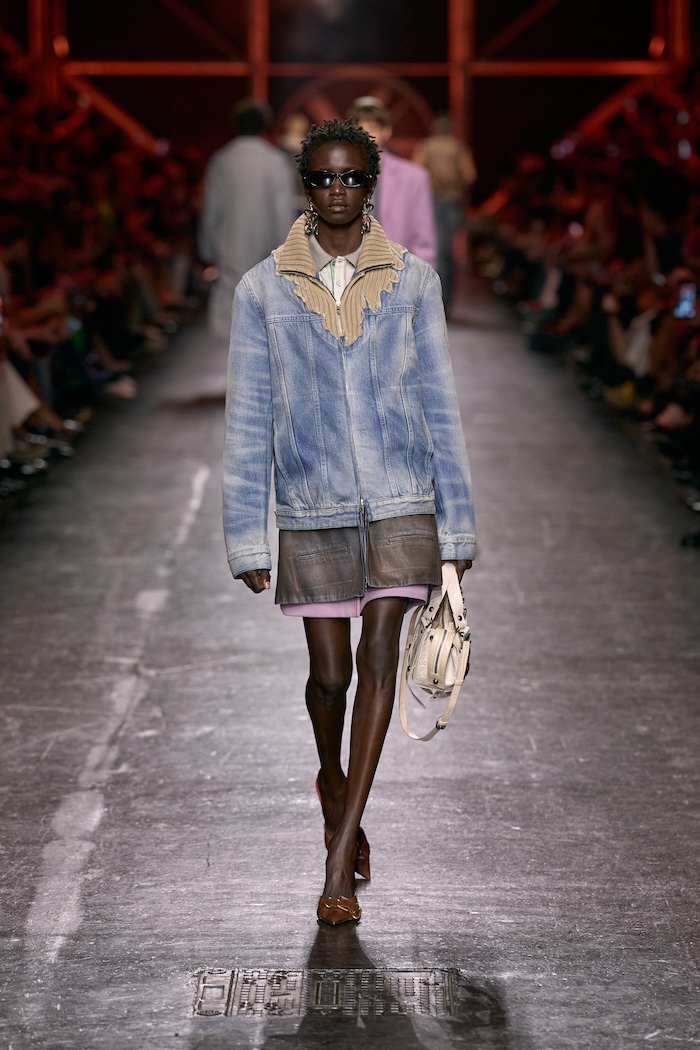
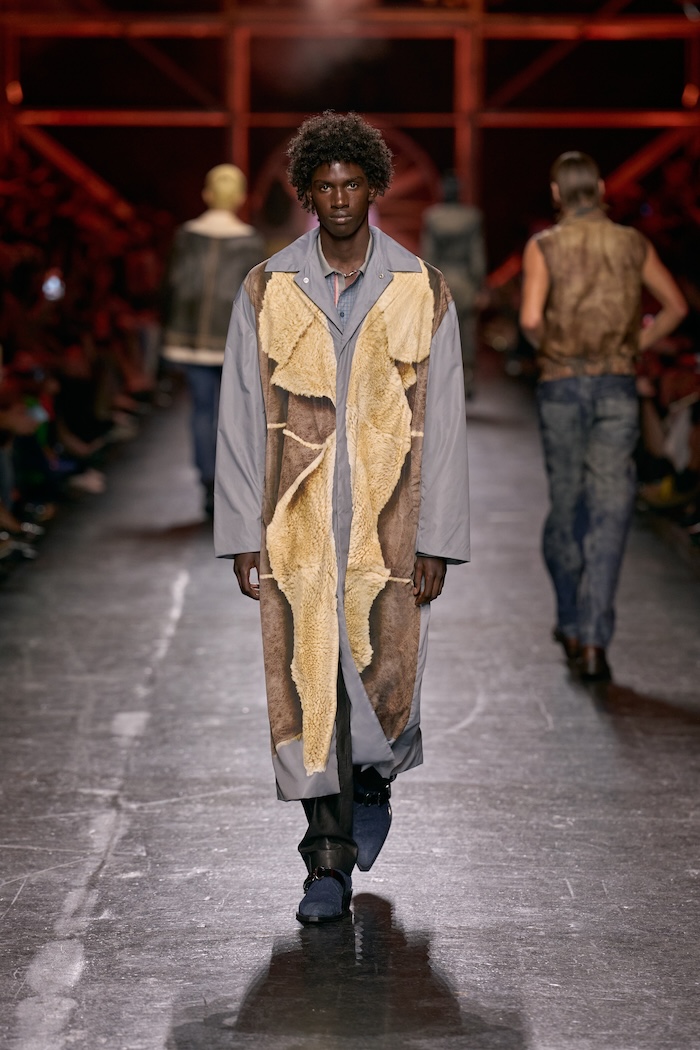
Glenn Martens was never going to leave Diesel quietly. For his final collection at the house, Spring/Summer 2027 felt like one last night at the club when nobody is checking the time and going home is simply not an option. The runway became a full-blown happening, with 200 performers from (LA)HORDE planted throughout the audience, turning the show into something unpredictable, uncomfortable and increasingly sensual before Donna Summer’s “Love to Love You Baby” helped bring the night to its climax. The clothes carried that same beautifully messy energy. Martens piled waxed leather over tailoring, knitwear and shirting, fused garments together and carved orchid-shaped cutouts through pieces as if they had been eaten away overnight. A gray coat layered over a cardigan, striped shirt and distressed knit looked like someone had thrown together everything they loved before running out the door, while a long coat covered in irregular shearling panels pushed Diesel’s obsession with trompe l’oeil and texture somewhere stranger. Nothing was supposed to feel too perfect. That was precisely the point.
Of course, Martens brought it all back to denim, the material he spent his Diesel tenure stretching, distressing, coating, printing and generally refusing to leave alone. This season, jeans were lasered to resemble leather, shirts masqueraded as winter coats through trompe l’oeil prints, micro shorts barely qualified as shorts and denim jackets arrived with unexpected layers and knitted collars. One oversized washed-denim jacket worn over a mini skirt captured the collection particularly well: familiar enough to immediately understand, but styled with enough attitude to make you look twice. Elsewhere, clothes twisted around the body as if hastily rearranged after a very long night, while orchids appeared across embroidery, lingerie and jewelry as a recurring symbol of desire. Even the accessories joined the party, from D-ONE bags dripping with buckled straps to leather socks turned into pouches and newspapers transformed into clutches. Martens closed the collection with Ella Snyder, the model who opened his first Diesel runway show, giving his exit the full-circle moment it deserved. After years of making Diesel dirtier, sexier, weirder and considerably more fun, Martens didn’t spend his finale trying to clean up the mess. He threw one last party in it.