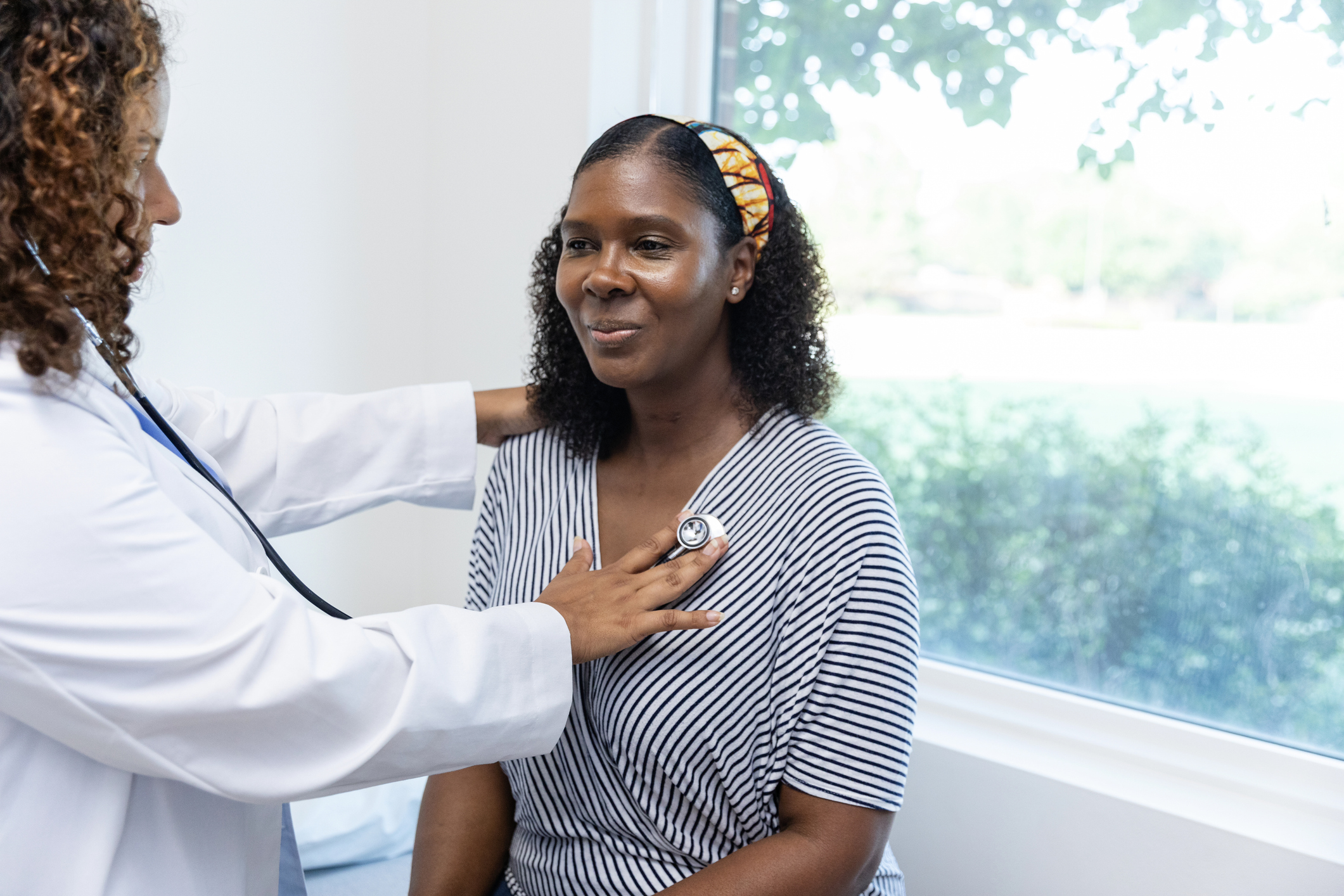
February is American Heart Month, and when it comes to heart disease, Black people, especially women, are severely impacted in the United States. There are a few reasons, such as a lack of education, limited access to equitable care, lifestyle choices, failing systems, and more.
TikTok star, entrepreneur, mother, and grandmother Shanta Quilette D Carter-Williams, PhD, MBA, who holds a PhD in public health, understands, from her own health crises, how care can slip through the cracks. Carter-Williams survived a series of health-related catastrophes that started in 2012, when she was in her early to mid-30s. The cardiologist diagnosed her with exercise-induced arrhythmia and told her to monitor her symptoms when she exercised, but her symptoms didn’t subside. Women don’t display what people have come to think of as typical signs of a heart attack. For Carter-Wiliams, that meant she was having a heart attack for two weeks.
“During that time, I was going back and forth to my doctor. I was going back and forth to the emergency room. They’re doing EKGs, they’re basically saying nothing is wrong other than lifestyle issues,” Carter-Williams told EBONY. “I needed to lose weight. I worked for the IRS, I was stressed, and I needed to drink water, all these things, which I tried to remedy, but the symptoms didn’t go away.”
In the following months and years, Carter-Williams had a mini stroke, and then about eight months later, a heart attack, and then nine months after that, a stroke, and then more weight gain that led to her developing diabetes, and eventually, she learned about her genetic heart condition after more testing. “It was due to my weight, stress and genetics. So, it wasn’t until 2019, after not even 24 hours after I was released from my cardiologist, that I had to go back,” she said.
What followed was that Carter-Williams medically retired from work and began to focus on making lifestyle changes and taking necessary medication that helped her regain control of her life. She also learned more about her family history and discovered relatives who had heart conditions, such as the one she inherited from her father, but were either reluctant to discuss or about relatives who had passed away.
It was a process, and Carter-Williams speaking up for herself is how she finally got answers. “It’s really important that we stay aware of our bodies. We have to advocate for ourselves, said Carter-Williams. “Our health is so important, especially as Black women. In this world of hustle culture, we do the most to be seen, and nobody talks about what’s happening in the background.”
Dr. Lindsey Beauboeuf, a board-certified family medicine doctor and the owner and medical director of Mozaïk Lifestyle Medicine, identifies how Black people can have better access. Making healthy diet and lifestyle choices is commonly prescribed in preventive care. However, when it comes to Black people, it’s much more layered. According to Dr. Beauboeuf, disenfranchised populations, and caregivers too, have a lot to learn about how closing healthcare gaps requires historical context and education.
“Heart disease shows up in the Black community not only sooner, but has a more devastating impact on us, and that’s staggering. Seventy-five percent of Black individuals get diagnosed with hypertension before the age of 55. Sixty percent of women aged 20 and over have some form of cardiovascular disease,” she told EBONY. “There was a study from Tulane where when they leveled the playing field for lifestyle changes, obesity, cholesterol, diet, and exercise, the gap between Black people and white people didn’t change. So, imagine you’re doing the same things as your white counterparts, but your risk is still too high. So, they went back and adjusted for socioeconomic factors, and that’s the smoking gun. Basically, we are seeing what I would call a result of the environment.”
Systemically, the only thing we can control is who we vote for. As a collective, we should elect officials who are invested in equitable healthcare. Given the current political climate, that may unfortunately be a long way off. In our personal lives, some of our stress may be hard to mitigate, for example, work woes like being stressed out or underpaid. However, we can steer our health in a better direction by not smoking, getting sufficient sleep, exercising, even if it’s something as simple as parking the car farther away to get some steps in, eating a balanced diet, and finding a trusted doctor who is equipped to have the necessary conversations with us about our risk, and the appropriate measures we can take. It’s also important that we advocate for ourselves, once again, especially if we don’t feel like our medical professionals are listening.
“Society teaches us that we need to be quiet or we’re going to be the angry Black woman. I would rather you be the angry black woman and alive than the docile Black woman and dead,” Dr. Beauboeuf said. “So, when you go to the hospital, and you say that you feel what you feel, and after you’ve waited all this time, and the doctor comes in and says maybe it’s anxiety. Maybe you have acid reflux, you’ve got to speak up and ask for an EKG because you deserve it.”