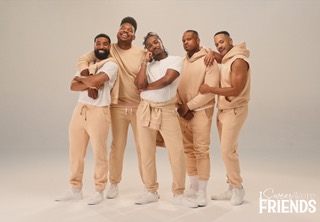
As an ode to some of our favorite TV classics like Girlfriends, Charmed, Succession, and Noah’s Arc, actor-comedian Dewayne Perkins is splitting his talents between the front and behind the camera with the release of “skitcom” series I Swear We’re Friends. Starring alongside actors Cameron J. Ross, Devere Rogers, Brian Jordan Jr., and Philemon Chambers, the series takes viewers on a journey into how Black queer friendships among men are navigated in a way that’s relatable yet witty, hitting all the right notes. I Swear We’re Friends offers a modern display of Black gay friendship, something that viewers haven’t seen since Darryl Stephenson’s show Noah’s Arc premiered in 2005, running for two seasons on the Logo network. Perkin’s appeared to pay direct homage to the show’s strides and early impact on gay friendship representation with a guest appearance of Stephenson on episode one of I Swear We’re Friends.
Although Perkin’s show is the new kid on the block, it’s already side stepping barriers by showcasing the cast outside of usual typecast roles Black gay men are routinely limited to: a best friend, cousin, or uncle.
Between his love for TV and a desire to provide more Black queer representation to the entertainment industry, Perkins’ vision ultimately came to life in a way that lets nostalgia lead. “I felt like this time was the right time to do it, mainly because I had the time, I had the resources, and I also really wanted to make a Halloween-themed episode. So I was like, ‘This got to come out in October,’ because I feel like that was a big part that I loved in TV was that with sitcoms, because of the time period that it was on, you were able to have the holidays with your favorite character. So I wanted to have that nostalgic feel, and so I felt like I had a tight window to turn it around, but it turned out really well, and I’m happy that I made that choice,” Perkins explained in an exclusive interview with EBONY.
Initially, the series was slated to have 15 episodes, but due to financial restraints it was condensed into six. Perkins allowed his passion to make him flexible enough to pivot by making the series shorter in length and watch time, as it was self-funded from former projects he’s worked on including The Blackening, Brooklyn Nine-Nine, Saved by the Bell (reboot), and The Upshaws to name a few. In doing so, this allowed him to truly hone his creative energy and foster a new level of self-confidence that wasn’t reliant on the praise of others, but rather from his own self-validation.
“I’m very grateful to be a part of the Hollywood entertainment business, but it was nice to create art that wasn’t attached to business, and it was just kind of a passion project, something that I could do from just pure inspiration. And I was very curious to explore what my work looks like without the confines of hierarchy or having to please someone who’s paying for it. So just being able to exist as the main curator of what it is was something that I just have not been able to experience at this point of my career.”
Beyond the comedic elements of the show, the episodes also touch on harder-hitting topics such as Black masculinity, the woes of modern-day dating, and navigating conflict in friendship. For example, in episode five the character Zeke (played by Brian Jordan Jr.) shares a scene with friends in the series where he addresses how masculinity shows up for him as it relates to his sexuality and his personal expression with the expectations and stereotypes projected by others. Being friends with each of the actors starring in the series personally, this allowed Perkins to creatively map how he wanted each of them to show up and tap into firsthand experiences or parts of them they may not show often. If given the opportunity, Perkins would’ve dove deeper into each respective character’s arcs and stories, but this is still be a possibility for the future.
To bring his character Billy to life, Perkins leaned on his personal experiences as a Black queer child and focused that energy to help provide elements to the character that wouldn’t have otherwise been seen. “I describe Billy as the version of my inner child that had the least amount of barriers, where I imagine ‘like ‘okay I am who I am because of the experience that I’ve had’ but what if I didn’t have those? What if I was able to exist in a lighter space and so I allowed myself to transform me through that lens and that was the first time I feel like I’ve been able to play a character in that way that I do feel is a bit more like light, airy, a little unstable at times, but like a fun way,” Perkins explained. “There were so many different versions of blackness and queerness that it allowed me to create Billy with a nuance that often I feel like I have less capability to do if I’m in a setting where I feel like I have to represent blackness or coordinates in a certain way because there aren’t that many versions of it.”
In bringing these unique experiences to screen, Perkins has been able to prove that the Black queer experience is not only worth showcasing, but how universal and true to life their experiences truly are to other people. The best part about it is that he was able to work alongside friends who’ve garnered their own careers and believed in his vision enough to walk alongside him in creating a special project for audiences to enjoy. The hope for future seasons is to make a more extensive series that continues amplifying these gravitating stories and experiences while securing funding and more support from fans.
“I think that there is a lane where this could be transformed into a linear television show for a streamer or a cable network. There’s a road where we just get more financing to make more on YouTube. I just think my goal is to be able to make more in whatever capacity that is, while retaining as much creative control as possible,”
To watch, I Swear We’re Friends you can visit the link here to enjoy via YouTube.