The year 1993 was, in every sense, unforgettable. It was the year Mighty Morphin Power Rangers debuted and Beanie Babies sparked a nationwide craze; the year of the World Trade Center bombing and the 51-day standoff in Waco, Texas. Intel launched the Pentium chip, changing personal tech forever, while Whitney Houston’s “I Will Always Love You” ruled the charts.
Amid all of this, in Hampton, Virginia, a real-life moment shifted for one all-American in the making. At seventeen, Allen Iverson, was arrested following a brawl at a local bowling alley. He was charged under a rarely used Jim Crow-era statute called “maiming by mob.” Ironically, this law was originally intended to prosecute group violence, specifically lynching mobs. Iverson served four months before being granted clemency. His conviction was later overturned, and his record cleared.
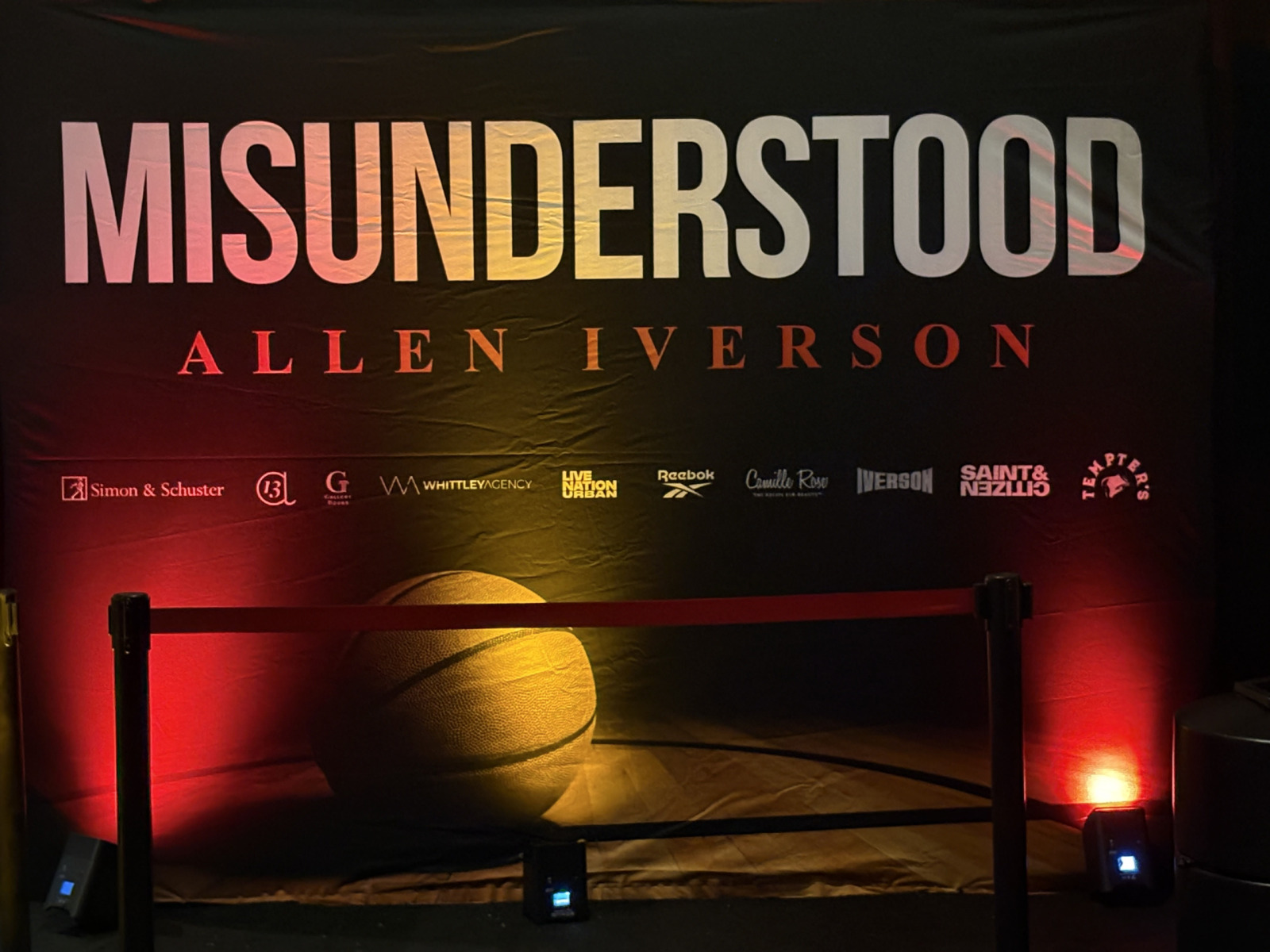
So, when Iverson’s memoir Misunderstood hit shelves—already a New York Times bestseller—you knew it would be a must-read. When EBONY was invited to his book-tour stop in Atlanta, you knew the NBA star known as “The Answer” wasn’t going to hold anything back.
At the Buckhead Theatre, Iverson sat down with T.I. on a night that appeared to double as the relaunch of ExpediTIously, T.I.’s podcast with Iverson as his first guest.
As one might imagine with T.I. at the helm, the two had the rapport where the questions were raw but gentle enough to let Iverson tell his story with humor and sincerity. “I’ve made mistakes, but I want people to learn from me,” Iverson told the crowd. “I work like you. I bleed just like you. I was a bad motherf*****, but I’m just like you.”
He talked about growing up poor, coming into millions overnight, and trying to bring his family and crew out of poverty with him. He challenged the crowd: “What would you do at twenty-one if someone handed you that kind of money?”
He reflected on his time after the bowling-alley incident, playing at Georgetown, and in the NBA where on several occasions he was subject of much consternation. “They tried to crucify me for that,” he said, recalling the backlash over his braids, tattoos and streetwear. Reflecting on the NBA’s early-2000s dress code, “The only time I thought you were supposed to wear a suit was for church and funerals,” he added with a grin. “Then I learned sometimes you gotta wear one to court.”
T.I. semi-joked that the league should reimburse him for all the fines he paid for breaking dress-code rules. Iverson humbly said he saw it as “paying it forward” for the current generation. Today’s players are now encouraged and are celebrated for expressing their individuality through fashion and hair, the same traits that once made him a target.
When Iverson entered the league, it was impossible not to notice him. Listed at six feet even and often labeled undersized for an NBA guard, he played with the heart of a heavyweight. He was named Rookie of the Year in 1997, NBA MVP in 2001 and was voted to be in 11 All-Star Games. Achievements that underscored how unstoppable that heart could be.
Before the event, I read — or rather, listened to — the audiobook version of Misunderstood. But I wasn’t a passive listener. I paid attention. I took notes. I thought about questions for a potential interview. But here’s the kicker. If I’m honest, and I think I should be… I’m still not entirely sure why Iverson felt the need to write this book.
I’m not saying it’s not a good read. As T.I. told the audience at the closing of the interview, “Don’t just go buy the book, make sure you read it too!”
What I am suggesting is that a tell-all-memoir goes against seemed to go against the very fabric of who Iverson always seemed to be.
His story, though compelling, isn’t entirely unique. We’ve heard it before: a gifted athlete from humble beginnings, recruited out of poverty, skyrocketing to fame, only to face the pitfalls of loyalty, money, and public scrutiny.
From afar, during his career Iverson carried this quiet confident, “hate me or love me, I’m gonna do me” energy. He never over-explained himself at press conference, even when sports journalists seemed more interested in his personal life than his game.
What makes Iverson singular isn’t the storyline. It’s the sincerity. He’s loved because he lived with his whole heart. Because he refused to dilute who he was to make others comfortable.
That’s why fans still showed up this night wearing vintage Sixers jerseys and his signature Rebook shoe. Some fans lingered outside the Buckhead Theatre after the show, hoping to catch a glimpse of him — I was one of them. While others tried to slip past security, swapping VIP passes to get close to their hero. Proof that the Iverson aura still pulls like the gravity, like the moon drawing the tide.
Through Misunderstood, we get a glimpse into Iverson’s world, but for me the real takeaway might be that he’s still an enigma, and maybe that’s how it should be.
And for all the questions about practice for “The Answer” perhaps the quiet revelation is that Iverson never owed us one. His life was never about solving a question. It was about surviving it. And maybe, after all these years, that’s the story he wanted always wanted to tell.