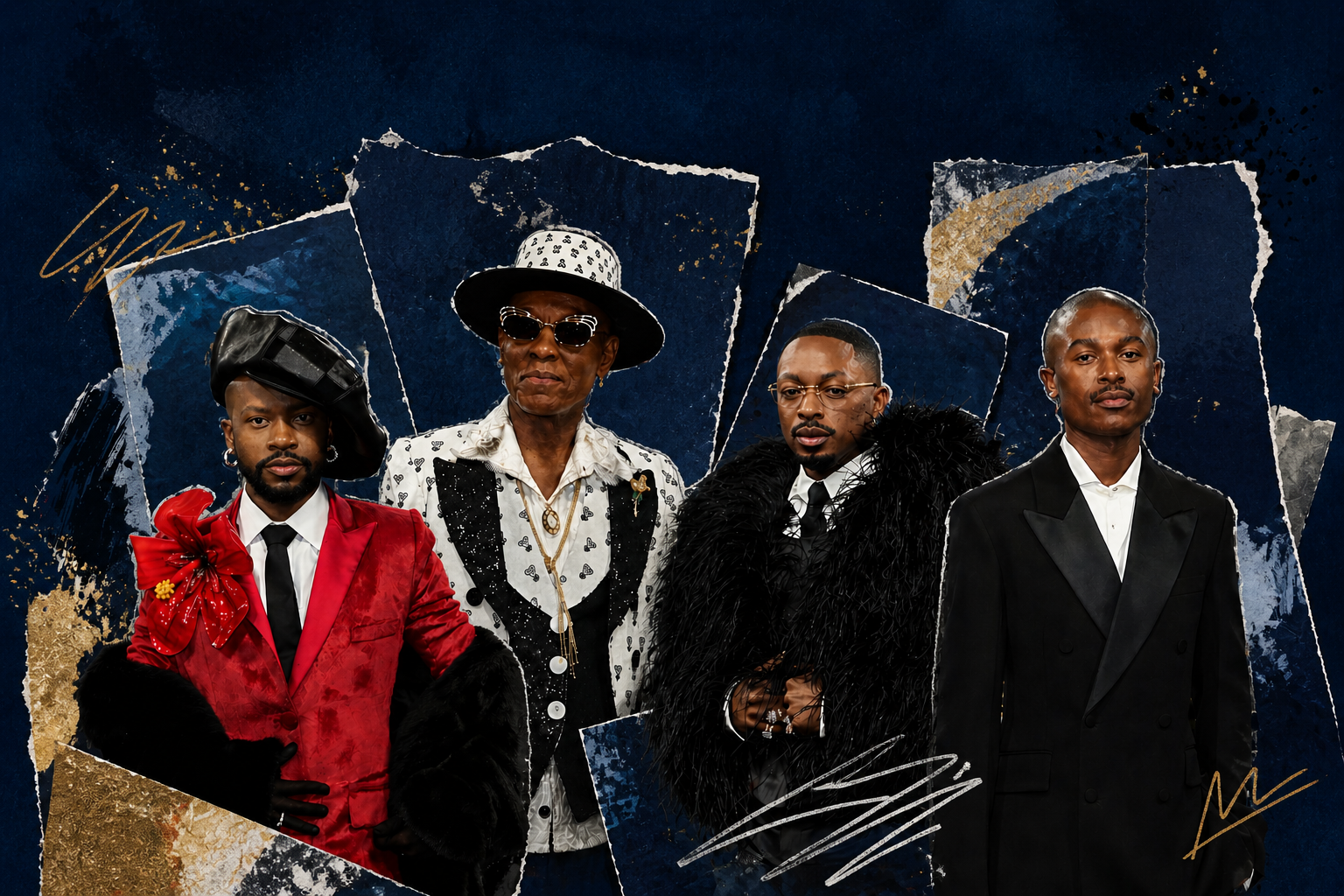
Every few years, the fashion industry circles back to the same question: is fashion art? Within Black design, that question feels late. Black designers have long operated as fine artists, whether institutions chose to recognize it or not. What the 2026 Costume Institute exhibition, Costume Art, and its accompanying Met Gala ultimately reveal is not a new idea, but a delayed acknowledgment.
Following last year’s Superfine: Tailoring Black Style exhibition, which placed Black designers in direct conversation with Black visual art, this moment sharpens the focus rather than introducing anything new. Designers like Ferragamo’s Maximilian Davis, shown alongside artist Julian Isaac, reinforce what has always been true: Black fashion exists as an evolving body of fine art. In that sense, the Met Gala reads less like a defining stage and more like an institution catching up to a language Black designers have already been speaking.
That language was established decades ago. Designers like Patrick Kelly, Stephen Burrows, and Dapper Dan approached the body as both canvas and site, using garments to shape form and tell stories. Their work moved beyond adornment into something more intentional, where clothing carried narrative weight. That sensibility continues through designers like Thebe Magugu, Priya Ahluwalia, Rushemy Botter, and Christopher John Rogers, whose work resists trend in favor of structure, history, and storytelling.
Across the spectrum, that approach shows up in distinct ways. Virgil Abloh’s Off-White, now under Ibrahim Kamara, positioned fashion in direct dialogue with contemporary art through collaboration. Kenneth Ize’s handwoven aso oke operates as a living archive, while Telfar Clemens reframes fashion as both performance and access. Martine Rose continues to document underground culture through subversive design, and Who Decides War approaches garments with an architectural sensibility, building pieces that feel constructed rather than simply styled.
Long before these conversations became industry talking points, Willi Smith was already working within this framework. In the 1980s, he fused art and fashion through performance-based runway shows and an artist T-shirt program that featured collaborators like Keith Haring. That model, bringing artists into fashion spaces, would later be adopted by houses like Louis Vuitton under Marc Jacobs and Dior Homme under Kim Jones, yet Smith’s role in shaping that blueprint remains under-recognized.
That lineage carries forward through Kerby Jean-Raymond, whose work with Pyer Moss treated fashion as sculpture, storytelling, and cultural preservation. His collaborations with artists like Derrick Adams, Jamilla Okubo, and Mickalene Thomas embedded the visual language of Black contemporary art directly into his collections. His Fall 2021 haute couture presentation blurred the line between runway and exhibition, underscoring how fluid that boundary has always been, even if recognition has not kept pace.
Beyond collaboration, some designers operate as curators, using fashion to build cultural ecosystems. Through Hood By Air, Shayne Oliver constructed a space where performance, club culture, and queer aesthetics converged. Grace Wales Bonner has advanced fashion’s place within fine art discourse through collaborations with Lubaina Himid, Kerry James Marshall and Theaster Gates, as well as her distinction as the first fashion designer invited to curate Museum of Modern Art’s Artist’s Choice series in 2023. Similarly, Duro Olowu’s Seeing Chicago exhibition at the Museum of Contemporary Art Chicago placed his garments alongside works by Simone Leigh and Amy Sherald, reinforcing the permeability between fashion and fine art.
Then there is LaQuan Smith, whose work returns the focus to the body itself, aligning closely with the 2026 Costume Art exhibition’s emphasis. His designs, precise, sensual and form-fitting, treat the body as both medium and muse. Seen on Beyoncé Knowles-Carter, Ciara, Teyana Taylor and Rihanna, his work shapes the body rather than simply dressing it, reading as a form of living sculpture.
Taken together, these designers reinforce a truth that predates any museum exhibition or red carpet theme. Black fashion has long existed as fine art, with its own language, references, and systems of meaning. The institutions are not defining that reality. They are finally beginning to recognize it.