Teyana Taylor took the stage at the Golden Globes to accept the Best Supporting Actress award for her standout performance in One Battle After Another and made a bold statement: “To my brown sisters and little brown girls watching tonight, our softness is not a liability; our voices matter and our dreams deserve space,” she declared.
It’s in stark contrast to a meme circulating on social media last week: Michael B. Jordan, holding a tight smile at the Critics’ Choice Movie Awards, watching Timothée Chalamet bound the stage to accept the Best Actor award for Marty Supreme. It happened again at the Golden Globes, with Wagner Moura receiving the award for his role in The Secret Agent.
While we don’t fault anyone getting their flowers, we can’t help thinking about that old adage: we’ve got to be “twice as good for half as much.” In Jordan’s case, who literally played two roles in the movie and had to experience these losses back to back, this never felt more in play.
The adage seems to extend to director Ryan Coogler’s vampire epic: full of racial subtext, self-determination, resistance and Black joy. Yes, it scored a Golden Globe win for Cinematic and Box Office Achievement. But let’s be real: for many, from TikTok and X to elsewhere, the win felt too much like a “here, n—-, damn” award: Translated? “Take this and be happy we acknowledged the film at all, even though we didn’t give it its full just due.”
Here are the facts: Sinners accomplished far more than an achievement in boffo ticket receipts. It impacted millions of fans who picked up on its examination of the importance of community and ancestral knowledge, and its stance against colonialism and white Christianity. Spike Lee considers it “a landmark in Black cinema.” With Oscar nominations set for announcement next week, the near snubbing of Sinners at recent award shows raises questions about the types of films that get attention and accolades from Hollywood.
Which brings us back to One Battle After Another. Written and directed by Paul Thomas Anderson and adapted from the 1990 Thomas Pynchon novel Vineland, Anderson is easily considered a critics’ darling on the strength of films like There Will Be Blood and Phantom Thread. He hasn’t stepped into mainstream moviegoing territory this boldly since the start of his career. (See Boogie Nights and Magnolia from the ’90s).
Taylor, who is only in the film for 19 minutes, kills every scene she’s in as Perfidia Beverly Hills—a member of a revolutionary outfit called French 75 and the girlfriend of Pat Calhoun (Leonardo DiCaprio). Corrupt military officer and white supremacist Col. Lockjaw (Sean Penn) relentlessly pursues the group while developing a kinky attraction to Perfidia. Karate instructor Sergio St. Carlos (Benicio del Toro) protects a community of undocumented immigrants throughout the movie, an on-the-nose subplot for the 2020s.
While One Battle After Another keeps racking up nominations and wins in critical circles, Black pundits online have been calling BS since its release. Among other criticisms, Perfidia’s interior motivations are never explored. She essentially serves as a Jezebel, a hypersexualized trophy between two competitive white men, one of whom is a racist. Consider too that Halle Berry, the only Black woman ever awarded Best Actress at the Oscars, won for playing the lover of a white racist in Monster’s Ball. It questions where potential Oscar attention will be rewarding a movie that turns a Black woman into a white man’s play object, once again.
A quick glance at some Threads posts proves the point. “White folk cannot write about Black ‘revolutionary’ characters” (@sapphriaem); “a film about white supremacy, critically outshining Sinners to any degree, is a product itself of white supremacy” (@myaharielwrites); “non-Black directors treat Blackness as a race and not a culture and that’s where they get it wrong” (@ariekiki). Remember the old viral phenom about the dress we all debated was either black and blue, or white and gold? Critical reaction to One Battle After Another, how we see the film, seems to depend heavily on whether you’re Black or white.
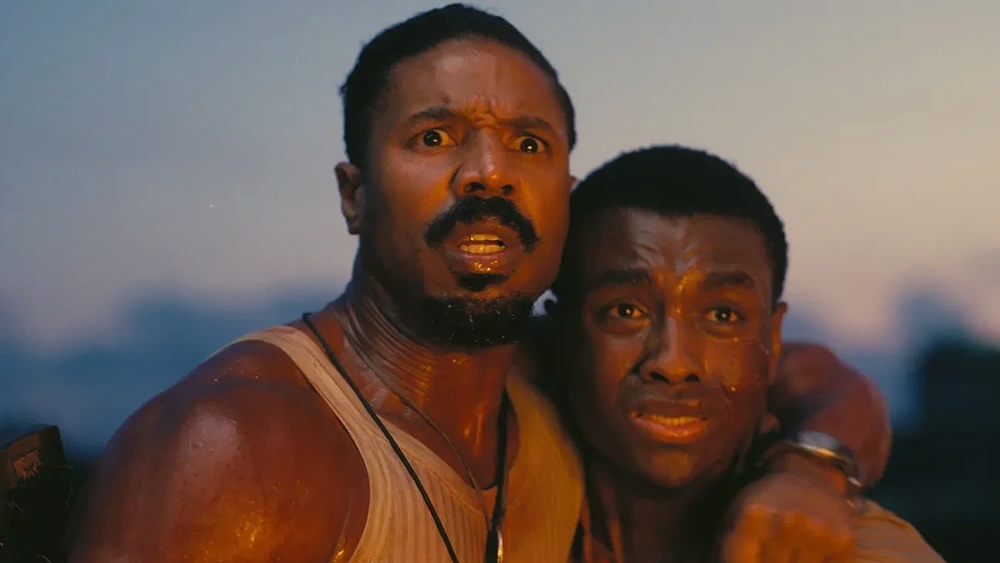
The same could be said of Sinners. Many melanated fans of the film paid to see Sinners in theaters more than once, praising Coogler’s standout juke joint dance sequence that spans generations, as well as electrifying performances by stars Wunmi Mosaku, Delroy Lindo, Omar Benson Miller and Michael B. Jordan, playing against himself as twins Smoke and Stack in the Jim Crow South of Mississippi.
From the offensive microaggressions from Variety about Sinners’ first weekend box office “fail,” to which Ben Still wrote on X, “In what universe does a $60 million dollar opening for an original studio movie warrant this headline?” to borderline disregard from the likes of the Golden Globes shows the cultural schism at work where movie accolades are concerned. Simply put, the nuances of intergenerational trauma, cultural preservation and assimilation in Sinners arguably seemed more obvious to its Black audiences than those who decide film accolades.
Will the Oscars reward Coogler and company in this Academy Award season? Maybe we don’t even need the affirmation of awards that never fully assess our cultural landscape or our achievements in good faith. (There’s a thought.)
Tinseltown’s uneven critical treatment for films of color doesn’t bode well of Sinners, but fingers crossed.