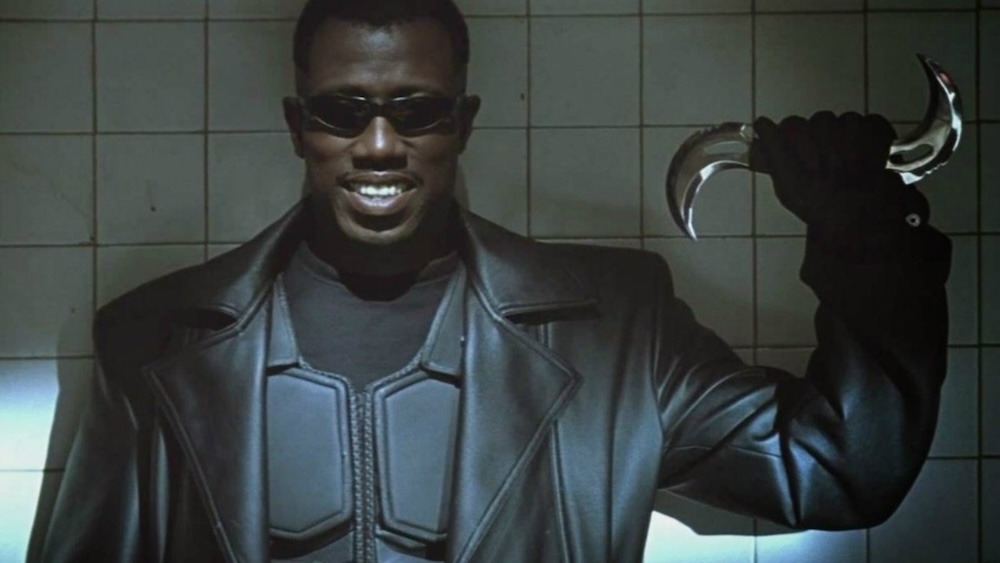
Disney and Marvel just announced new details for the upcoming Avengers Doomsday, revealed the new cast for the rebooted X-Men franchise, and are basking in the juggernaut success of Spider-Man: Brand New Day. But one character has been running through my mind through it all. Its reboot is one of many canceled MCU projects with Black leads that have sparked significant public uproar. Yet today, August 21 — two years out from its 30th anniversary — Blade is the foundational Marvel movie that helped create the movie universe I’ve known to love.
The 1998 superhero movie, starring Wesley Snipes in the titular role, showed movie watchers their first taste of the human-vampire hybrid that’s been killing any and every bloodthirsty vampire since his comic book debut in 1973. Rewatching superhero flicks in preparation for Doomsday, I hadn’t realized how much I loved this movie. It set the tone for Marvel with its gritty, groundbreaking approach and influenced how the cinematic universe portrays heroes and dark storytelling.
Now, has Marvel evolved to tell better stories, with stronger emotional throughlines, and developed superheroes into multi-layered characters beyond this movie? Absolutely! Does Blade need all of that to wow me? Not really.
Despite some dated CGI and effects that reveal the movie’s age, it still holds up in ways that don’t detract from its tone or story. The main way you see how this movie still holds strong 28 years later is in the opening sequence.
Let me paint you a picture:
After showing Blade’s birth, which came as his mother was bitten by the main antagonist of the film, Deacon Frost, they immediately take us to one of Frost’s nightclubs. The most stereotypical yet stylized late-90s, early-2000s nightclub scene ensues. Complete with blood sprinklers, a thumping club banger, makeout sessions, and vampire goons galore, this felt like a thing that would only make sense in this movie, either here or if the juke joint massacre in Sinners was in a European dance club.
Then the whole room goes quiet as the frightened vampires yell, “It’s Blade, it’s the Daywalker,” and you lock in for one of the coolest action sequences in a comic book flick. Snipes hasn’t uttered a word yet, but has shotgunned, sliced and diced these vampires in the most gruesome way you could as a hero. I think this speaks to how much coolness the actor brings to the character, and how it serves as the blueprint for where Marvel goes next in film.
After the brutal nightclub fight, Blade escapes just before police swarm the scene. The body of Quinn, Frost’s second-in-command vampire, is brought to the hospital, where hematologist Dr. Karen Johnson is examining him. Quinn suddenly reanimates and bites her; Blade arrives while tracking Quinn and pulls the doc out of the attack. He brings Karen to Whistler, Blade’s mentor and weapons maker. Her infection, along with her medical expertise, makes her an integral part of the rest of the movie.
Watching through all the action sequences, dramatic twists and plot points that are expounded upon in the two Blade sequels, I couldn’t help but react with pure glee and anticipation, and that joy just comes from Blade’s first film and how it establishes so many staples for future Marvel movies — through post-credits scenes that connect to other movies, gigantic action set pieces and stylized story beats that only the Marvel universe can carry.
I was super excited about the 2019 announcement of a new Blade film, fully part of the MCU, with Mahershala Ali taking on the mantle. Coming right after Black Panther, it felt like the homecoming of one of Marvel’s pioneering superheroes in live action, reminding audiences who truly helped start the Marvel movie machine.
Then the anticipation lingered, and lingered, and continued to linger until it was dropped from Marvel’s release schedule in 2024. The sidelining of Black characters like Teyonah Parris’ Photon, Dominique Thorne’s Ironheart, and Yahya Abdul-Mateen II’s Wonder Man highlights the ongoing need for more Black representation in Marvel’s cinematic universe, making the call for diverse heroes like Blade even more urgent and personal for fans like me.
Even with these feelings, as I watched Snipes’s portrayal of the character hack and slash through waves of vampire enemies, I’m reminded that the original is something that we can always hold onto … whether protected by the light of day, or the Blade.
Watch Blade on Prime Video.