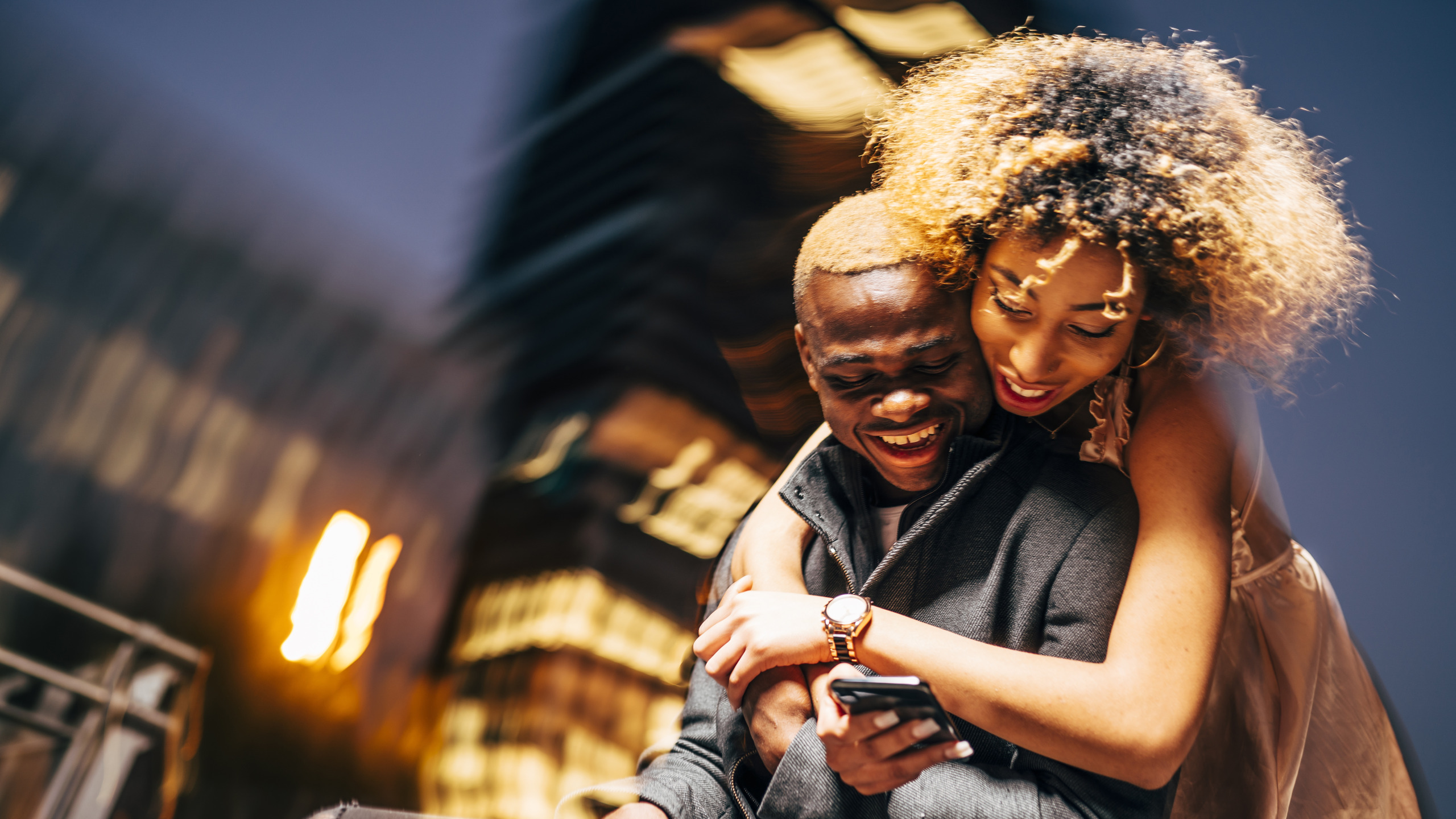
Over the last few years, there has been a salient uptick in Black people posting their significant others on social media. However, it’s not in the manner that one would think. Instead of transparent images and visuals, many have opted to conceal their partners’ identities with the contemporary magic of AI technology or to remove them altogether from their social media presence.
While it does feel a bit cheeky and odd, this phenomenon has taken off with little to no signs of slowing down. With love still being very much in the air and social media being, arguably, the most viable platform to show said love to the world, the concept of the “phantom post” can feel like a blatant paradox.
To be clear, the term “phantom post” refers to someone removing or editing their partner out of photos during the relationship or after a breakup. With greater opportunity for visibility and optics than ever before, one would imagine that posting a significant other would be a piece of cake. Is it the idea of losing your partner to the low-key converter, or is marriage a necessary prerequisite before posting your partner online? Let’s make it make sense
There are several rationales for why one might resort to the phantom post. The pressures of social media regarding relationships and the subsequent break-ups have devolved into de facto public performances that can, at times, feel like a losing game. ”Social media turns private loss into public consumption,” said Jennifer Ochiagha, LMHC, Therapist and Founder of Mind Matter Mantra LLC. “Instead of grieving quietly, people now grieve under surveillance through likes, views, unfollows, DMs, and assumptions. That can make people feel rushed to clean up their social media before they’ve even navigated their own emotions.”
When trying to understand this, it’s worth considering how attachment styles might play a role in this trend. If someone has a “secure” style, they may be inclined to post about their significant other with no hesitation. This evolution has yet to be defined, for better or worse, but they’ve definitely shifted the optics of relationships and, more specifically, the expectation of what might be considered “appropriate visibility” in the modern era.
When it comes to the psychology of it, the idea of the phantom post straddles the fence between power, shame and protection. “Seeing reminders, especially ones that others can comment on, like, or ask about, can keep the nervous system activated,” Ochiagha said. “Removing photos can temporarily reduce rumination, embarrassment, grief, or the pressure to perform being ‘okay.”
For some, it’s also about protecting dignity. As well as not wanting the relationship to be dissected, speculated on, or misunderstood by an audience that doesn’t have context. There can also be a grief component. Sometimes people erase their content because looking at it hurts too much, not because the relationship didn’t matter.”
There’s an innate sense of power that comes from being able to post your partner online. “In close-knit communities like the Black community, where visibility, respectability, and narrative control often carries extra weight, digital erasure can feel heavier,” Ochiagha said. “For the person doing the erasing, it may be about self-preservation. For the person being erased, it can feel like social death, not just relational loss especially if community overlap exists. Digital choices don’t exist in a vacuum. They land within cultural contexts that already carry pressure around strength, silence, and image.”
In the grand scheme of things, this discourse begs several questions: Is erasing an act of healing and self-protection or is it just a matter of mere avoidance? In the case of distancing from a former partner in general, does erasure bring peace or prolonged grief? What does it mean to pretend someone never existed and is this a healthy form of coping? These are all newfound thoughts that one must consider.
According to Ochiagha, digital erasure can be driven in two different ways. “Digitally erasing a former partner is about self-protection and boundaries when the person feels calmer after removing content, Ochiagha said. “It helps them stop checking, ruminating, or emotionally spiraling. They can still reflect on the relationship internally. Or there’s acceptance, even if sadness remains.”
On the other hand, there can be another less healthy reason behind erasure that manifests as well from time to time, depending on the person. “Digitally erasing a former partner becomes about avoidance when the erasure is impulsive or fueled by anger or shame,” Ochiagha said. “It’s followed by suppression (“I’m fine, it never mattered”). There’s a rigidness and a lack of tolerance for reminders of that relationship. Or if grief resurfaces later as anxiety, bitterness, or emotional numbing.”
We’ve become more comfortable erasing than being honest because deletion offers control without accountability. In a digital world where perception feels like currency, it’s easier to vanish a moment than to stand in it and admit we’ve evolved, misspoke, or simply changed. But growth has always been public — even when it’s messy. What we delete isn’t always harmful; sometimes it’s evidence of becoming.
Letting posts live as artifacts of who we once were would mean treating the internet less like a highlight reel and more like an archive. It would require us to see our timelines as timelines — records of thought, experimentation, vulnerability, and contradiction. In doing so, we might finally make room for a more honest digital culture — one that allows people to grow without pretending they were never human to begin with.