
These brand origin stories share a similar truth: when needs translate shared cultural codes into products—a scalp oil, a basket, a sauce, a hair trimmer—those objects become wearable declarations. Walmart knows this firsthand and it’s why they’re proud partners with Black founders and designer for the brands Alodia, Capital City Products, The Cut Buddy and Temi Coker Home Collection. These individual companies products don’t just meet needs; they signal belonging. Black consumers reward this with reciprocity, supporting businesses that see them and invest in them, thereby turning purchases into acts of cultural affirmation.
Alodia
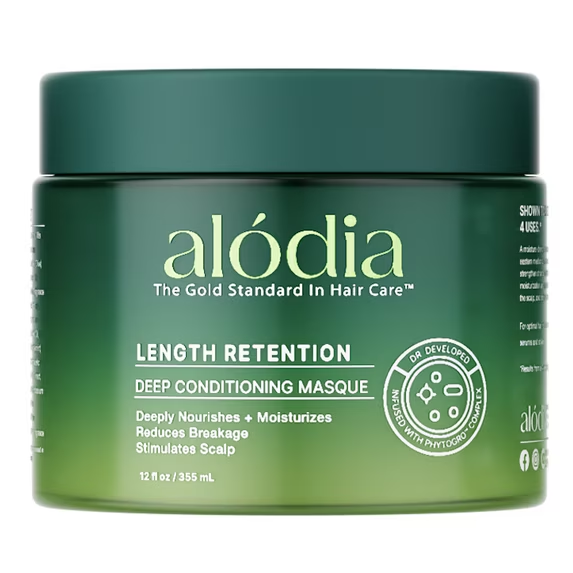
Dr. Isfahan Chambers-Harris didn’t set out to start a beauty brand. She was busy earning a PhD at Vanderbilt School of Medicine when she had an aha moment. While researching sarcoidosis, a debilitating autoimmune disease that disproportionately affects Black women, she wondered whether something familiar to her was the issue. What if the haircare products Black women use weren’t just a cosmetic choice, but an underlying cause?
She saw herself in her patients: same demographics; same history with hair care products. The scalp damage she’d known from chemical relaxer was personal, but the question of a solution now felt bigger. She looked for answers in science. As a biomedical scientist and trichologist, she understood what was happening under the surface in a way most beauty founders don’t. She decided she would create products rooted in research and shaped by her own lived experience. In 2017, she launched Alodia Hair Care with her husband Dr. Rashad Dupree Harris, MD, creating plant-based organic formulations that took a holistic and educational approach to Black hair. Alodia has since expanded beyond shampoos and conditioners, but remains deeply aligned with its founder’s mission to “help women love on their hair through education, empowerment and evidence-based care.”
Alodia’s brand ethos is testament to why brands that prioritize emotional connections lead to relationships that go beyond transactions. This connection is highly valued by Black consumers, who seek out brands with deep cultural resonance. Long underserved by companies that did not see them as a priority demographic, Black consumers developed their own vetting strategies instead of relying on traditional advertising: Group chats, barbers, social media, aunties, and founder stories that felt real.
Capital City

A need rooted in culture also spurred Arsha Jones and her late husband, Charles, to start Capital City Mambo Sauce. After moving from the city to the suburbs, the Joneses realized they missed mambo sauce, the sweet-and-savory condiment born in Washington, D.C.’s Black community. “I would make mambo sauce in my own kitchen for my sons and one day decided that this deserved to go to market, for others outside of D.C. to experience,” Jones said. “You see, mambo sauce isn’t just a condiment; it’s a part of the cultural fabric of Washington, D.C. It’s a taste of home, a source of comfort, and a symbol of community for so many Washingtonians.”
So beloved was Capital City Mild Mambo Sauce, and later Capital City Sweet Hot Mambo Sauce, that customers began asking local supermarkets to stock it. “Our customers were tired of having to go to these very specific stores to buy this product,” Jones said. “They’d say, ‘Why aren’t you selling in Capital City? I’m tired of having to drive to Eastern Market to pick up this mambo sauce. When are you guys going to carry this product?’ ”
The Cut Buddy

Joshua Esnard, founder of The Cut Buddy, invented a grooming product to solve a problem with deep cultural resonance in the Black community. Only someone attuned to the cultural currency of looking “fresh from the barbershop” would identify that need. Esnard’s founder story is partly comical, but it offers lessons in authenticity and barrier-breaking. As a child of immigrant parents, Esnard’s father skipped the barbershop rite of passage so many Black boys enjoy, preferring to cut his son’s hair at home. By high school, with jokes about hairlines likely circulating, Esnard’s father’s buzz cuts were becoming a liability for the self-conscious teen. Desperate for a shape-up, Esnard began experimenting with pizza boxes and detergent bottles as stencils to achieve the perfect line-up.
Almost two decades after those experiments, Esnard realized he had an invention and filed a patent for The Cut Buddy in 2016. The company has since expanded into more at-home grooming products, and Esnard encourages the next generation to become inventors. “It is an honor to know that I may be an example for other young men to become inventors and entrepreneurs,” he said. “I rarely hear about inventors who are young and are minorities. The Cut Buddy was just a cardboard and plastic stencil I had sitting in my bathroom for years that I’d use regularly to give myself a fresh-looking haircut. Some kid out there may very well have the next billion-dollar idea sitting next to his or her sink.”
Temi Coker Home Collection

A similar sense of culturally-inspired intention guided Nigerian-American artist Temi Coker as he designed his exclusive 18-piece home collection. His pieces pull from the bold colors and vibrant textiles of his Nigerian childhood while nodding to his wife’s African American heritage. Braided hair patterns show up as beautifully crafted surfaces on the vases while deep, saturated hues anchor the collection of rugs and towels. Coker calls these pieces “heirlooms,” objects that celebrate the diverse culture of the diaspora and hold memory.
Said Coker, “The living room is the heart of our home, where the majority of our family memories happen, so I designed these pieces to live in that sacred space and be accessible to every family.”
Connection through the very things we touch, taste and use daily sits at the center of Walmart’s service and loyalty to their customers. By providing access and support to Black-led brands not only celebrates the continued legacy of Black excellence, it affirms Walmart’s commitment to the communities they serve.
Feel the impact for yourself and shop these inspiring Black-owned brands at walmart.com/BlackAndUnlimited.