The first thing you encounter in Paul Tazewell’s exhibit is puppets.
Handmade marionettes. Paper mâché. Wood dowels. Scraps of fabric. Objects that feel less like museum artifacts and more like pieces of a private childhood.
“I wanted visitors to engage with the work the way I engage with my work,” Tazewell told me. “Up close and personal. Seeing texture. Understanding culture. Feeling like you’re experiencing it.”
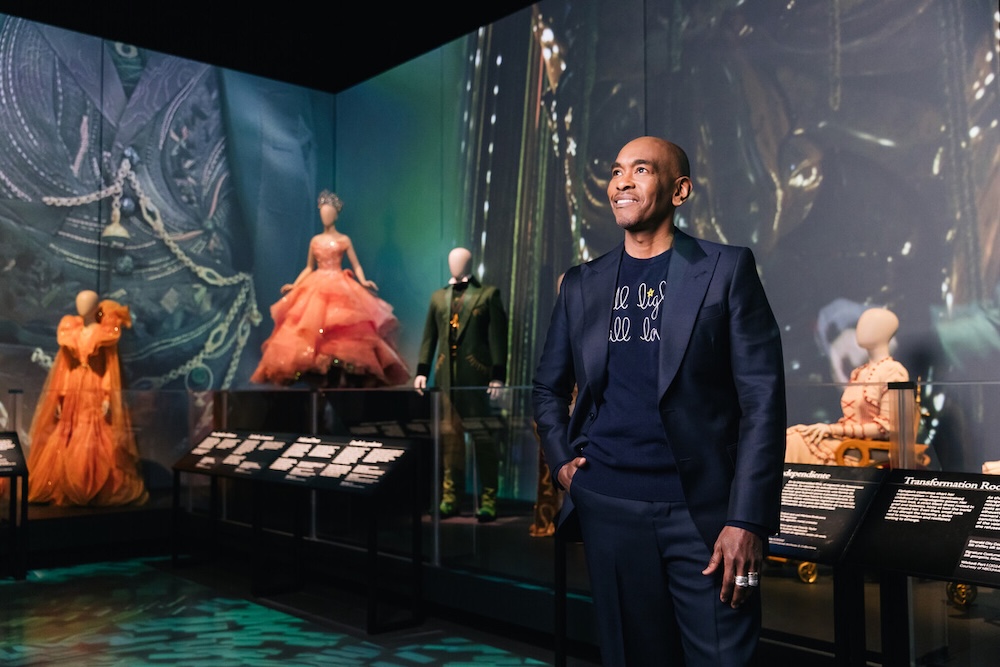
That intention shapes every room of the “Crafting Character: The Costumes of Paul Tazewell” exhibition
now on view at the Griffin Museum of Science and Industry in Chicago, which traces Tazewell’s journey from a creatively nurtured childhood to one of the most influential costume designers working across theater and film today.
Rather than opening with his biggest productions, the show begins with his origin story: a mother who sewed at the dining room table, a home where making things by hand was normal, and a young boy who learned that objects could become characters once imagination entered the equation.
“My mother taught me how to think creatively and how to problem-solve creatively,” Tazewell said. “She taught me how to tell stories.”

That early foundation carries visitors through family photographs, early sketches, and design renderings before arriving at the expansive costumes audiences now associate with stage productions like Hamilton and the film adaptation of Wicked, for which he won his first Oscar. The progression feels less like a victory lap and more like a working map showing how curiosity, training, and persistence compound over time.
Tazewell entered the professional theater world in the early 1990s after rigorous training that included opera, ballet, and classical design. Yet early on, opportunity came with limits.
“I was being pigeonholed,” he said. “I was grateful to be working, but people were seeing me in a very specific way.”
Regional theater became a crucial proving ground. There, he built relationships with directors who trusted his range and invited him back for increasingly expansive projects. Broadway proved slower to open.
“Most of the work I’ve done on Broadway centers on stories about people of color,” Tazewell shared. “That didn’t really start to open up until Hamilton.”
Even then, broader recognition took time. Nearly 25 years into his career, the industry began widely viewing him as an expansive designer rather than a niche one.
That timeline quietly challenges the narratives about creative success. Talent alone is not enough to guarantee access. But Tazewell found his way in.
Inside the exhibition, his process becomes as important as the finished garments. He describes costume design as both artistic and technical—closer to engineering than decoration.
“Every costume is custom,” he explained. “They have to move. They have to last. They have to work for dancing, quick changes, and repetition.”
Beyond function, each garment carries meaning. Color, texture, silhouette, lining, and construction all communicate information about a character’s psychology and journey.
“What’s the lining underneath the top color? What does that say about the character?” he stated. “How does it move through space?”
Placing the exhibition inside a science museum underscores that point. Visitors are encouraged to think about the mechanics behind clothing—not just how it looks, but how it’s built, tested, and refined.
Tazewell is candid about the advocacy required to protect his vision. Producers, he theorized, often understand the value of scenery and lighting more readily than costumes, which can make budget conversations and creative negotiations ongoing.
While working on Wicked, a turning point came when studio executives visited a massive workshop filled with samples, sketches, and works-in-progress created by nearly 70 artisans.
“I don’t think they understood what we were doing until they walked through,” Tazewell exclaimed.
Seeing the scale, craftsmanship, and narrative detail embedded in the costumes shifted the conversation. What began as conceptual suddenly became concrete.
“That’s when they saw the significance of what we were building.”
Outside of filmmaking, Tazewell’s work is also cultural. His collaboration with Janelle Monáe and Thom Browne during the Met Gala’s Black dandyism–themed year reflected a shared interest in fashion as performance and historical dialogue.
“I was thrilled they were focusing on Black dandyism,” he stated. “Historically, designers look to the street first. That’s always been the source.”
For him, the moment represented lineage more than trend. It was an acknowledgment of Black style as the origin point.
As expansive as his résumé has become, Tazewell emphasizes that costume design remains deeply collaborative.
“I don’t sit at a sewing machine and make everything,” he said. “I start with an idea. Then collaborators manifest it. Actors embody it. That’s when it becomes alive.”

More than anything, he hopes young visitors leave the exhibition understanding that his path isn’t mythical.
“This is something you could potentially do,” he declared. “You can be creative. You can be successful. Your voice is important.”
Walking through the exhibition, what lingers isn’t just admiration for beautiful garments. It’s an understanding of how much thinking, testing, and persistence live inside each piece.
Tazewell’s work not only showcases what he has made but also how a life in creation gets built.