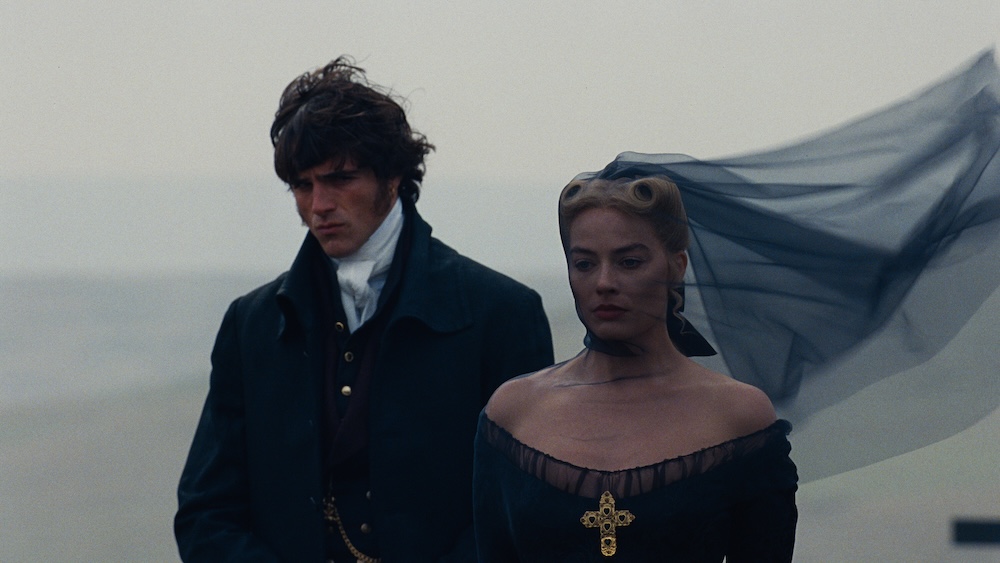
Another adaptation of Wuthering Heights has arrived…and once again, it misses the point.
Director Emerald Fennell recently explained that she isn’t making “Wuthering Heights,” quotes on her part, but rather “a version of it.” Yes, all adaptations are interpretations. But interpretation does not grant permission to erase racially coded characters.
Emily Brontë’s 1847 novel is a gothic tragedy, no matter how often Hollywood markets it as a romance. At its core, it is a story about two people who can’t be together because of the societal restraints of race, gender, and class. Through those challenges, abuse is passed down like inherited property in Victorian England. And peace is finally found when younger generations refuse to continue the cycle. Heathcliff and Catherine’s romance serves as a vehicle for exploring these restraints that keep them apart. That’s their tragedy.
Heathcliff’s racial identity in the novel is intentionally ambiguous. Described as “dark-skinned,” he is called a “gypsy,” a racialized slur historically directed at Romani people. He is referred to as a “lascar,” a term associated with Indian sailors. As a boy, Heathcliff is found without an “owner” in Liverpool, a major port city deeply entangled in the Transatlantic Slave Trade. Heathcliff may be Romani, Indian, Black, or some combination—the text leaves space. What it does not leave is whiteness.
Heathcliff’s non-white status is what drives the plot. That “othering” shapes every injustice he endures and every monstrous choice he later makes. Remove the racial tension, and the story becomes a soap opera instead of an examination of societal systems.
When Fennell said, “You can only ever kind of make the movie you sort of imagined yourself when you read it,” it revealed something larger than this adaptation. When imagination consistently defaults to whiteness, even when the text suggests otherwise, that’s cultural conditioning.
Psychologists refer to this as unconscious or implicit bias, which refers to unconscious forms of discrimination based on race, gender, sexuality, and so on, shaped by repeated exposure. In a media landscape where white characters have historically been centered as the default, readers fill in racial ambiguity with whiteness. Unconscious bias doesn’t mean someone intended harm, but it also doesn’t remove responsibility, especially when films reach global audiences.
After seeing this adaptation, however, it feels less like unconscious bias and more like deliberate reframing. In Brontë’s novel, when Heathcliff first arrives at Wuthering Heights, he speaks in “some gibberish that nobody could understand,” suggesting he speaks a different language. In the film, he is solely mute. He is no longer picked up in Liverpool; he is a local. Each racial clue is softened or erased to fit a white Heathcliff.
And we’ve seen this time and time again throughout Hollywood.
- In the 1979 movie adaption of The Warriors, the leader is part of a predominantly Black and Latino gang, yet the film centers a white lead while moving characters of color to the periphery.
- The novel Warm Bodies describes Nora as half Ethiopian, with “cream-coffee colored skin” and “frizzy curls.” In the 2013 film adaptation, she is played by a white actress.
- In the comic series Wanted, the character Fox is black; in the 2008 film adaptation, she is portrayed by Angelina Jolie.
Even true stories aren’t spared. A real black Marine, Jason Thomas, who saved lives on 9/11, and Chante Jawan Mallard, who committed the crime at the center of the film Stuck, both had their stories reshaped by white casting. The message, intentional or not, is clear:
Characters of color are less “believable” as heroes or main characters.
The new Wuthering Heights film tries to rectify this with “colorblind” casting of the side characters, Nelly and Mr. Linton. Both were white in the book, and are now Asian and Pakistani, respectively. It’s giving, “we added in people of color, are you happy now?”
Nelly, originally a dutiful servant, is now the villain and the cause of the main characters’ misery in the film. Linton is framed as undesirable and weak. The racial shift doesn’t just diversify the casting, instead, it redistributes blame away from the white main characters and onto the side characters of color.
The film is visually stunning. The performances are amazing. But aesthetics cannot compensate for thematic butchering that drives its whole premise.
And because of that, the story suffers.
Jess Dotson, a.k.a. Jess, The PrideBrarian, is an Emmy-nominated TV producer and creator of PrideBrary, a YouTube channel with supporting social media channels where she creates infotainment content exploring race, LGBTQ+ representation, and gender representation in media.