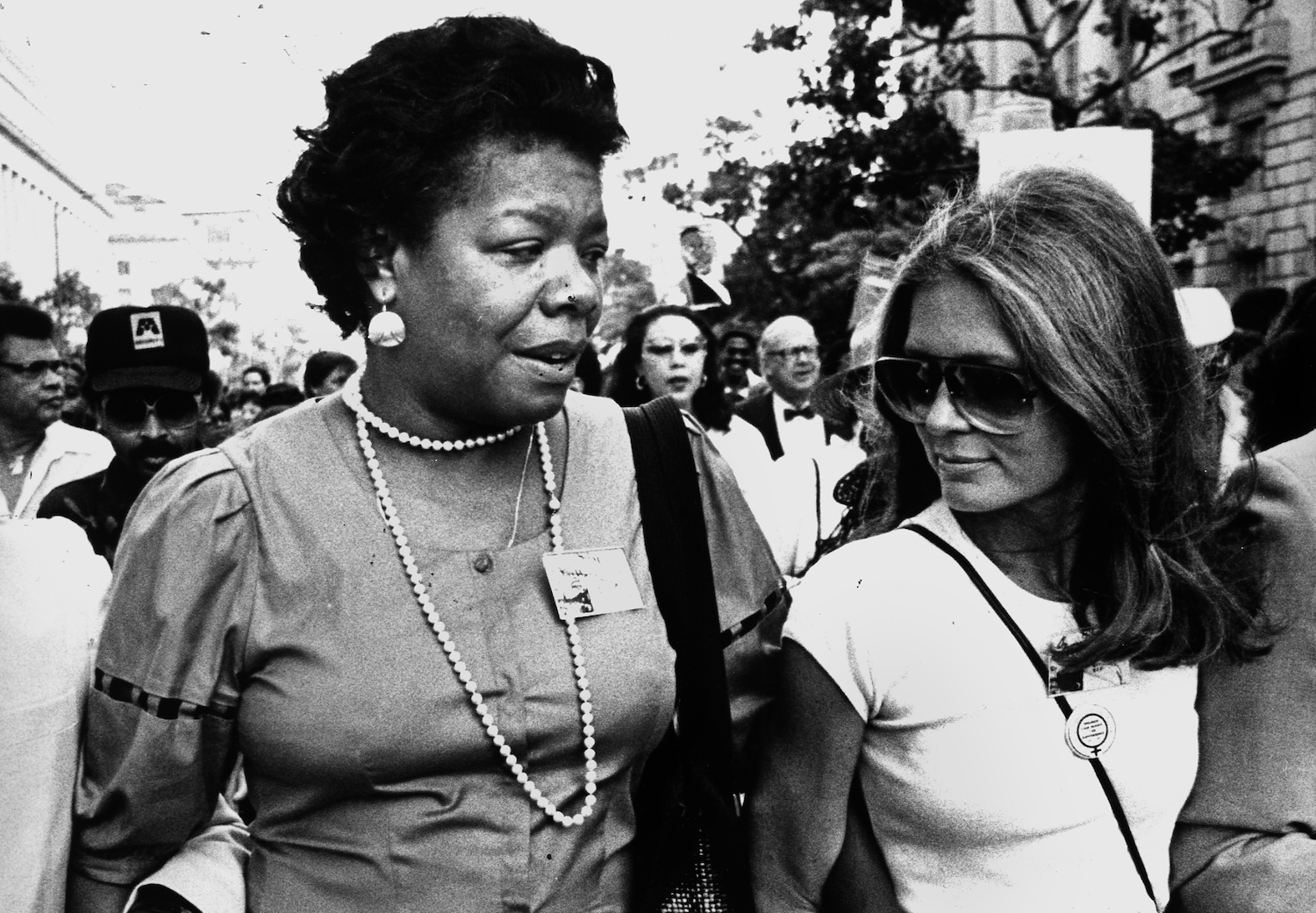
The world is mourning again, this time for the loss of feminist Gloria Steinem, who died on September 2 at age 92. In the seventies, she was an emblem of the movement, standing up for women’s rights and serving as a founding mother of Ms. magazine, where Pulitzer Prize-winning author Alice Walker was one of the publication’s first Black editors. But Steinem didn’t do it in a vacuum. She stood beside countless Black women who were fighting not only for their rights within the feminist movement, but also for civil rights and equality across the African American community.
An immediate image that comes to mind is Esquire magazine’s iconic 1971 shot of Steinem and Dorothy Pitman Hughes, fists in the air. Hughes, who built her activism around community programs centered on childcare, jobs and family services, partnered with Steinem, who was initially terrified to speak in public. Steinem credited Hughes with helping her transform into a brilliant orator. They became a visual duo, noted for their eloquence and also their interracial partnership. Hughes was instrumental in bringing the Black voice into the feminist movement, which had been largely seen as white and middle class.
Steinem also connected with Shirley Chisholm, the first Black woman to run for president. Together with other trailblazers like Fannie Lou Hamer, Betty Friedan and more, they founded the National Women’s Political Caucus, an organization created to elect and support pro-equality women in government.
As Chisholm challenged America to see Black women helming political power, Steinem strongly supported her. She ran as a Chisholm delegate, along with Arturo Santiago and lawyer Florynce Kennedy, at the 1972 Democratic National Convention.
Hamer also profoundly influenced Steinem, who often acknowledged that the activist taught her what real grassroots activism required. Hamer had shared the devastating experience of being forcibly and unknowingly sterilized in a Mississippi hospital, and Steinem used that testimony to fight against racist and sexist reproductive laws.
Kennedy and Steinem shared a kinship. The two joined forces starting in the 1960s, traveling to universities and community halls across the nation to educate people on racism, sexism and the need for equality. Both were fiery in their tactics, never backing down from a public protest or explosive media moment.
Many more Black women influenced Steinem over the decades: activists like Margaret Sloan-Hunter, writers like Maya Angelou, organizers and political leaders who challenged her thinking, broadened her understanding of equality and helped push the feminist movement beyond narrow borders. Steinem acknowledged as much herself, telling Black Enterprise in 2015 that she had learned feminism “disproportionately from Black women.”
Steinem consistently showed up for women, but she also listened to and learned from women in the Black community. These are voices that shaped her, shaping the movement she carried into the mainstream and, ultimately, into America itself.