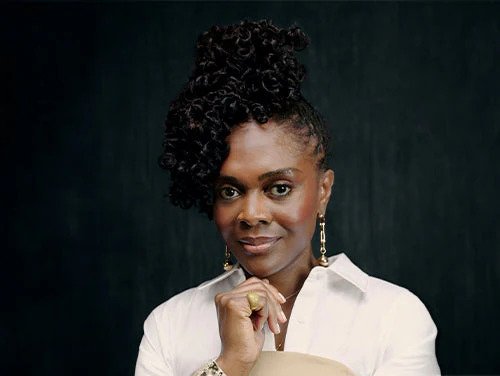
EBONY’s Power 100 has always been about recognizing the individuals who move our culture forward, but some of the most influential people are the ones doing the work long before the world catches up. Dr. Kari Williams is one of them. Named one of EBONY’s 2026 Power 100 STEM Trailblazer of the Year, the trichologist, educator and beauty industry veteran has spent her career challenging the way Black hair is studied, treated and understood. Her work sits at the intersection of science, beauty and culture, where the conversations surrounding Black women’s hair go far beyond what happens in the salon chair.
Today, Williams is helping shape the future of hair care at Cécred, the beauty brand founded by Beyoncé, but her journey began in South Central Los Angeles, where a young girl with a love for hairstyling would eventually discover that her passion for beauty and curiosity about medicine didn’t have to exist in separate worlds.
“Before the accolades, I was a young Black girl from South Central Los Angeles who simply loved hair and the way my gift made people feel,” Williams tells EBONY. “Growing up, I actually wanted to be a pediatrician. I always had a deep curiosity for medicine and science, but as I settled into my passion for hairstyling, I couldn’t initially envision how to integrate those two worlds.”
Like many Black women, Williams’ earliest understanding of beauty began at home. Her mother introduced her to hair care as something much deeper than a routine. It was an extension of self-love, identity and the understanding that Black hair, in all its textures and expressions, deserved to be celebrated rather than corrected.
She remembers watching her mother embrace her natural hair, first cutting it short before eventually growing locs. Even when Williams wanted to straighten her own hair, her mother encouraged her to explore its versatility without compromising its health. Those early lessons would eventually become the foundation of a career dedicated to making sure Black women had the knowledge and resources to care for their hair without sacrificing their individuality.
While studying at UC Berkeley, Williams decided to pursue her professional cosmetology license. It was during those undergraduate years that she stumbled across an article introducing her to trichology, the scientific study of hair and scalp health. Suddenly, the two interests she had spent years trying to reconcile made perfect sense together.
“Trichology was the perfect bridge between my early medical curiosity and my artistic, expressive side,” she explains. “Discovering that field showed me I didn’t have to choose between science and art.”
That discovery would take her from California to the International Institute of Trichology in Huntsville, Alabama, where she completed an accelerated four-year dual master’s and doctorate program. The hybrid program allowed her to continue working in Los Angeles while traveling to Alabama twice a year for intensive laboratory training.
But the education she was receiving didn’t always reflect the women sitting in her salon chair.
At the time, much of the existing trichology curriculum was rooted in European research, with limited attention given to the specific needs of Black hair and scalp health. Williams found herself navigating a field where the science was available, but the cultural context was often missing. Rather than accept those limitations, she began supplementing her education with medical literature, dermatological research and the firsthand experiences of her predominantly Black clientele.
“I had to combine my lived experience as a Black woman with my expertise as both a cosmetologist and a trichologist to create a standard of holistic care that our community actually needed, but didn’t yet have access to,” she says.
For decades, Black women have been among the beauty industry’s most influential consumers, shaping product development, hairstyles and trends that eventually find their way into the mainstream. Yet that cultural and economic influence hasn’t always translated into adequate research, education or medical attention surrounding the health of Black women’s hair.
Williams witnessed that disconnect firsthand. Behind the chair, she began noticing clients experiencing symptoms associated with Central Centrifugal Cicatricial Alopecia, commonly known as CCCA, a form of scarring hair loss that disproportionately affects Black women. She also recognized how generations of beauty practices, including tension-heavy hairstyles and chemical treatments, had shaped the way women understood their scalp health.
Some of the most concerning discoveries weren’t necessarily new conditions, but the normalization of symptoms that should have prompted further attention.
“I started diving into dermatological journals and noticed undeniable patterns: the historical, prolonged use of chemical relaxers, a lack of access to proper products, and a cultural misinterpretation of symptoms—like being taught that an itchy scalp meant that hair was growing,” she explains.
Although research continues to examine the causes and contributing factors behind conditions such as CCCA, Williams understood that education could make an immediate difference. As a trichologist rather than a medical doctor, she recognized the importance of helping stylists identify warning signs and refer clients to qualified medical professionals instead of attempting to diagnose conditions themselves.
“Stylists are our front line of defense,” she says. “By teaching them to be early detectors of these symptoms, we can intervene sooner, educate our clients on when to seek medical care, and ultimately protect our community’s health from the root.”
That philosophy helped establish Williams as an important voice in a growing movement to bring science-backed education into Black beauty spaces. Through salons, digital platforms and professional training, she began challenging long-standing misconceptions while encouraging hairstylists to see themselves as essential partners in the larger conversation surrounding hair health.
Her approach, however, has never been about dismissing the traditions that Black women have passed down for generations. Instead, she believes the future of hair care depends on understanding the relationship between cultural knowledge and clinical research.
“I believe many of our ancestral rituals are rooted in a kind of ‘cultural science,’” Williams says. “Our traditions were built on deep experiential knowledge.”
From the oils and butters used in family kitchens to the braiding techniques passed between generations, Black hair care has always been a form of innovation. Williams believes science can help distinguish which practices support healthy hair and which require adjustments. Protective styling, for example, can offer convenience and versatility, but excessive tension or improper removal can contribute to breakage and hair loss.
The objective isn’t to abandon tradition. It’s to make sure those traditions can evolve alongside a better understanding of hair biology.
That marriage of cultural knowledge and scientific research eventually led Williams to Cécred, where she found a brand whose philosophy reflected the work she had already dedicated her career to.
Her relationship with the company began two years before its public debut, when a friend and colleague introduced her to the leadership team. Initially brought in to test and advise on early product formulations, Williams continued consulting with the company before pursuing a formal role.
By then, she had spent more than a decade working across the beauty industry as a hairstylist, salon owner, trichologist and educator. Cécred offered an opportunity to bring those experiences together on a larger platform.
“Beyoncé’s vision for the brand completely mirrored my own lifelong passion for bridging hair artistry with scientific care,” Williams says.
She also credits Cécred CEO Grace Ray with recognizing the value of her expertise and creating an environment where her scientific background and creative experience could work together. Working alongside Tina Knowles, whose own history as a hairstylist is deeply connected to the brand’s origins, has made the experience especially meaningful.
“To now serve as an education leader at Cécred, alongside Ms. Tina Knowles, is an extraordinary honor,” she shares. “It feels as though every step of my journey prepared me for this exact moment.”
For Williams, the significance of that opportunity extends beyond working with one of the world’s most recognizable entertainers. It represents a larger shift in how the beauty industry approaches expertise, particularly when it comes to Black women whose knowledge has historically been overlooked despite their influence on the market.
And while her career has been defined by studying hair, Williams says the women themselves have taught her just as much.
“The physical structure of our hair is a perfect metaphor for Black women,” she explains. “There is an incredible strength in our strands that allows for beautiful versatility, giving it the ability to transition from tight coils to silky, straight. But right alongside that strength is an inherent fragility.”
It’s a comparison that speaks to something larger than beauty. Black women are often celebrated for their resilience while simultaneously being expected to navigate spaces that don’t always provide the care, protection or consideration they deserve. Williams sees a similar contradiction in an industry that profits from Black beauty while historically investing too little in understanding its specific needs.
“Studying this balance is a constant reminder that for all of our celebrated resilience, we also need and deserve spaces to be cared for,” she says.
Now, as an EBONY Power 100 honoree, Williams is thinking about what comes next. Her ambitions extend beyond product development and consumer education. She wants to create sustainable professional pathways for hairstylists who are interested in science, research and education, challenging the notion that a career in beauty must begin and end behind the chair.
“For too long, our profession has been boxed into the stereotype of the ‘kitchen beautician’ or the expectation that we simply have to work behind the chair until our bodies physically cannot take it anymore,” she explains.
Through educational platforms and professional development, Williams hopes to establish a model that allows beauty professionals to expand their expertise into new disciplines while building careers with greater longevity. It’s also about changing who gets to participate in scientific conversations and whose experiences are considered valuable enough to inform research.
For the next generation of young Black girls who love beauty but may never have considered a future in STEM, Williams wants her journey to serve as proof that the two aren’t mutually exclusive.
“You can love beauty and ask scientific questions. You can come from South Central, begin as a braider or stylist, and find your way into rooms where decisions are made,” she says. “You can show up as yourself and have an impact.”
Her recognition as EBONY’s 2026 Power 100 STEM Trailblazer of the Year is a celebration of that philosophy, but Williams is far more interested in what the recognition might make possible for someone else. After years of building a career in a field where she rarely saw women who looked like her, she hopes the next generation won’t have to work quite as hard to find its place.
“I have always just put my head down and done the work, so to receive this recognition as EBONY’s 2026 Power 100 STEM Trailblazer of the Year fills me with immense joy and gratitude,” she says. “I am deeply honored, and I hope the trail I have blazed makes the way a little clearer for the next generation coming behind me.”
For Williams, the future of Black hair care isn’t simply about creating better products or discovering the next breakthrough ingredient. It’s about ensuring that the women who have shaped beauty culture for generations are finally at the center of the science designed to serve them. And if her journey from South Central Los Angeles to the forefront of hair health is any indication, she’s making sure the next generation has more than a seat at the table. They’ll have the knowledge to help build it.