
The end of Bridgerton, Season Four, Part One, left us all with a burning question. No, not that one. We’re talking about Lady Danbury’s request to Queen Charlotte. In short, the former member of the queen’s royal court requested, then stated, then requested again that she must leave Mayfair, London, to explore new possibilities, return to her ancestral home in Africa, and become a new version of herself. Without hesitation, pause, or care-laden consideration, her closest friend of decades, immediately responded with a sharp, simple, and cutting:
“…and No.” Gasp.
How could this be? And what exactly was Queen Charlotte saying “No” to?
Mental Health expert and educator Dr. LaNail R. Plummer of onyxtherapygroup.com has a lot to say on the subject.
“Was she using her power to deny her friend what she wanted? Did she want to stunt her friend’s growth? Was she jealous that Lady Danbury was freer than she was—able to leave without cause or constraint—while she was bound to remain Queen of England,” she theorized to EBONY. “Was she power-hungry and selfish? Was she scared? Vulnerable? Was she… what?”
In her new book, The Essential Guide for Counseling Black Women, Dr. Plummer explores the depth of why friendships are so important to Black women. “They are far more than surface-level exchanges of news, gossip, or giggles,” she explained. “They are more than shopping buddies, restaurant explorers, or drink connoisseurs. They are more than what we see in romantic comedies, dramatic reality television, or young adult novels.”
Friendship: A Window to Our Identity
To understand the complexity of friendship between Black women, one must recognize that it is not shallow and extends far beyond conscious thought. “They are safe spaces of community, vulnerability (where armor is removed), and exposure of fear,” Dr. Plummer continued. “They are beautiful, powerful, carefully evolving, and soul-connecting. They are historically rooted, subconsciously intertwined, and spiritually significant. Real friendships between Black women are mirrors of ourselves—divinely ordained and, quite frankly, sacred.”
So, when a friendship is about to end, it has the potential to shatter everything.
A friendship that deep can shatter how one sees herself—her abilities, capabilities, and identity, Dr. Plummer revealed. It can fracture the mirror of who she believed herself to be, who she believed the other person was, and what she believed the world to be. It can reopen old wounds, insecurities, heartbreaks, and unhealed parts of the self.
“When Queen Charlotte sharply said, ‘No,’ she was not simply saying, No, you cannot leave. She was also saying, No, I do not know who I am without you here.“
That is a level of grief Black women have not been socialized to process.
“When we lose someone or something, we are often told to move on—and move quickly. We do not pause to explore how that loss shapes our self-concept, our sense of safety, or our predictability. We do not consider who will now help us think through our deepest problems and darkest secrets. Instead, we are reinforced to keep working, keep pushing, and let it go.”
But grief—whether present or anticipatory—is life-altering and needs space to breathe.
“Rushing grief is like shaking a soda can and opening it too quickly. It explodes everywhere, creating a mess that takes far longer to clean than if we had opened it slowly and allowed it to fizzle naturally.”
How Culture Shaped Our Sisterly Bonds
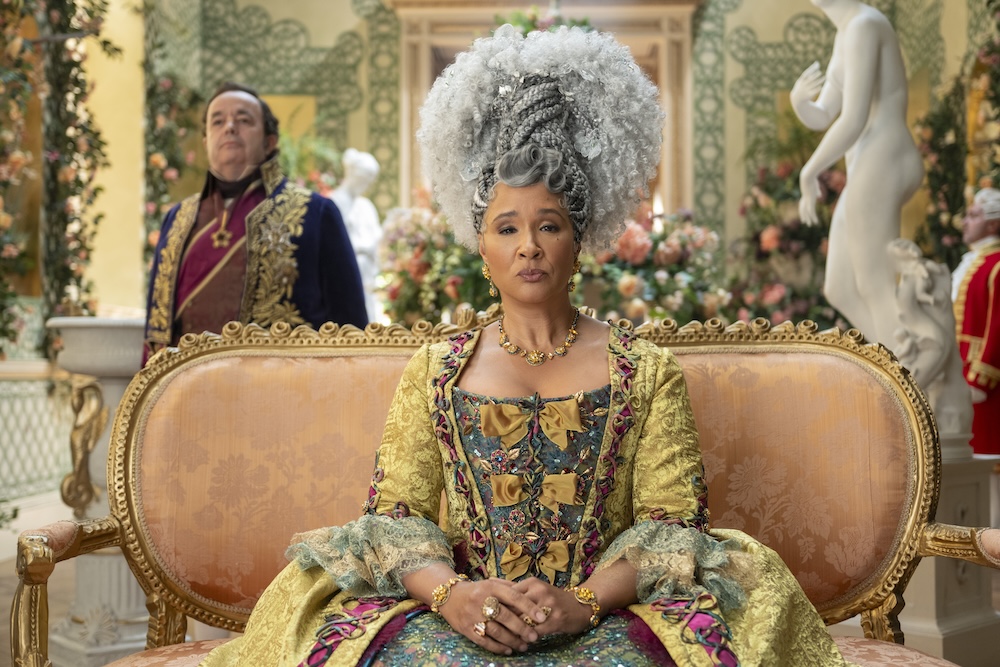
Image: Liam Daniel/Netflix
In Chapter 4 of The Essential Guide for Counseling Black Women, Dr. Plummer breaks down the history of Black women’s friendships to explain why they differ from those in other cultural communities.
“Due to enslavement, our ancestors were forcibly removed from their biological families. All they had were the relationships with those around them,” she vocalized.
“Friends became family. The concept of fictive kinship—play cousins and chosen aunties—was not symbolic. It was survival. In the Black community, ‘my sister,’ ‘ my cousin,’ and ‘my auntie’ are often not used metaphorically. They are functional. When blood was stripped away, water became life.”
In other words, your friend becomes a primary source of survival.
In that context, it makes sense how codependence can form in friendships. It is about life. It is about community. It is about the soul. And the removal of that bond is grief.
“When something is inevitable, it is best faced intentionally. When it is time to end a friendship—whether because you have grown, healed, or simply evolved—it is important to close that chapter with care.”
Closing the Door

Dr. Plummer shared a few tips for closing the chapter on a friendship you have outgrown or that has become strained.
Lead with Respect: Be honest about your changes. Do not project change onto them if it is you who has evolved. Perhaps you are healthier, more whole, or have established new boundaries. Maybe they have shifted from your inner circle to an outer one. Lead with courage. Do not ghost. Speak truthfully about what is happening to you.
Use Constructive Language: Although you are moving on, you do not need to leave them wounded. Share what you appreciate and value. Build them up. Let their memory of the conversation feel dignified, even if painful.
Address the Facts: You may see each other less. Call less. Attend fewer gatherings. Acknowledge that your being is evolving. Reassure them that your care remains.
Stop the Noise: If gossip begins, interrupt it. Say: “Like a caterpillar evolving into a butterfly, the core of the friendship remains the same, but it looks different now.”
If the friendship has become unhealthy or no longer aligns with who you are:
Set and State a Firm Boundary: Using clear communication, state what occurred, how you feel, and your decision. Boundaries are clarity, not cruelty.
Establish Rules of Engagement: Discuss mutual friends. Discuss how you will engage publicly. Discuss how you will speak about the ending. This requires maturity and emotional regulation—but it is possible.
Stop the Noise (Again): If others attempt to fill gaps with assumptions, repeat: “Like a caterpillar evolving into a butterfly, the core of the friendship remains the same, but it looks different now.”
Friendships among Black women are unlike those in any other race, culture, or gender context because of historical and spiritual roots. “We may not always have healthy examples of how to end them, but we can break cycles,” Dr. Plummer emphasized. “We can trailblaze. We can walk away knowing we honored what was and made space for what is becoming.”
Bridgerton, season four, Part II returns to Netflix on February 26.
Learn more about Dr. LaNail R. Plummer at onyxtherapygroup.com and follow her on Instagram @MahoganySunshine.