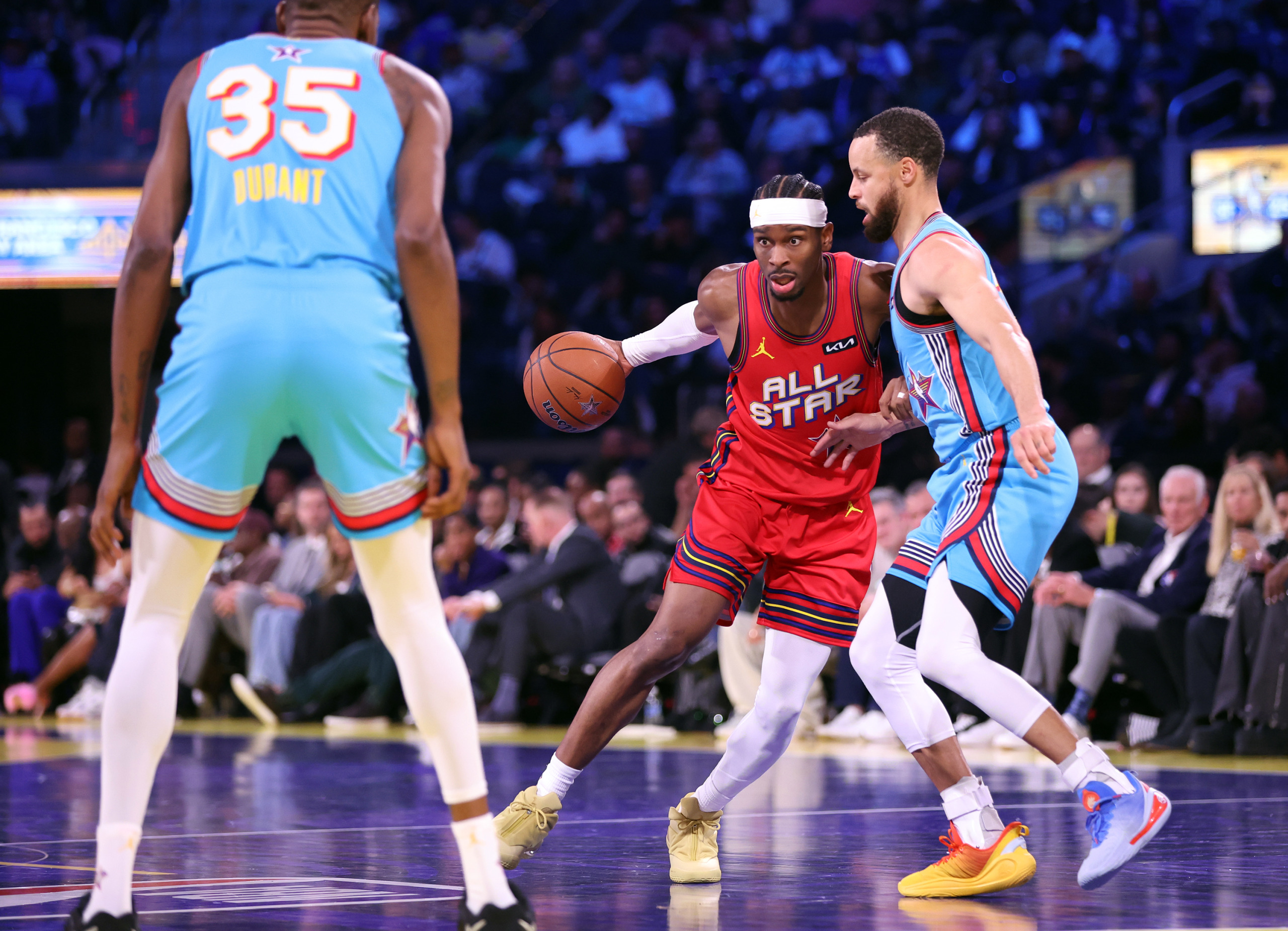
This weekend, the NBA’s finest will all congregate in Los Angeles for its All-Star events. And yes, the league’s best will be there in person, but let’s be honest: for years now, All-Star Weekend has been less than stellar. The Slam Dunk Contest rarely attracts the league’s top flyers. The league keeps rolling out new skills challenges to shake things up. We even get the occasional gimmick like Steph Curry going shot-for-shot with Sabrina Ionescu in 2024 … actually, we didn’t mind that one.
But the main event? The game itself has tilted so toward offense that defense has basically been downgraded from “requirement” to “lightly suggested,” and lately, nobody’s even pretending to read it.
The NBA has tried just about everything to get players to care: format changes, financial incentives, charity donations to the winning team, and captains who can pick their own squad instead of the traditional East and West teams. Outside of injecting the competitive spirit of Kobe Bryant (R.I.P.) into players, it felt like the league had run out of ideas to bring back the edge that once made All-Star Sunday feel like “Must See TV.”
Enter USA vs. the World
The NBA is acknowledging two truths at once: All-Stars need stakes, and the league’s future is undeniably global. So the league is reframing the game around identity, borrowing the competitive charge we saw at the 2024 Summer Olympics and leaning into a simple reality: some of the NBA’s most dominant stars—Victor Wembanyama, Giannis Antetokounmpo, Luka Dončić, Nikola Jokić, and more—aren’t from the U.S. That’s why this new approach might actually stick. It’s not about cash prizes or charity totals. It’s about the one incentive that can’t be negotiated: good old national pride.
And it’s giving that rivalry a stage with a new short-game tournament format that reads Above the Rim energy—less “exhibition,” more Rucker Park under the lights, where reputations still matter.
What “NBA vs. the World” Actually Is
Instead of one long exhibition, the game has now been turned into a mini tournament built around a simple premise: U.S. players versus international players, with the American pool split into two squads. There are three teams total: two Team USA teams and one Team World team—playing a round-robin of short, 12-minute games.
After the round-robin, the top two teams advance to a final, with tiebreakers in place if records get messy. The whole thing is designed to do one very specific job: compress the action so the game can’t drift, and give players something that feels closer to a win than a cameo.
Why The NBA Is Doing This Now
All-Star used to feel coveted—like a badge you had to protect. Some players played the game as if they had something still to prove. Others had actual rivalries, while most today are business partners. The way the current game is played makes it feel like some players show up as if they’re entitled to the honor. Not because it’s necessarily true, but because the intensity doesn’t match the legacy.
And honestly, the players are in a bind: the All-Star break is the one real pause in the season, then the league asks them to rev the engine back up for a nationally televised sprint. Fans want competition. Players want longevity. In the modern star economy, plenty of All-Stars are already living at the intersection of max contracts, endorsements, and brand leverage that extends well beyond the court.
So, “extra” motivation, such as getting chosen to the All-Star Game (players were paid a minimum of $25k in 2024), doesn’t land the same way when the downside is an awkward landing and twisted ankle. The NBA can offer prizes and charity stakes, but it can’t outbid the one thing players value most: staying healthy.
But borrowing the Olympic blueprint might be genius. Countries don’t have to beg their athletes to compete. The jersey does it. The flag does it. The idea of “us vs. them” does it. You don’t need a pregame explainer to understand what it means if one of the USA teams loses.
Will It Bring Energy Back To The All-Star Game?
It might. This format changes the incentive structure in the simplest way possible: pride. Sure, there is cash incentives to the winning team, but in a 12-minute game, there’s no room for the usual “we’ll turn it up in the 4th quarter” pacing. And the rivalry is clean. Team USA doesn’t want to be embarrassed. Team World doesn’t want to be treated like the side-chick. Excuse me… side-person.
What Success Looks Like This Weekend
Success doesn’t mean playoff-level defense for three straight games. It might, however, mean more sequences that feel real: a possession where the player demands an isolation and the rock and the defender across from actually sitting down in a defensive stance, ready to make a late stop. It means a crowd on the edge of their seats for more than just their Getty photo. But we are in L.A., there will be plenty of that too.
What we can ultimately hope for is that it means the NBA gets one storyline that survives the weekend: Who runs the league? Team USA, or the rest of the world?
And if fans are still arguing about that on Monday, then the NBA didn’t just create a new format. It created a reason to care.