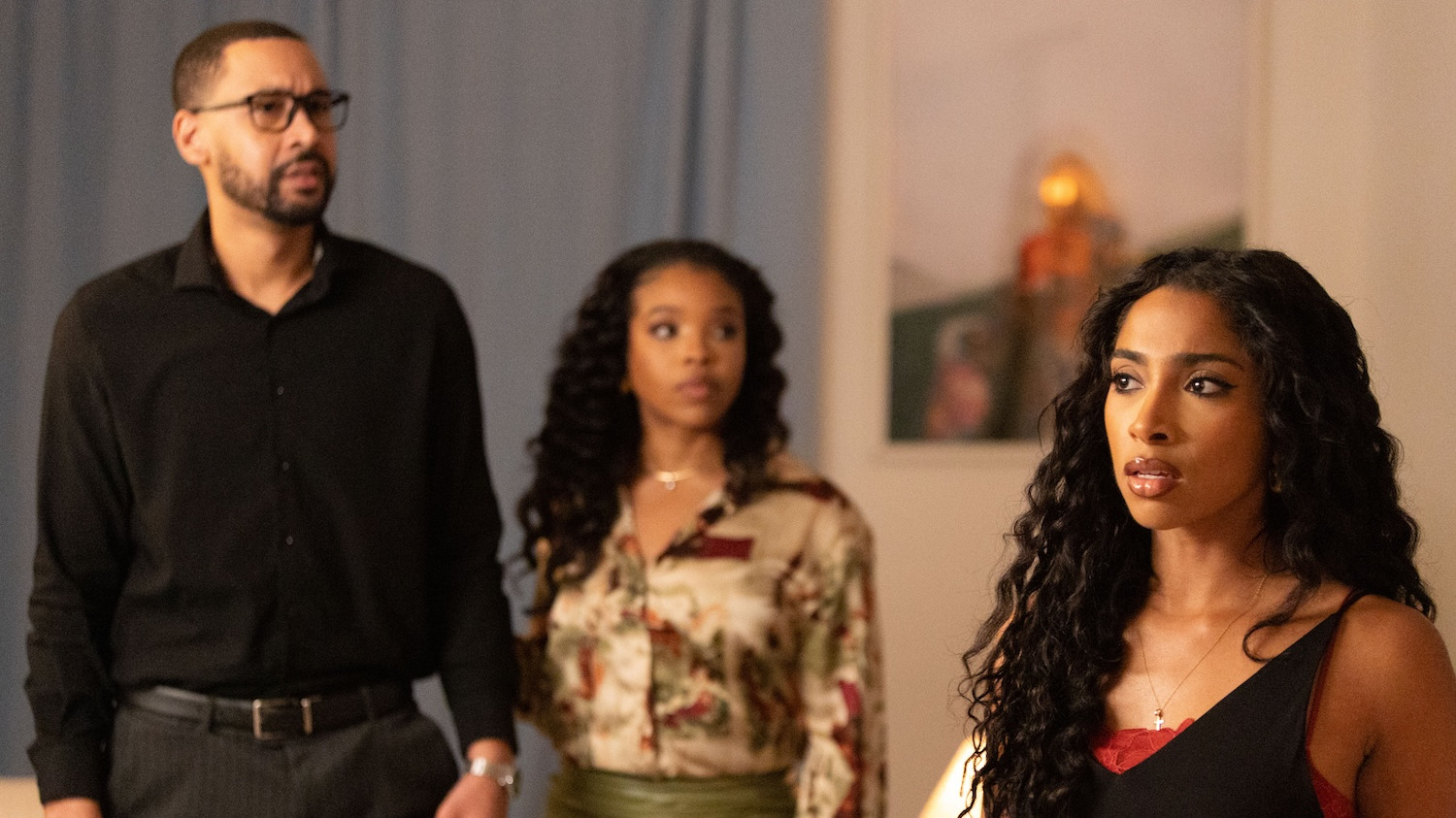
The end of each episode in Issa Rae’s latest show, Screen Time, following two married couples being blackmailed by a Big Brother-like figure, leaves you on the edge of your seat. Unlike Insecure or Rap Sh!t, you can’t catch this show on streaming platforms like Netflix or HBO Max. In fact, that may be the reason for its success — 369 million views globally, to be exact.
Screen Time is the first project stemming from Rae’s historic distribution deal with TikTok. The vertical series launched on April 29, but it already has 57 episodes and a massively engaged fanbase, as shown by the comment section. With episodes running between one and two minutes long, Screen Time and microdramas like it are leaning into the bite-sized binging habits audiences have become accustomed to over recent years.
The Rise of Microdramas Is Rewriting Hollywood’s Playbook
When Dzifa Yador, who is the Head of Digital at Hoorae, saw a fan comment that read, “who put Netflix on my TikTok feed,” she said it spoke volumes. “It told us that the quality our audience expects from their favorite shows and films translated fully in Screen Time,” she told EBONY. “We didn’t ask audiences to come to a new place for great content. We brought the content to where they already are, and where they’re already spending a significant amount of their screen time. Pun very much intended.”
Vertical videos on platforms like TikTok, Instagram Reels and YouTube Shorts have opened the door for audiences to spend more time on multi-part storytimes and sketches. Most famously, when Reesa Teesa’s 50-part “Who TF Did I Marry?” saga broke the internet in February 2024, a wave of imitators followed, hoping to ride the success. Creators found that if their stories were captivating enough, audiences would follow along and invest their time in storylines that unfolded over a series of videos.
Since 2020, Chinese filmmakers and studios have made microdramas a billion-dollar industry. Now filmmakers in the United States are getting in on the boom, hoping to transform what was seen as lowbrow content into premium offerings. Platforms dedicated to vertical media like ReelShort, DramaBox and CandyJar have entered the zeitgeist, opting for a more cost-effective format that can be filmed in a fraction of the time it takes for larger productions.
According to Variety, microdrama revenue grew to $819 million in 2024 and is projected to hit $26 billion annually by 2030. In May, Sunset Studios partnered with vertical media studio Knockout Shorts to create premium standing sets for microseries on their lot. Sundance Institute and TikTok recently partnered to launch a micro-series storytelling program. Peacock and Bravo are throwing their hat in for unscripted microdramas this summer.

FOX just announced it will produce the third and fourth seasons of Besties, Christina Richardson’s independently produced vertical-video series that follows a group of friends navigating relationships, identity, ambition, and the challenges of adulthood, delivered through this highly bingeable, mobile-native storytelling formula.
Why Microseries Are Becoming a Crucial Pipeline for Black Storytellers
With the entertainment job market in a slump, well-established actors and producers have also expanded into the space. So far this year, Taye Diggs has been involved in two microdramas, starring in CandyJar’s Off Limits And All Mine and executive producing Lifetime’s Tides of Temptation. On the heels of the latter, he collaborated with that same production team (Autumn Federici, Shelby Stone, James Black, and Troy Brookins) to launch Microhouse Film. Microhouse gives creators more power to distribute and monetize content, which is key for “Black people who don’t have a space or a platform to tell their stories,” Brookins said.
The shift towards microseries has become a timely response to the financial strain in Hollywood that is disproportionately affecting marginalized talent. With the exception of the spike in New Jersey, film and TV production in the U.S. is down, according to the Hollywood Reporter. Fewer projects means not only fewer opportunities for Black cast and crew members, but also fewer big-budget productions that reflect their communities.
Though it’s not a one-to-one replacement, Brookins believes that when the Microhouse Films app launches in July, they will have the opportunity to fill in the gaps he sees in what newer generations have to choose from today. “All of those classics from back in the day were heavily centered around Black people that looked like us, and that moved like us,” Brookins told EBONY. “It gave me a thrill as a kid to watch that, so I feel like for us to do that for the next generation, it’s very, very important to be in this space.”
Why Hollywood’s Future May Be Shot in 9:16
This year’s American Black Film Festival saw its inaugural 9:16 Project Showcase, which featured a range of vertical series from eight first-time microdrama filmmakers. Bobbi Broome, a filmmaker and event coordinator with ABFF, said it was vital they apply their mission to create pipelines for Black people to this “new frontier.” “Trying to rewire your filmmaking brain to fit a vertical format [is a challenge],” Broome said. “Black people are always trying to make something out of nothing, and I can really see us completely transforming the entire landscape and the entire field as we know it. Mostly, I’m just really excited to see us transform the industry.”
Though these mini soap operas are still in their infancy, they are growing at an exponential rate. That coincides with the industry’s appetite to lean further into AI to carry the future of microdramas. However, human-driven stories maintain the credibility needed to earn audience trust and loyalty, which is crucial to the engagement these shows rely on.
This era is reminiscent of early YouTube days when Black creators like Rae, Lena Waithe, Donald Glover and more had to greenlight themselves when Hollywood refused. The format may be new, but adjusting distribution strategies to meet the moment isn’t for Black talent. Yador maintains that microdramas aren’t here to replace long-form and standard series, but rather to meet an audience demand in an exciting way.
“There is still so much room to innovate and define what this space looks like,” she said. “Creators of color can be scrappy, invest in themselves and each other, and build and own IP that reaches millions of people. That’s the kind of reach that, until recently, was reserved for major studio releases or big streaming deals. The barrier to entry is lower, but the ceiling is just as high. That’s a powerful combination, and HOORAE is proud to be helping set that standard.”