A recent episode of BET’s For the Fellas, hosted by Brian McIntosh, offered a closer look at the management and marketing of professional athletes, examining how Black fathers are often pushed to the wayside when it comes to being acknowledged for their role in their sons’ success. Guests Za’Darius Smith, J.R. Smith, Charles Oakley and Justin Tinsley shed light on experiences they and other athletes have encountered throughout their careers.
Despite the close relationship J.R. Smith shared with his father growing up and throughout his rookie year, he experienced firsthand the pressure to distance himself from his dad as his career began to take off.
“The league was pushing me to get rid of my dad like get my dad out the house, push him out like ‘you your own man’, two men can’t stay in one cave and it really played a part on me to the point where me and my dad kinda separated after my first year cause I’m starting to feel myself, think I’m a man. I got money coming in like bro you always told me when I get my own money and my own house I can do this, I can do that. Turns out, I can’t do none of that which was the right move to make because what you gonna do at 19-years-old? You got $3 million in your pocket. What you going to do? Go crazy. So he was trying to guide me from being the wild man that I did become at some point,” Smith said.
Like J.R. Smith, Za’Darius Smith described outside influences attempting to drive a wedge between him and his father. While recounting his family’s experience during the media coverage of his NFL draft night, Smith appeared visibly uncomfortable discussing how the story was framed.
“I can remember coming out, man and getting ready for the draft. I was doing it at home and my dad actually showed up. I had the news people there, you know they want to do interviews but nobody wanted to do it with my dad. Everybody wanted to do it with my mom cause my mom worked in a correctional facility so they wanted to paint that picture as a single mom. You know, son got drafted and it was all about her, but I really got the work ethic from my dad cause he was a farmer. […] The story was more like the single mother son made it to the NFL from a small town,” Za’Darius Smith explained.
As the conversation continued, McIntosh brought up Michael Jordan and his father, James Jordan, whose death became the subject of media speculation about the circumstances surrounding their time together. Oakley added nuance to the discussion, suggesting that Jordan’s team may not have wanted his father’s personal dealings associated with his professional career. The conversation raised a broader question about how Black fathers are represented when their sons achieve widespread recognition. Their experiences point to a pattern that extends beyond professional sports, appearing in media, advertising, television and film.
Black Fathers Speak Out
The discussion on For the Fellas echoes a separate conversation on Ultimate Dads Unplugged, which explored the issue from the fathers’ perspective. Hosted by Dwayne Wade Sr., LaVar Ball and Marcelis Brown Sr., the podcast asked fathers how they feel when they are overlooked or notice changes in how they are treated because of their high-profile sons.
Justin Tatum, father of NBA player Jayson Tatum, shared his experience of being overlooked during media coverage of his son’s career.
“It’s a messed up situation. I mean I’ve seen it when it started with the draft. You know, mom got interviewed and I’m sitting right next to her and nothing was being asked of me, but at the end of the day we know what it took for us to get our kids there. I know my son and how much he cares and loves me and he knows what we’ve been through.”
Wade Sr. shared a similar experience from the early stages of his son’s basketball career, reflecting on the changes he witnessed in his own relationship with his son and in the experiences of other fathers.
“I was a part of the first nine guys who came up with the fathers being a professional basketball player and so I saw it, but I saw dads crying because of that situation and what I try to do is I try to instill what I learned from my situation and let them mature, and then everything will work out. But it’s a lot of dads that’s crying because of what’s going on with them trying to separate the players from the dad or the family,” he said.
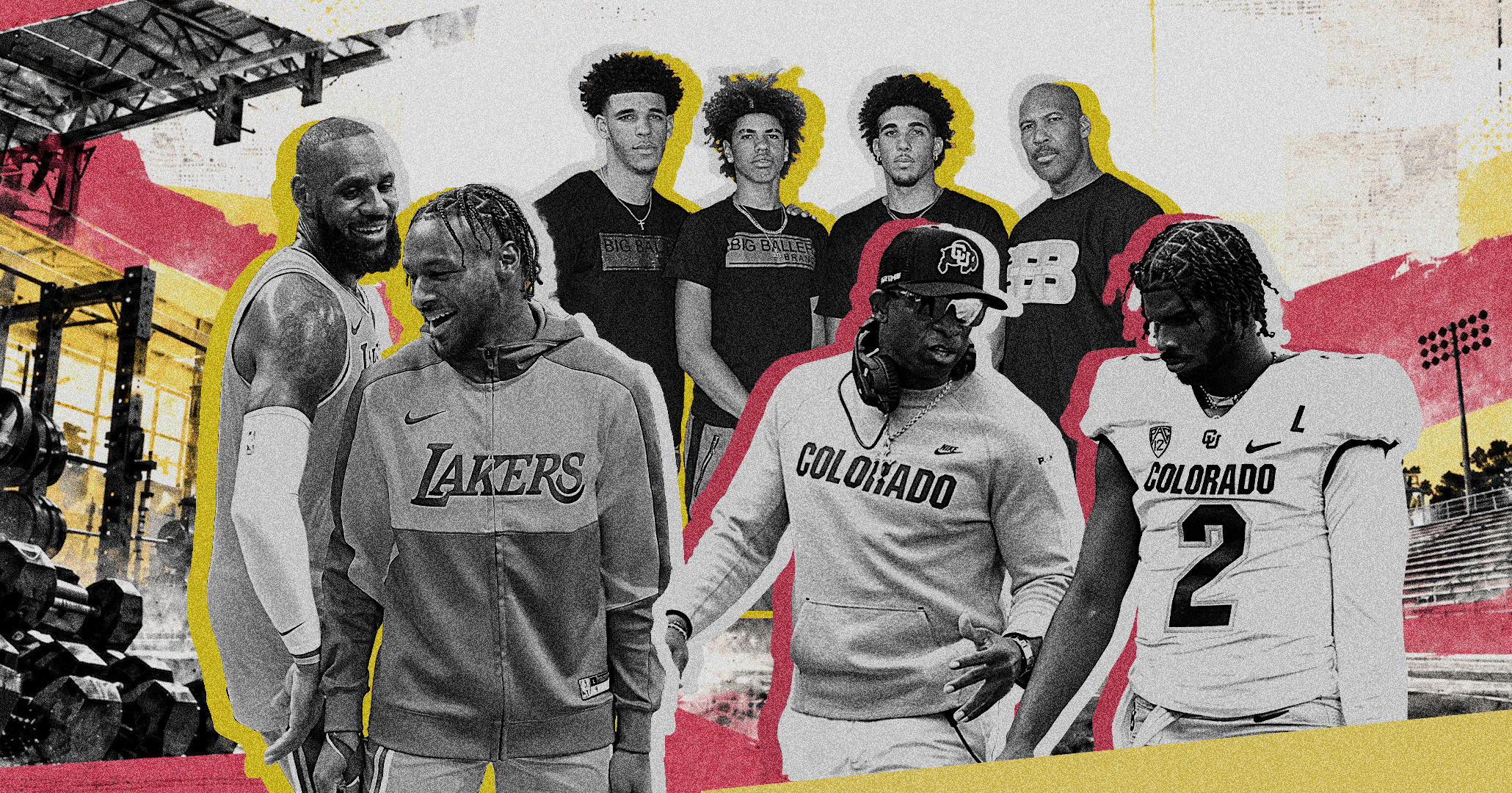
More recent examples of involved Black fathers navigating public scrutiny include Deion Sanders’ vocal advocacy for his son Shedeur Sanders when he began playing for the Cleveland Browns and the attention surrounding Bronny James playing alongside his father, LeBron James, for the Los Angeles Lakers. These examples highlight how fathers can be perceived when they remain actively involved in their sons’ professional careers, from advocating for opportunities to offering guidance and protection.
The issue extends beyond whether fathers receive recognition. It also raises questions about how their involvement is interpreted. Actions that might be viewed as support, mentorship or advocacy in other families can be scrutinized differently when Black fathers are involved, reinforcing longstanding assumptions about Black fatherhood.
Challenging the Narrative of Black Fatherhood
The media’s portrayal of Black families has long been shaped by narratives that amplify single Black motherhood, toxic or absent Black fathers and other social challenges. These portrayals can obscure the many ways Black fathers actively participate in their children’s lives, despite research that challenges assumptions about their absence.
Research published by the Centers for Disease Control and Prevention (CDC) found that Black fathers are highly involved in their children’s lives. According to the figures cited, Black fathers account for approximately 4.2 million individuals, including 2.5 million who live with their children and 1.7 million who do not live in the same household. However, household status alone does not fully capture a father’s involvement, as living under the same roof does not necessarily determine the quality or consistency of a parent’s presence.
Research published in the Howard Journal of Communications further highlights the lack of representation of Black fathers in media and advertising. According to the study, 92.7% of the Black fathers surveyed, or 51 out of 55 participants, identified discrepancies in how they were represented after viewing 15 national advertisements released between 2016 and 2021.
Positive portrayals of Black fathers in media have often benefited from internal advocates, particularly people of color, who bring their perspectives and experiences to creative decisions. However, with mass layoffs affecting Black women and men across the country, questions remain about how that representation will be maintained as media organizations lose staff members who may help shape more nuanced portrayals of Black life.
The responsibility for accurate representation should not rest solely on Black-owned media companies and productions. Yet, too often, they are left to address the gaps. When media consistently emphasizes the absence of Black fathers rather than their involvement, it reinforces a misleading picture of the demographic.
There is also a need for greater representation of the men who serve as father figures beyond biological parenthood. Coaches, mentors, uncles and grandfathers often play significant roles in the lives of children and young adults, offering guidance, stability and support. Their contributions are an important part of the broader story of Black fatherhood, one that deserves to be reflected with greater accuracy and care.