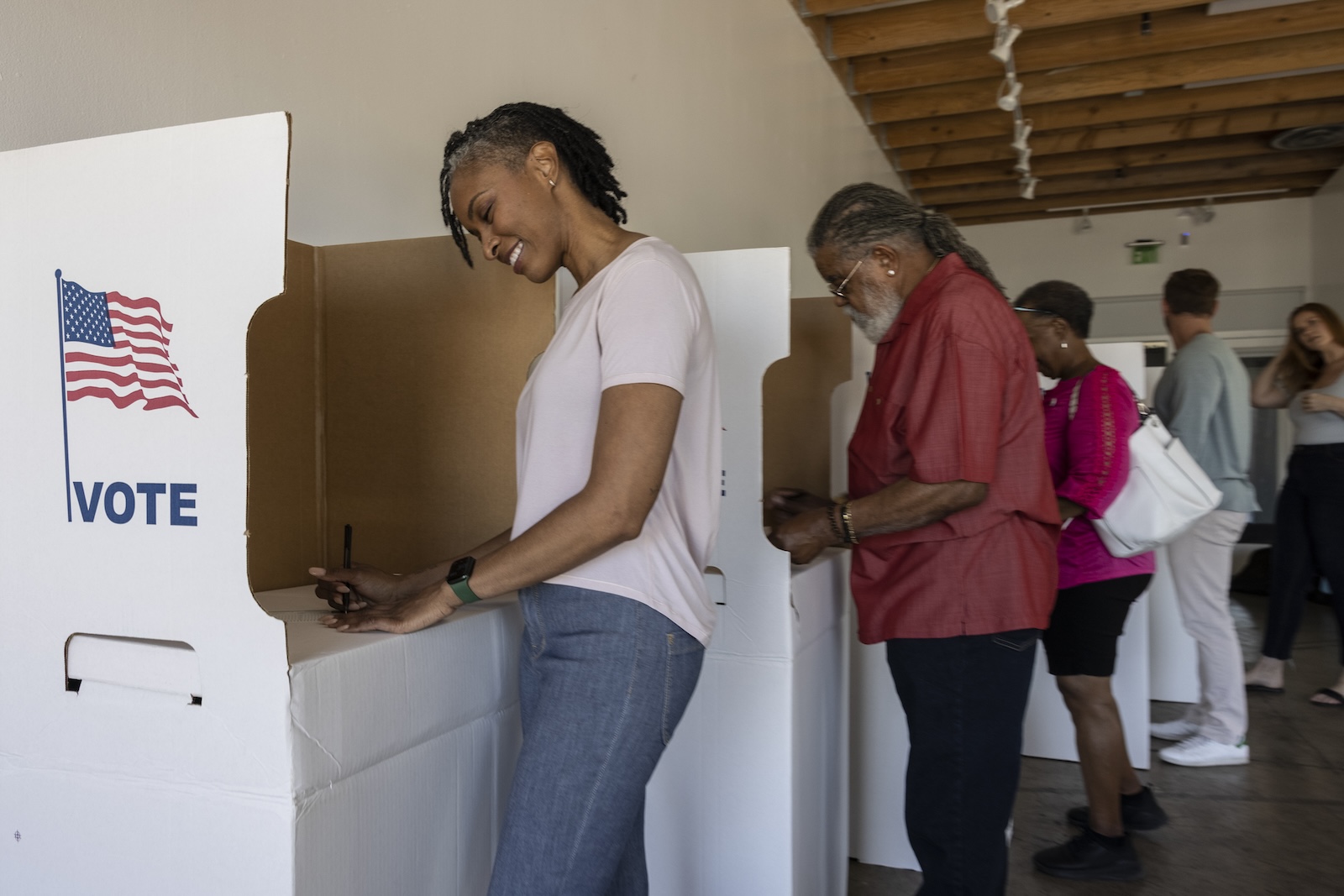
As early voting commences across the country, polling booths are filled with heavy anticipation and optimism for the future. To win control of the House of Representatives, Democrats need three to four seats of wins to take back Senate control. The opposite also stands true for Republicans, if they win a majority of Senate seats they will have control over the House, Senate, and presidential seat. With congressional seats being more reflective of a specific party, this is what can help push pieces of legislation forward, who will enact changes, and what fuels why midterm elections are important beyond election day. The roles that have the potential to be impacted include governor, attorney general, secretary of state, and district representatives in the House.
Some are predicting that some states might turn blue as the sentiment of President Trump has changed since his second term in office. According to data collected by NBC News, Trump’s approval rating is at 38% as of October 12 2026 with a 60% disapproval rate. This rate can be tied to overall political party sentiment considering Trump has publicly tied himself to the Republican party and others within the respective affiliation. With debates among the parties ranging from healthcare, immigration, education stipulations, and gas prices, the American people have a lot on the ballot than just candidate names. Across election prediction platforms Poliwave and Polymarket, they’re predicting a Democratic House and Senate result. However, the final say remains with final tallied votes.
Here are state-by-state midterm election result predictions as of October 2026:
Alabama
As one of the few southern states that still has a no in-person early voting rule, Alabama is estimated to have yet another elected term under Republican leadership after having voted that way both in presidential and midterm elections. During the 2024 election, the state even voted for President Trump in a 30.5 point margin, making it one of the largest margin states across all 50 states, according to NBC News.
Alaska
Alaska is predicted to vote Democratic for their Senate placement, based on their midterm primary election results across the Senate and governor seats being for Democratic candidates Mary Peltola and Jonathan S. Kreiss-Tomkins. Despite Republican voters making up 24% of voters, the state has a large number of undeclared voters at 63% making the state varying from election to election on final results as reported by PBS. Alaska is also a state to watch as it’s being predicted they have the potential flip from their historic Republican voting to Democratic.
Arizona
In 2022, Arizona had a voter turnout rate of 50.2% for that year’s midterm election cycle according to Ballotpedia. With a gradual increase of votership each cycle for midterms, this number could increase again. While the state has flipped back and forth over the course of presidential elections, it’s being predicted that the state will vote split between Katie Hobbs (D) as their predicted governor and a blend of House representatives between Democrats and Republicans being elected. The state is not conducting a senate race this year.
Arkansas
With the history that Arkansas has had over the last few elections across midterms and presidential elections, it’s being predicted that they will remain a Republican-majority state. In 2020, Tom Cotton won the Senate race and it’s being predicted he may win again this year against Democratic opponent Hallie Shonffer. For the state’s House race it’s being predicted that those seats will also be won by Republicans with point margin leads ranging from 11 to 41 points.
California
California is netting to have a Democratic-majority predictive result with areas of the state such as congressional districts CA-05, CA-20, and CA-23 having a Republican predictive result in comparison to the state’s over 50 districts. With no Senate seat up for grabs this year, voters are still able to cast their vote on gubernatorial election and House representatives. Forecasts believe that Xavier Becerra will win the gubernatorial race for governor.
Colorado
Between John Hickenlooper (D) and Mark Baisley (R ), it’s being forecasted that Hickenlooper will take the Senate seat. With the forecasted point margin being 16.5 points and the state having a history of being split with political party affiliation, it’s safe to say the state’s vote may lean in this manner. The last three senators over Colorado have been Democratic except for 2014’s election where Cory Gardner (R ) won. Colorado’s district eight is predicted to flip with a 6-point margin in favor of Manny Rutinel. Meanwhile, districts three, four, and five are predicted to lean Republican with CO-4 being the closest race by an estimated 1.8 point margin.
Connecticut
Connecticut is not holding a Senate race this year. However, governor-elect Ned Lamont is forecasted to take home the win against opponent Ryan Fazio, and Independent write-ins Zenobia Adgers and Christian Noe. Meanwhile, the state’s five districts are all netting to vote Democratic with Luke Bronin, Jim Himes, Rosa DeLauro, Joe Courntey, and Johana Hayes being potential winners.
Delaware
Based on predictive forecasting and how Delaware has historically voted in previous midterm elections, it is believed that Chris Coons will win the Senate seat with a 29.7 point lead. Coons previously won the election for the same position in 2020 with 21.5 points. It is also being predicted that Sarah McBride will take home the Democratic win for the House of Representatives against Joe Arminio by a forecasted point margin of 21.8. Similar to Coons, McBride is also running for re-election.
District of Columbia
Text
Florida
Across the House, Senate, and state representative seats, Florida is predicted to vote Republican with Byron Donalds taking the helm as governor. In the event Florida does continue its traditional voting pattern of being predominantly Republican, Ashley Moody will take on the role as senator. This win is forecasted to have a 8.3 point margin against Angie Nixon (D). Across the state’s 28 districts, only six are predicted to have a Democratic turnout. These include FL-10, FL-14, FL-20, FL-23, FL-24, and FL-25.
Georgia
Georgia will not be holding an election for a new governor. However, House and Senate seats are still in question on the ballot. It’s being forecasted that the state will vote Democratic this year and elect Jon Ossoff as senator. Meanwhile, for for House seats it’s a blend of the two political parties. With the state being still in the south, majority of districts are netted to vote Republican excluding a few. The districts that are not forecasted to vote that way include districts GA-02, GA-04, GA-05, GA-06 and GA-13.
Hawaii
Hawaii is being predicted to be Democratic across the Senate and House ballot. The state has also historically voted that way on a local and national level. In the event this happens, this would mean that Josh Green would be governor of the state. For the districts, this would mean Ed Case and Jill Tokuda would be district representatives.
Idaho
In a forecasted 5.6 point lead, Jim Risch (R ) is predicted to take the win for Idaho’s Senate race. The state’s two districts are also estimated to pull in Republican wins. This forecast is not a big surprise considering the state has historically had Republicans win during the midterm elections over the past few cycles. The state also voted in this manner during the 2024 presidential election.
Illinois
Juliana Stratton has potential to make history in the state of Illinois in the event that she wins the Senate race which would make her the sixth Black woman to be granted the title in America’s history. To date, she’s forecasted to win against her opponent Don Tracy (R ) by a 18.1 point margin. The state is predominantly Democratic and typically votes that way. IL-12, IL-15, and IL-16 are the only districts out of 17 that have the strong forecast of a Republican voting result.
Indiana
While Indiana is not running a Senate race this midterm election cycle, historically the state has voted Republican and is forecasting a similar voting style for elected officials for the House. The only districts that are estimated to vote Democratic are IN-1 and IN-7.
Iowa
As one of the few states to be predicted as being a toss-up, Iowa has a close race ahead for its Senate seat between Josh Turek (D) and Ashley Hinson (R ). With the forecast margin being a 0.9 point lead for Hinson and the historical representation of Republicans as senators for the state, Hinson has the advantage here. However, across the districts in the state it’s being predicted there will be split representation between the two political parties with Iowa’s first district being a flip in favor of Christina Bohannan by a 2.1 point margin.
Kansas
Another state considered to be a tipping point is Kansas, which is known for voting Republican across the ballot. For this cycle’s Senate rate, Roger Marshall and Adam Hamilton are facing off for the role. Marshall is forecasted to win against Hamilton with a forecasted point margin of seven points. While this isn’t a huge lead, the state’s voting history is what’s feeding into the forecast. Marshall has also previously served a term as senator after being elected in 2020. For House races, out of four districts only one is forecasted to vote Democratic. If the forecast is correct, district KS-3 will have Sharice Davids as their representative. The forecasted point margin for this win is 15.6.
Kentucky
As another state that’s historically voted Republican, Kentucky is netting to elect another candidate of the party in this year’s Senate race. Andy Barr is running for the seat against Charles Booker and is forecasted to have a 15.6 point margin against his opponent. Out of all six districts in the state, only Kentucyky’s third district is forecasted to lean Democratic with Morgan McGarvey as its elected candidate.
Louisiana
Similar to the other southern states mentioned, Louisiana has historically voted Republican and is forecasted to do the same for its Senate race coming up. With a forecasted 14.6 point lead, Julia Letlow could be the state’s next senator. Meanwhile, across the remainder of the state House races are forecasted to be predominantly Republican with Louisiana’s sixth district being forecasted to flip with a 25.4 point margin to the aforementioned party. If these calculations come to fruition, the state’s second district will be the only one that is Democratic.
Maine
Maine is a state that’s been a topic of conversation for this upcoming election cycle considering it has the potential to flip. The state is predicted to have a 2.2 point margin between Troy Jackson and Susan Collins for the Senate race. Collins was previously elected to the role in 2020 and won by 8.5 points. In previous years, the Senate has gone between Independent and Republican nominees for the Senate. Meanwhile, for the House races the two districts are forecasted to be split between Democratic and Republican representation. ME-1 is forecasted to have a 30.5 point margin with Chenille Pingree (D) winning against Ronald Russell ®. In ME-2, the race is forecasted to be close between Matthew Dunlap (D) and Paul LePage (R ) with a point margin of 3.8.
Maryland
In the state of Maryland, it’s being forecasted that the state will vote Democratic across their respective state districts. The state is not holding a race for the Senate. However, they are holding a gubernatorial race between Dan Cox (R ) and Wes Moore (D) who is currently governor. Moore has been predicted to win considering his sentiment among residents, having previously been in the role, and the state’s typical voting style. Across the state’s eight districts, the majority are also predicted to be won by Democrats.
Massachusetts
As a state that’s had Democratic representation and voting style throughout the last few midterm election cycles, this year’s election prediction rules that this will be another cycle where the party wins. On the ballot for senator is Ed Markey (D) and John Deaton (R ). Markey has a forecasted margin of a 29.2 point lead with all districts in the state voting similarly for House races. Districts MA-01, MA-02, MA-5, and MA-7 were even predicted at a 100 point forecast to win Democratic as those areas do not have a Republican nominee.
Michigan
Classified as one of the few tipping point states, Michigan has the potential to go in either direction for their Senate race. Mike Rogers and Abdul El-Sayed have faced off during the campaign trail and voter sentiment is hard to call to date. While Sayed is forecasted to be the winner of the race, the point margin is only 2.9 making it a close call similar to 2020’s senate race where the point margin was only 1.7. Across the state, representative placements for districts vary with an 8:5 ratio of Democratic and Republican representation. The point margin range for these races are between 2-50 with MI-7 being forecasted to flip party representation.
Minnesota
For Minnesota’s House races, the state is split between Democratic and Republican voting styles. Districts MN-2, MN-3, MN-4, and MN-4 being forecasted as Democratic. Meanwhile, MN-1, MN-6, MN-7, and MN-8 have been predicted to lean Republican. In previous midterm elections, the state has voted for Democratic representation, and this year may not be different as poll forecasting predicts that Peggy Flanagan (D) may take the Senate seat win against Michele Tafoya.
Mississippi
With a forecasted point margin of 8.2 points, Cindy Hyde-Smith (R) is predicted to win the Senate race for another term against Scott Colom (D). If Hyde-Smith does win the race, this will be her second term as senator. Across the state’s four districts, only one is forecasted to vote Democratic, and that’s district two. In the event this happens, Bennie Thompson (D) will represent the district. It is forecasted that she will have a 28.6 point lead against opponent Ron Eller (R). The state has historically voted Republican and this election is forecasted to go similarly.
Missouri
Missouri’s voting history over the last few elections has leaned Republican. The political party is forecasted to maintain leadership post-midterms. For the House race, it’s being forecasted that all districts will vote Republican including MO-4, MO-6, and MO-8. Missouri is not holding a Senate or gubernatorial race this year.
Montana
While Montana has no governor seats on the ballot this year, the state has three opponents running for Senator. These opponents are Alani Bankhead as the Democratic nominee, Seth Bodnar running as an Independent, and Kurt Alme representing the Republican party. With a forecasted 10.5 points ahead of Bodnar, Alme is predicted to win the Senate seat. However, Montana has flipped back and forth in representation over the years so there is still a chance that someone else could take the role. When it comes to House races, both districts for the state are forecasted to vote Republican in favor of Aaron Flint and Troy Downing.
Nebraska
For this year’s midterm election cycle, Nebraska’s Senate seat has no democratic representation so the title will either go to Pete Ricketts (R) or Dan Osborn who is listed as Independent on the ballot. Ricketts is only being predicted to be 0.6 points ahead, so the state could still change representation. This close range in points makes the state a toss-up. If Ricketts wins, this will be his second term as senator for the state. It is also being predicted that there will be a split among districts with Denise Powell (D) being forecasted to win Nebraska’s second district by 7.8 point margin against Brinker Harding.
Nevada
When it comes to voting on the House in the upcoming midterm elections, Nevada is forecasted to have almost a fifty-fifty split through the state. Districts NV-01, NV-03, and NV-04 are projected Democratic while NV-02 is projected to vote Republican. The state is not holding a Senate race this year.
New Hampshire
This state’s race might be close as it is estimated to have a 6.7 point margin with Chris Pappas (D) taking the lead. The state has historically voted Democratic in previous midterm elections. As well as the 2024 presidential election. Across the state’s two districts, they’re also netting to vote Democratic to elect Stefany Shaheen and Maggie Goodlander for the House races with a 12-13 point margin among competitors.
New Jersey
Vying for his third time in the role, Cory Booker is running against Justin Murphy for this midterm election’s Senate race and is predicted to win by a forecasted 23.2 point margin. When Booker took the seat least time in 2020, he won the race by 16.3 points. While the state has historically voted Democratic and is estimated to have 10 districts vote so for the state’s House races, districts NJ-2 and NJ-4 are predicted to vote in Jeff Van Drew (R) and Chris Smith (R).
New Mexico
New Mexico’s historic voting style has leaned Democratic across presidential, Senate, and House races. Ben Ray Luján (D) is predicted to win the New Mexico Senate race by 17.8 points against Larry Marker (R ). If Luján wins, this will be his second time winning the seat. When he won in 2020, he won by 6.1 points. For the state’s three districts they’re also forecasted to lean Democratic with potential wins for Melanie Stansbury, Gabe Vasquez, and Teresa Leger Fernández in the event these wins happen.
New York
With 26 districts to vote in, voters in New York are getting an extensive amount of information to digest as they prepare to make their way to the polls next month. As much of the state is forecasted to vote Republican, there are still districts such as NY-19, NY-25, and NY-26 that are expected to vote Democratic. New York’s first district is anticipated to be a close race with a point margin of 1.9 between candidates Nick LaLota (R ) and Christopher Gallant (D).
North Carolina
In a forecasted 10.9 point lead, Roy Cooper (D) could be North Carolina’s next senator. Though the state previously voted Republican, the close point lead has the potential to make a strong difference in the state’s leadership. Across the state’s 14 districts, only three are forecasted to vote Democratically. These include districts NC-2, NC-4, and NC-12, all of which have forecasted point margins of over 40 points against opponents.
North Dakota
North Dakota has no senate seats nor do they have anyone being elected or re-elected as governor on the ballot for the upcoming election cycle. However, the state is running elections for who will represent them in the House of Representatives. The districts that are predicted to have the closest races in the state as ND-27, ND-41, and ND-43. Republicans are forecasted to maintain political party leadership among the races.
Ohio
Ohio is a state to keep an eye on this upcoming election cycle not only because they’re holding a special election, but because they have the potential to flip. Predictors believe the state may turn Democrat again with an overall poll forecast of 50.3% in favor of Sherrod Brown as senator. However, the point margin between Brown and his opponent, Jon Husted is a close call with a 0.7 point margin between the two. Across 15 districts throughout the state, it’s also being forecasted that Republicans will win the majority with only four of the districts being predicted as Democratic wins. These include OH-1, OH-3, OH-11, and OH-13.
Oklahoma
In a predicted 18 point margin, Kevin Hern may take the Senate seat win from N’Kiyla Jasmine Thomas. In the state’s Senate voting history and predicted House races, Republican voting style is where the state leans more heavily. However, in the event Thomas does take the Senate seat should we be the state’s first Millennial to win the seat. As well as, the state’s first Native and African-American woman to hold the position as one of the few Black women running for Senate seats this year.
Oregon
At a forecasted point margin of 27.4, Jeff Merkley (D) could take home the Senate seat against David Brock Smith (R ) in the upcoming midterm elections. The state has not only previously elected numerous Democratic candidates, but has also voted similarly in most House races. If this serves true in the next election, district OR-2 will be the only in the state considered Republican. If this happens, only PA-1 and PA-9 would be Republican.
Pennsylvania
Pennsylvania is not holding a gubernatorial race this year. However, district representation is up for grabs as the state’s singular House seat for the state becomes a hot commodity. It is forecasted that across the state’s 10 districts that the majority of them will lean Democratic in voting style.
Rhode Island
Rhode Island has a history of voting Democratic, and it’s forecasted to keep this voting style ahead of the midterms. Jack Reed (D) is forecasted to win against Raymon McKay (R) with a 25.2-point margin. In the event Reed wins, this will be his third term in the role. This forecast is in part as a result of the state’s voting history throughout the last few Senate elections, all voting for Democratic representation with point margins ranging from 20-41 against opponents. Similarly, the House races are also trending to vote Democratic in favor of Gabe Amo and Seth Magaziner.
South Carolina
While parts of the state have voted Democratic, South Carolina is a predominantly Republican state with Tim Scott having been senator for three terms. It’s being predicted for the upcoming election that Darline Graham will take the win for the Republican party against Annie Andrews for the Senate race. While the forecasted point margin for this race is 9.2, point margins across the House races range from 5-39, with six out of seven districts being forecasted as Republican.
South Dakota
With a forecasted 7.6-point lead, Mike Rounds (R) is predicted to beat Brian Bengs (D) in the Senate race. While both have close poll averages in the 45-48% range, the state has a record of electing Republican senators, with the past four all being from the party. It is also forecasted that the state’s district will elect Marty Jackley (R) over Nikki Gronli for House representation.
Tennessee
Bill Hagerty (R) and Marquita Bradshaw (D) go head-to-head for the Senate seat in Tennessee. With the state’s voting history and public sentiment toward candidates, it’s being forecast that Hagerty will take the win by 21.2 points. All nine districts of the state are also being forecasted to vote Republican, with point margins ranging from 13-51.
Texas
The Lone Star State is being predicted to have a tight race between James Talarico (D) and Ken Paxton (R), with a toss-up result of a 0.7-point margin, as reported by Poliwave. While the state has historically voted Republican, this year’s race has the potential to shift things, with the favorability of Talarico in the polls and among the community. This state is one to keep a close eye on, as it could be one that’s a make-or-break for political party power within the Senate. Across the state’s 38 districts, the vast majority are predicted to vote Republican, including Texas districts one through six. As well as districts 8-14.
Utah
Similar to Washington and North Darkota, Utah also doesn’t have a Senate seat on the ballot this year. However, voters will be making the decision on local district representatives as other states are during the upcoming election cycle. Among the state’s four districts, it’s being forecasted that there will be a 3:1 ratio for seats. Utah’s first district is the only that’s being predicted to have a Democratic win for Ben McAdams with a point margin of 31.3 points against Riley Owen. The state is known for leaning more Republican during election cycles.
Vermont
As a state that’s historically voted Democratic, this result is what’s being forecasted for Vermont’s midterm election results. For the state’s House race, the results are forecasted similarly in favor of Becca Balint (D) with an estimated 71.2% favorability. The state’s gubernatorial election will highlight opponents Amanda Janoo (D) and Phil Scott (R), who is seeking re-election. Scott is predicted to win the race against Janoo. There are no Senate seats up for election.
Virginia
Mark Warner has the potential to be re-elected to the Senate seat for a third term after being forecasted to win in Virginia’s Senate race against Bert Mizusawa. The forecasted point margin is estimated at 20.4 points. In 2020, Warner won by 12.1 points. As for the remainder of the state, House races are forecasted to be a 7:4 ratio with Democratic representation taking the lead.
Washington
In the state of Washington, polling forecasts estimate a Republican voting majority among districts. Districts such as WA-05, WA-08, and WA-10 are some of the few that have been predicted to lean more Democratic in comparison to the majority. The state is not holding a gubernatorial or Senate race this year.
West Virginia
As a state that’s historically voted Republican, it’s being predicted that West Virginia will do the same this year in electing Shelley Moore Capito as senator. If she wins, this will be Capito’s second time being elected as senator in the state. In 2020, she won by 43.3 points. The state has historically flipped between Democratic and Republican for the Senate seat, but this year might be where it stays red. This theme is consistent with what’s being forecasted for the House race. WV-1 and WV-2 are forecasted to vote Republican with voting margins ranging between 32-36 points over opponents.
Wisconsin
While the state is holding a Senate race this year, it’s being forecast across districts that Wisconsin may lean Republican in this midterm election cycle, with a few close calls and potential flips. For example, the state’s third district has the potential to flip by a forecasted margin of 2.8 points, with Rebecca Cooke (D) as the winner against Derrick Van Orden (R). WI-2 is also projected as Democrat, as there’s no Republican opponent in that race. Meanwhile, for the remaining districts WI-1, WI-5, W-6, WI-7, and W-8 they’re forecasted to lean Republican.
Wyoming
Similar to other aforementioned states, Wyoming has historically voted Republican during their midterm election and it’s being predicted that this cycle will be no different. Harriet Hageman is predicted to win the vote by a point margin of 44.8 against James Byrd. The state is also predicted to vote Republican in favor of Chuck Gay for the House of Representatives against Lisa Kinney.
Methodology: To estimate midterm election results for each state, the digital platforms Poliwave and Polymarket were used to draw conclusions. Historic election and midterm primary election results per state were also used.