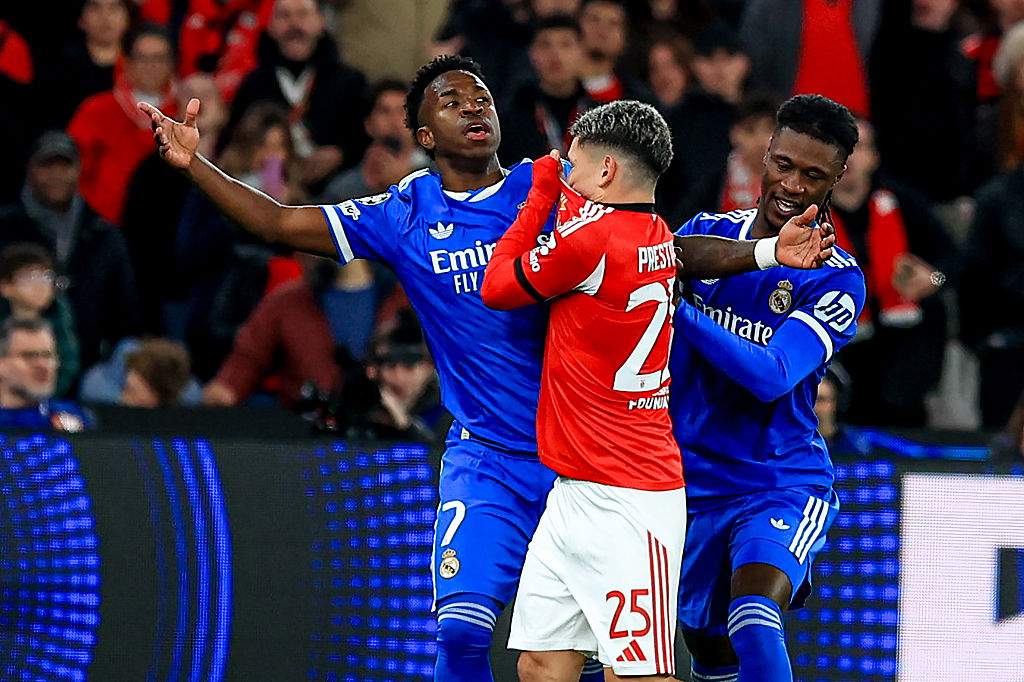
Nobody likes secrets. But in the modern sports era, where every broadcast angle can become a viral clip and amateur lip readers can turn a sideline exchange into a full investigation, athletes have gotten used to covering their mouths when they speak to each other.
Mostly, it is harmless. After a match, two players may hide a quick conversation during a handshake or jersey swap. Maybe they are saying “good game.” Maybe they are making dinner plans or just sharing their thoughts on “what the heck is happening this season of Euphoria.”
But in soccer, that same gesture has gotten a bit blurry.
Ahead of the 2026 World Cup, FIFA is backing a new disciplinary measure that would allow referees to issue a red card to players who cover their mouths during confrontational exchanges with opponents. The rule is not aimed at every private conversation on the field. It is meant for moments when players appear to be hiding what they are saying during a dispute, especially if that language could be discriminatory, abusive or otherwise punishable.
The rule has been informally connected to Brazil’s Vinícius Júnior, the Real Madrid star who has become one of the most visible voices in soccer’s fight against racism. Reports have referred to it as the “Vinícius rule,” a reference to recent incidents where alleged abuse was difficult to fully prove because a player covered his mouth while speaking.
For FIFA and the International Football Association Board (IFAB), soccer’s lawmaking body, has decided that if a player is confronting an opponent and feels the need to hide his words from cameras, officials and viewers, that act may now become part of the offense.
The rule arrives with a larger history behind it. European soccer has long struggled with racism and bigotry, particularly toward Black players. Vinícius has repeatedly spoken out after being targeted by racist abuse in Spain. Kylian Mbappé has also called for stronger action, saying influential players have a responsibility to speak out against racism in the sport.
These incidents are not new. Soccer’s biggest stage has always carried the tension of what gets said in the heat of competition. In the 2006 World Cup final, Zinedine Zidane’s headbutt of Marco Materazzi remains one of the most infamous examples. Zidane later said Materazzi insulted his mother and sister. FIFA said the comments were not racist in nature, but the moment still became part of a larger conversation about provocation, identity and the invisible language exchanged between players.
The difficult part of this new rule is that while the gesture is easy to see, the intent behind it may be harder to judge. But in a sport where racist and homophobic abuse can be denied, disputed or lost in translation, FIFA appears to be trying to remove one more layer of uncertainty.
The rule will not eliminate bigotry from soccer. It will not erase the biases players bring onto the field, or the abuse some fans still direct from the stands. It does, however, place more responsibility on the referees, who will have to decide in real time whether a gesture is innocent or meant to conceal something inappropriate.
Still the rules send a clear message. Players are allowed to argue. They can try to get under each other’s skin. But if they cover their mouths while doing it, they may get sent off to hit the showers early.
Whether the rule actually creates a more respectful World Cup remains to be seen. But one thing is clear—the game’s ugliest words can no longer hide so easily.