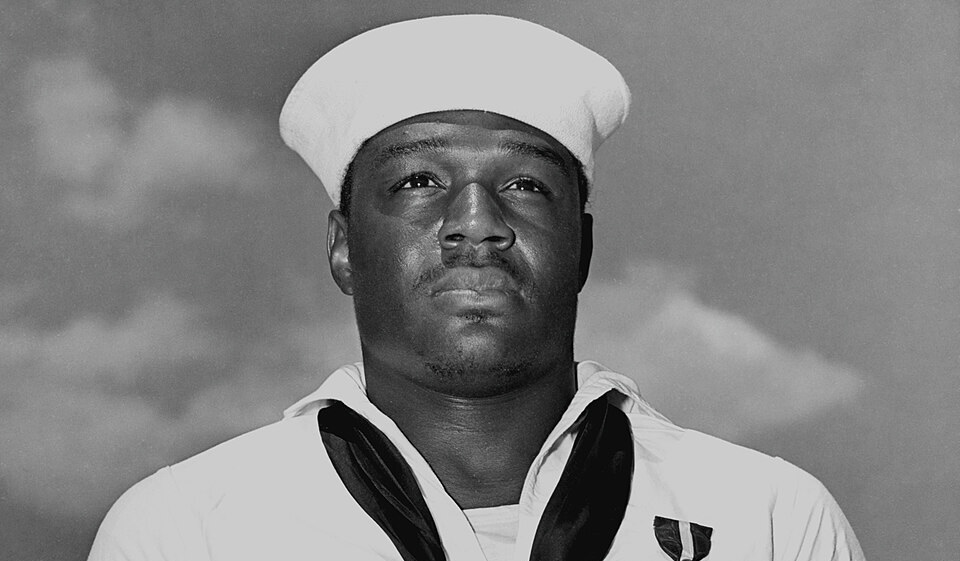
The future USS Doris Miller is keeping its name.
The aircraft carrier honors Doris “Dorie” Miller, one of World War II’s most celebrated Black heroes. When Japanese forces attacked Pearl Harbor on December 7, 1941, Miller helped rescue wounded sailors and took up an anti-aircraft machine gun to shoot down the attackers.
In August, CNN reported that officials had discussed renaming the carrier after President Donald Trump. On November 20, a spokesperson for Acting Navy Secretary Hung Cao told USNI News and CNN, “There is no intention to change the name of the USS Doris Miller.”
The Navy first announced the carrier’s name at a Martin Luther King Jr. Day ceremony at Pearl Harbor on January 20, 2020, during Trump’s first term. The future carrier, designated CVN-81, will be the first U.S. aircraft carrier named for a Black American and the first named for a sailor for actions taken while serving in the enlisted ranks.
What Miller Did at Pearl Harbor
Miller enlisted in 1939 as a mess attendant third class at a time when the segregated Navy restricted Black sailors to roles like his. He was serving aboard the USS West Virginia when Japanese torpedoes struck the battleship. Miller helped move the ship’s wounded captain, then manned an anti-aircraft machine gun and fired at attacking aircraft, even though he had never been formally trained on the firearm. He also helped other wounded sailors during the attack.
On May 27, 1942, Adm. Chester W. Nimitz presented Miller with the Navy Cross. He was the first Black American to receive the award.
Miller later served aboard the USS Indianapolis and, later, the escort carrier USS Liscome Bay. On November 24, 1943, a Japanese submarine torpedoed and sank the Liscome Bay near Makin in the Gilbert Islands. Miller, 24, was among the 646 officers and sailors lost. The Navy initially listed him as missing in action and formally presumed him dead on November 25, 1944.
Efforts to award Miller the Medal of Honor date back to World War II, when Sen. James Mead and Rep. John Dingell Sr. introduced legislation on his behalf. In 2016, Rep. Eddie Bernice Johnson of Texas introduced a bill to authorize the president to award Miller the medal posthumously. In recent years, Rep. Kweisi Mfume of Maryland has continued the push.
What’s Next
Newport News Shipbuilding has scheduled the carrier’s ceremonial construction start — known as a keel laying — for December 5 in Newport News, Virginia. Miller’s family told NBC 5 Dallas–Fort Worth that they had been invited to the ceremony and were encouraged by reports that the ship would keep his name. The shipbuilder plans to livestream the ceremony.
Honoring a Hero
After his heroic feat, Miller’s image appeared on a World War II recruitment poster, now held by the Smithsonian’s National Museum of African American History and Culture. Cuba Gooding Jr. portrayed him in the 2001 film Pearl Harbor, and in 2010 the U.S. Postal Service honored Miller with a stamp in its Distinguished Sailors series.
Miller is also prominently featured in Take Me to the Water: Histories of the Black Pacific, currently on view at the Maritime Museum in San Diego, California. Curated by UC San Diego’s Dr. Caroline Collins, the exhibition explores five centuries of Black maritime history, from the lives of sailors and waterfront workers to the communities they helped build, on view aboard the historic ferryboat Berkeley, through Spring 2027.