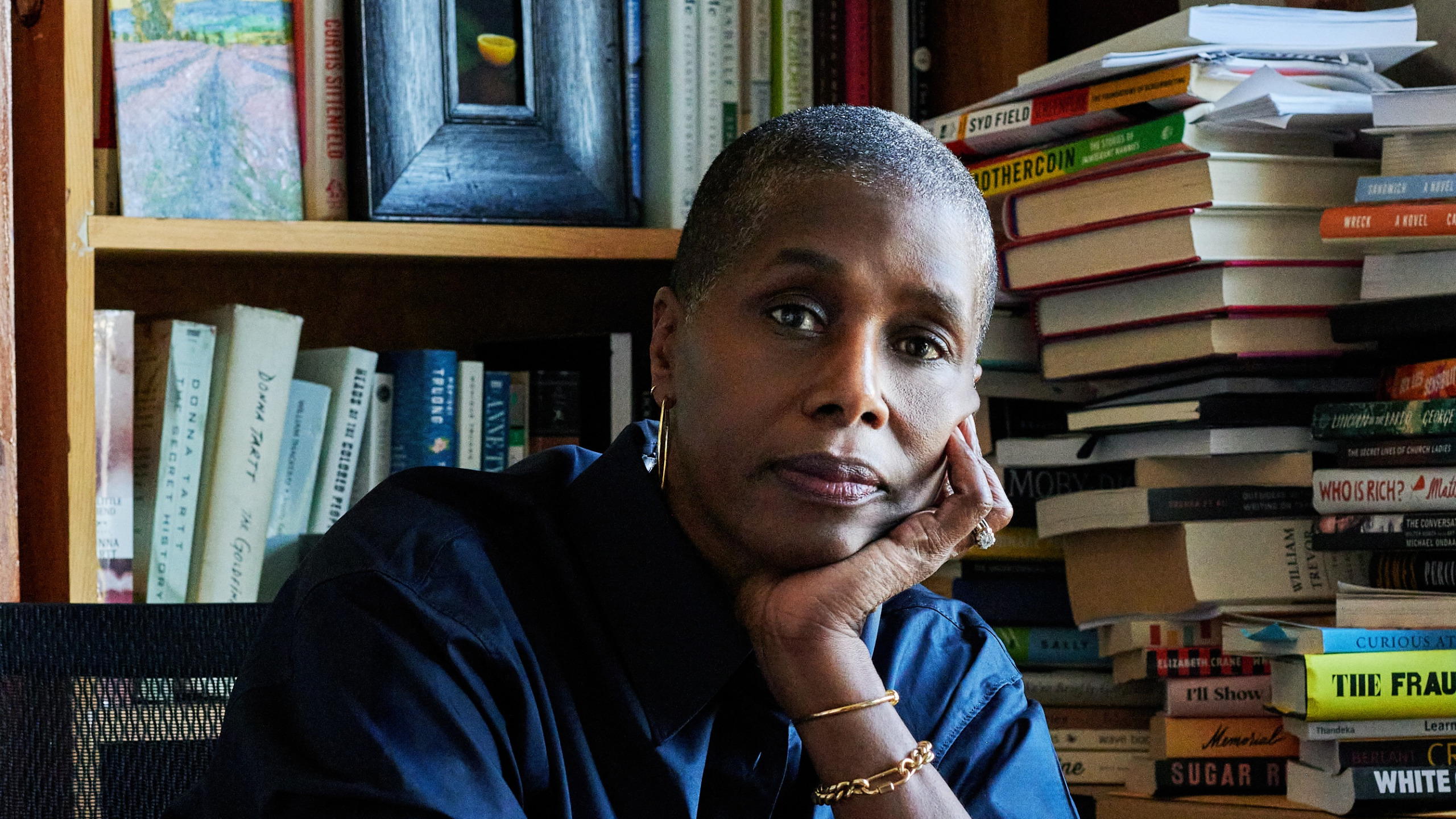
Natalie Baszile is no stranger to writing at the uncomfortable intersection of race and familial relations. In her latest novel, Friends & Family, the author explores how racial identity, privilege and the desire to protect those we love can complicate even the closest relationships. Inspired by a real-life encounter involving police and a Black teenager adopted by a white family, Baszile examines what happens when good intentions collide with the realities of racism. Through the strained friendship between Babs and Nora, she asks readers to consider what it means to show up for the people we love when understanding their experiences requires more than love alone.
EBONY: Your novel explores how a friendship can be deeply meaningful while still being shaped by fundamental differences in perspective. What interested you in exploring that tension?
Natalie Baszile: This idea came to me back in 2016. My husband and I were going away for the weekend for our anniversary, and we had given our younger daughter permission to have some friends sleep over.
When we left, we were on the flight when my daughter called to say, “Mom, something happened. The police are here at our house.” One of our neighbors had called the police on my daughter and her friends, reporting that there was a six-foot-tall, 250-pound Black man with a knife. There was no one there who fit that description. The only other Black boy at our house was 17 years old.
The dynamics that unfolded in the wake of this police encounter, with my family and his family, were fascinating. I was dealing with this as a parent, trying to make sure the kids were okay, but I was also watching this as a writer.
Nora makes efforts to support Nathan’s Black identity, but her response to the police encounter reveals a significant blind spot. How did you approach writing Nora as a white character, particularly in a moment when her instincts and privilege come into play?
Figuring out how to write Nora as a white character at this moment was really challenging. The book takes place in the perpetual present, as if it’s happening today or maybe recently. And so it meant that Babs, as a character, had to be conscious, of all the things. Nora couldn’t be a naive white woman.
I was talking to a friend of mine, a white woman, and we were comparing our experiences when we’ve been pulled over by police. She often will talk to the officer, try to talk her way out of the ticket, and she knows what she is doing. When my friend said this to me, I was shocked and kind of appalled. It was like, “I don’t have that luxury.”
And that’s what I was thinking about in that moment with Nora in the police station. She’s knowingly using her tools as a white woman to get what she wants, to get what she needs in that moment. It wasn’t to show that Nora was naive. It was to show a moment when Nora is relying on instinct, even if it’s subconscious.
Nora and Stuart love Nathan, but their responses to the police encounter raise questions about whether they fully understand the world he has to navigate. What did you want readers to consider about the difference between loving a child and understanding that child’s lived experience?
When I think about Nora and Stuart, I almost think the question I had early on in the novel for them was: This is a couple who almost thinks that they can lift their kid out of race, out of Blackness, into class and wealth with their money. That their financial resources will be enough to shield this kid from all of the dangers that he will encounter.
Do they love him? Yes. Does Nora love Nathan more than Stuart? Maybe. Does Stuart feel responsible for Nathan as a parent? Yes. But is he invested in Nathan in the same way that Nora is? No, he’s not.
When I was thinking about Stuart, I was thinking about a lot of the white guys up here in San Francisco who kind of are a little checked out on their families. They’ve invested in their careers. A lot of them are in tech. They’re like, “You do the family thing. You do the raise the kids, have the pets. That’s your job. My job is to be me.”
And that’s Babs’s whole thing. At some point, money doesn’t mean a goddamn thing. You have to be in it with this kid.
If the characters had come together to discuss their experiences and determine how best to support Nathan, what do you imagine that conversation might have looked like? What makes genuine community difficult to achieve?
I think it can be difficult to really have community. Nora sees the community that Babs has, and she envies that. When I think about community, I think it would be so nice to live in a place where there were multiple generations of people, where you had a grandmother or older people, and it was more of a mix.
I think about New Orleans. I spent a lot of time in New Orleans, especially for Queen Sugar. One of the things I love about New Orleans is, you go down there and you feel embraced, you feel welcome. You feel a sense of, “We’re all in this together.” There are more people who are just going to come to your aid, help you out.
I think that San Francisco (the novel’s setting) wants to think of itself that way, and in big cultural moments, people will come out for protests. But on an interpersonal level, I don’t know that people have that same sense of being in it together. The concept of community is dependent on a lot of variables, region being one of them.
What do you hope readers take away about the people we choose to call family?
To allow yourself to be open to sit in discomfort. When you have a connection with somebody, but they have wounded you, it is very easy to just drop the steel door and say, “Never mind. I’m good.”
I have had to learn how to sit with the discomfort of rage or disappointment, to try to move through that, and really ask myself, “I know that they said that thing. I remember they did that thing. But is that really all there is to this person? Or was this a moment? Where were they coming from?”
Most of the time, if I can figure that out, we can move through the discomfort and maintain the connection, and often the connection is stronger. And I think, especially if you’re not bound by blood, to resist the temptation to just snip the tie.
That’s what I hope.