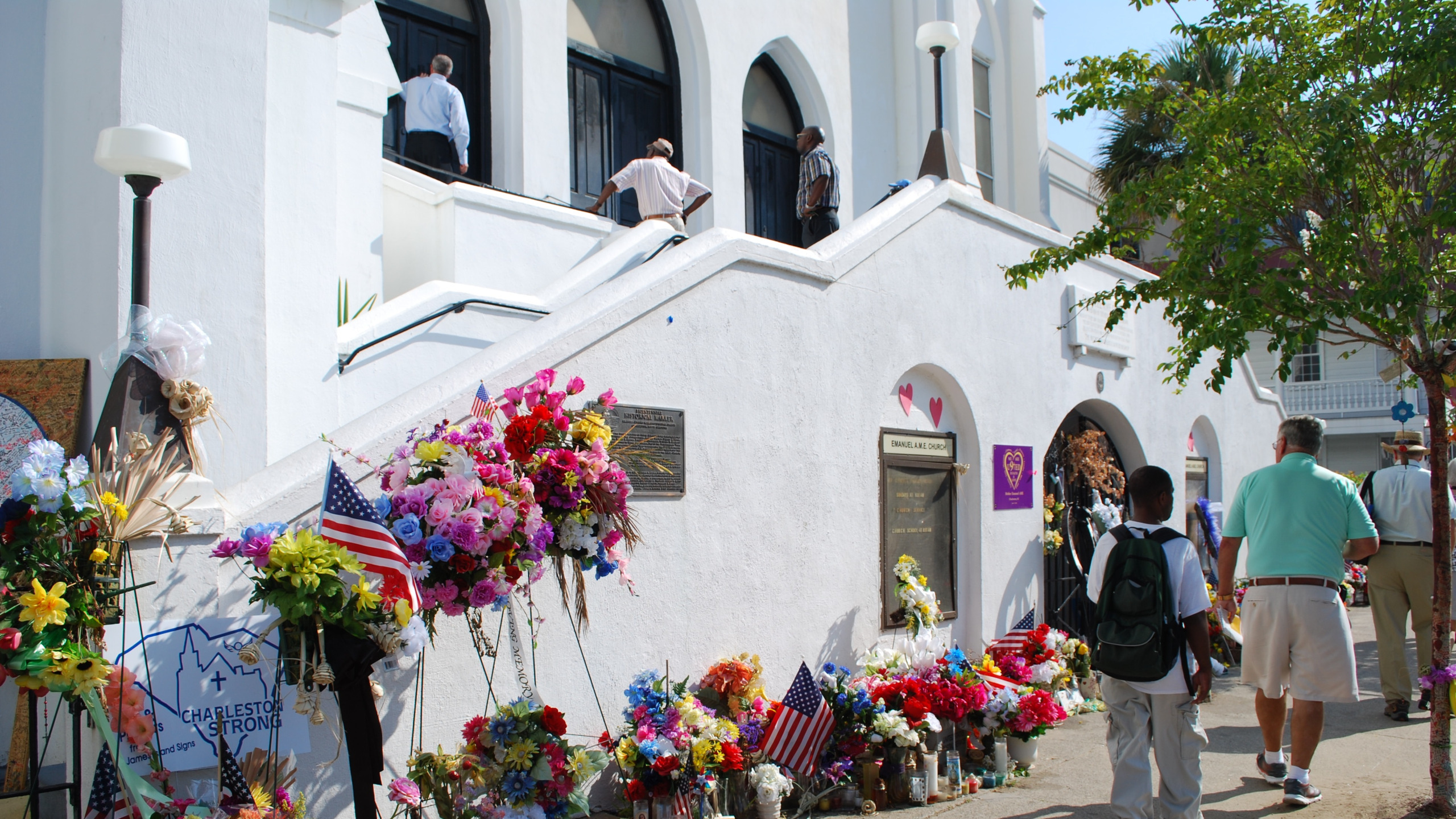
The day of June 17, 2015 changed the lives of many. For many Black Americans and beyond, the massacre that took place at Mother Emanuel AME Church inflicted a deep sense of communal grief and weariness lingering within Black Americans. The community of Charleston, SC were forced to grieve nine lives while simultaneously supporting five survivors with healing from the inflicted trauma. Over 10 years later, the Charleston and Mother Emanuel AME Church is still picking up the pieces. Through the new Emanuel Nine Memorial and forthcoming survivor’s garden, the community is honoring the lives lost and impacted with its new memorial that will open November 14. EBONY spoke with Deona Smith, the Executive Director of the Mother Emanuel Memorial Foundation to talk about the new memorial, how the community has approached rebuilding, and what the greater Charleston community hopes to accomplish with the memorial.
EBONY: More than a decade after the murders of the Emanuel Nine, what does it mean for this memorial to finally be taking shape, and what do you hope people understand about the significance of this moment when they walk through it?
Deona Smith: First, we want people to remember those nine remarkable lives that were taken from us and think of the survivors who are still dealing with the trauma of that moment. But then also to do some soul searching and sit and reflect on how they are showing up in the world.
We’re really excited to welcome people, especially here in our community, the families and the survivors, but also people from all over the world to come in and experience the memorial. It’s such a powerful space, and I think it’s going to be incredible for folks to come in and be able to sit and reflect and remember.
The memorial is stunning. It is a space worthy of the Emanuel Nine. When I was first brought on to the project, I thought, ‘My goodness, this is such a big project and a fairly big price tag’. And I had to catch myself because why not? Why not us? Why shouldn’t we have something beautiful and magnificent to represent these people who were tragically taken from us?
EBONY: The memorial is intended not only to honor the nine people who were killed, but also to create a space for reflection, education, resilience and community engagement. How did the Foundation think about balancing remembrance of such profound loss with a message of hope and healing?
The Foundation, in all things that we are doing and have done, takes our cue from the families and the survivors. They expressed such dignity in their grief and in the way they handled the situation, which is just unimaginable to most of us. I think that helped guide us as to how we wanted to construct the memorial and what we want people to take away from it when they experience it firsthand.
One of the things that’s so important is recognizing what community looks like and the strength of community, and how it has helped us become more resilient in the midst of our grief. The fellowship benches are a good example of that. They were designed to lean on each other. They fit together in pieces, almost like a jigsaw puzzle, and they lean on each other for support. That’s so symbolic to me of how the families and the community all had to lean on each other for support after what happened on June 17, 2015.
At the center of those benches is the Fountain of Grace, a water fountain with the nine names inscribed. It has a cross in the middle, and water flows from the center of the cross over the sides and the names of the Emanuel Nine.

EBONY: How important was it to the Foundation that this story be told through the community’s own voice and perspective?
I think we first have to start with serious truth-telling. This was something that happened in a Black church, to nine Black people who were murdered, and five other Black people who were there to witness it. So you have to start there. We have to be able to tell the story and share it in a very honest way.
At the same time, I want folks to come and experience what community looks like. Had it not been for the resilience of the families and the survivors, had it not been for the community and the support of not just the Charleston community but people all over the world, we wouldn’t be where we are today. It really is a testament to what can be done and how we can overcome a lot of the ills that we have in this world through community. Resiliency is in the DNA of Black people. We have always, even when we shouldn’t have to be, been resilient people.
EBONY: How has the community’s relationship with grief changed over these past eleven years, and what have you learned about what healing actually looks like when a community has experienced a loss of this magnitude?
Grief is such a personal thing. We all grieve in different ways, and it’s difficult because I think that the families are still grieving and, to some degree, the community as a whole is still grieving. But then there are always moments of hope where you see that we’re working through this process.
One thing that I’ve noticed is the families, in particular, being a lot more willing to share their stories and to speak about what happened to their loved ones, how it impacted them and the message that they hope this carries forward. It’s powerful for us to remember.
I think that’s a huge part of working through the grieving process. We don’t want to forget. We can’t forget. But we will all go through healing in a very different way. Everyone is in a different stage of the grieving process, so it’s hard to speak for a community at large.
But I think the community is ready to show our resiliency and how we’ve started to overcome what happened 11 years ago, at least some of us. And I think that’s what healing can look like: not forgetting what happened, but finding ways to continue forward together.
EBONY: When the memorial opens, what do you hope a young Black person—or someone who knows very little about the Emanuel Nine—walks away understanding about the nine lives that were lost, the community that survived them, and the responsibility we all have to remember their legacy?
First, I want them to understand that these were nine remarkable people and that they were more than the headline of how they died. They were educators, professionals, librarians and people who lived incredible lives of service. We want to recognize their humanity.
I also want young people to understand the weight of hatred and what happens when we are not afraid to use our voices to oppose hatred. But I also want them to recognize what community looks like and the strength of community, and how it has helped us become more resilient in the midst of our grief. I want them to see the importance of sharing our stories, recognizing the humanity of the people who are taken, understanding the damage that hate can do, and then also reflecting and inspecting their own thoughts.
And when you leave our memorial, it’s time to act. Us building the memorial doesn’t end the story. When we open the gates, that’s just the beginning of the work. Because now we need to show people what hate caused, the result of it, but then also show them the beauty of what came from it. And that really was the demonstration of community. I want people to understand the legacy of these nine lives and the responsibility we all have to remember.