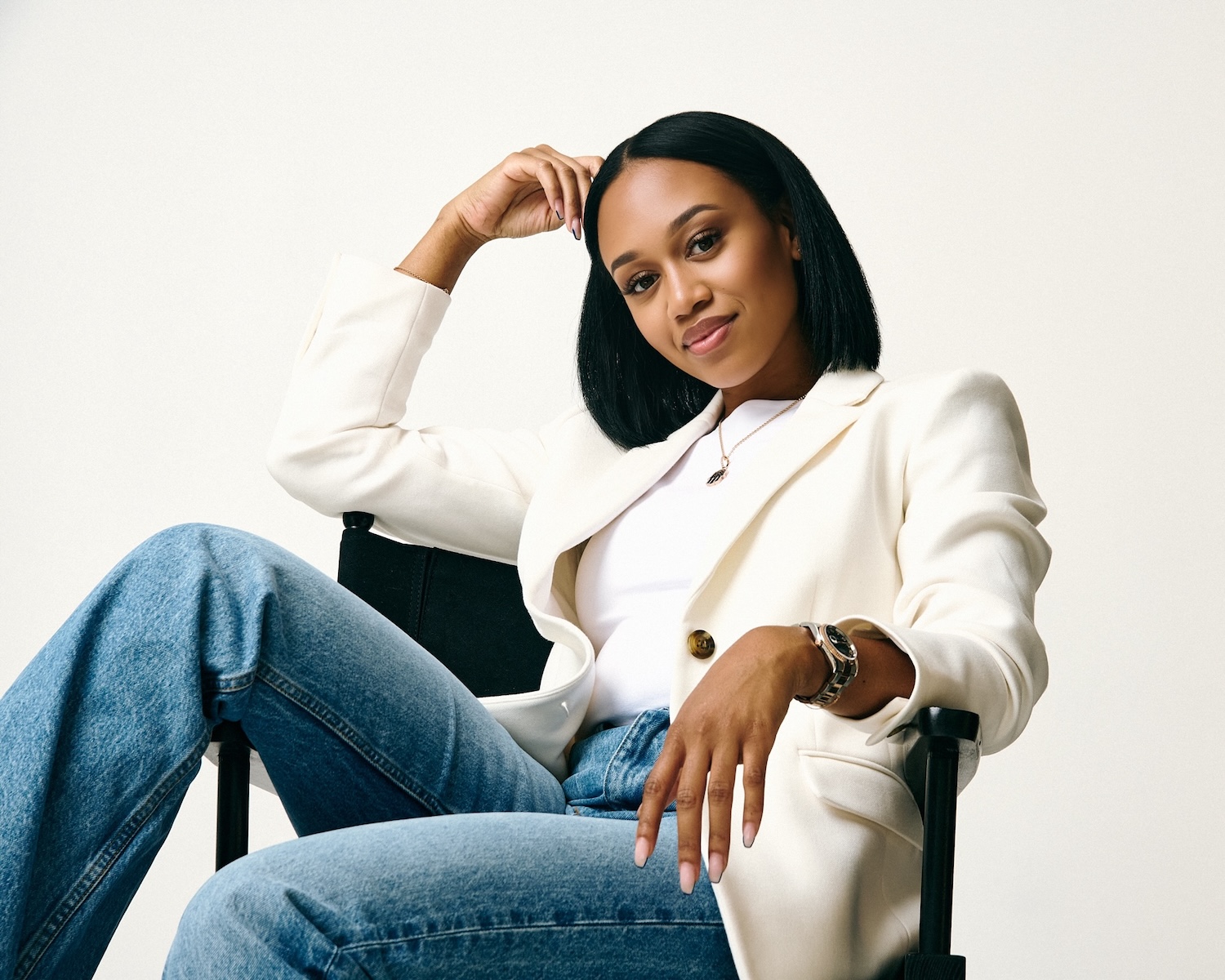
For years, Besties has explored the blurred lines between friendship and attraction, growing from an independently produced series into a vision with room to expand. For filmmaker Christina Richardson, the project is both a testament to the power of Black storytelling and a reminder that creative ownership begins with the courage to bet on yourself.
That philosophy extends beyond the screen: through her ebook, The 1st AD You Never Had: Filmmaking Guide Ebook, Richardson is sharing the production knowledge she’s gained to help aspiring filmmakers bring their own visions to life.
Now, as Besties enters its next chapter with Fox Creator Studios, she reflects on the persistence required to bring a vision to life before the industry catches up—and why the future of Black creativity depends on those willing to bet on themselves.
EBONY: Your first acting role was at 12, in a McDonald’s commercial. Did you walk away with any amazing perks—or maybe even a lifetime supply of fries?
I wish I did! But I did get something more important, and that was the vision for my life… wanting to be a director. Being on that commercial set literally changed the entire trajectory of my life. The director brought me over, and he let me sit in the director’s chair. And then I watched them as they brought in this huge light—to light the house from the outside.
And I was like, “Oh, my God. They just made it daytime, and it’s pitch black outside.” After that one thing—I knew I wanted to be a director. There was no denying it. And ever since that day, I never wanted to act again.
You attended Benedict College, an HBCU in South Carolina. With A Different World rebooting, what does it mean to see HBCU culture back in the spotlight, and do you think audiences understand what makes that experience so special?
I am an HBCU grad, and I’m also a Delta. Shout out to my sorors! I am so happy to see HBCU culture represented on Netflix and on TV… The accuracy and attention to detail make you feel so nostalgic watching, ’cause I’m like, even the scene about refund checks and breaking out into a song. I was part of the choir. We used to sing everywhere.
On HBCU campuses, there’s just this energy and community. Everybody feels like a cousin, and you just feel seen. You can let your guard down. And I just love that we get to see that excellence and that level of being a student, scholar, and figuring out life.
Your series Besties incorporates short-form vertical episodes for social platforms. What made you feel now was the right time to revisit the format, and what can vertical storytelling offer that traditional formats can’t?
When I created Besties, it was right when IGTV came out. It was six months before Quibi, and I had just done all these short-form projects. I knew that we were headed toward a culture where people were gonna wanna watch narrative, more substantial content on their phones.
But I always thought of it as a pipeline. I never thought this was the final place. It was just like, “I’m going to use this platform. I’m going to create this amazing story, put out these amazing characters that people are gonna fall in love with, and they’re gonna want more.” We start here, and then we take it wherever the audience wants it to go, which is why I shoot it both ways. We have it in a vertical format, and then we also have a longer-form version meant for traditional viewing, whether on YouTube, Tubi, or any other platform.
When I think about shows like this, I immediately think of Martin, Moesha and Living Single, with Insecure as a more recent example. We haven’t seen as many shows exploring friendship, attraction and those complicated “are we just friends?” relationships in this way. When creating the characters and storylines, did you draw inspiration from any of those shows?
Yes, I did. One of my inspirations for my very first Besties episode was definitely Spike Lee. But my biggest inspiration, I would say, is Two Can Play That Game. That is my movie. I love ’90s rom-coms. I love organic storytelling because, especially in that film, you have Vivica A. Fox, who was an executive. And I love that because we are so multifaceted as a people, and sometimes on TV, you tend to see a lot of the same stereotypes.
Everybody in Besties is a nepo baby. These are things we haven’t really gotten to explore yet. They all come from elite parents. They’re all legacy. They went to college. They’re figuring out life and going through struggles, but not the typical Black struggle.
After two independently produced seasons, Besties is now moving forward with Fox Creator Studios for Seasons 3 and 4. What does having studio support make possible that you couldn’t achieve independently, from production and storytelling to distribution and reaching a wider audience?
I think, just as a creator in general, you have to know what your own personal non-negotiables are. You have to be willing to say no, and you also have to know what you’ll compromise on. And for me, my one non-negotiable is that I have to have creative control. And also, building leverage for yourself and understanding the business side, because I was able to understand the cost of things just from my production experience. I understood how much funding to ask for.
Sometimes we get so excited and say, “Well, just give me a little bit, and I can make it work.” But no, I want to deliver. This is how much it costs to deliver what you’re asking for. If it’s less, then this is what you’re going to get. ‘Cause I could struggle all by myself. If you’re gonna come in and partner with me, and we’re gonna make this thing happen, this is what I need. And if you trust me to make it happen, then trust me all the way.
Issa Rae famously built The Misadventures of Awkward Black Girl independently before making the leap to television. Your first two seasons of Besties were also independently produced. What did it take to bring those seasons to life, and what did you learn from building the series without traditional studio support?
So the biggest thing is, when I shot Besties, I had one DSLR camera. That is it. I did not have a crew. I didn’t have any lights. I didn’t have anything. It took me about six months to find my actors because I was doing auditions. And I knew that even though I didn’t have money, resources, locations or anything, if I had great dialogue and great actors, it didn’t matter where they were or what was happening. It would be a good story.
At that time, I had come off of writing stories for major artists. I wrote Meek Mill’s Wins & Losses short film for his album. And then I wrote the short film for Meek Mill and Tory Lanez’s Litty. I also wrote another short film for Future and Young Thug. These are all films from this renaissance of storytelling in music videos that was happening. Writing these short films to accompany artists’ music taught me the power of impactful short-form storytelling, which ultimately led me to create my series.
How did your experience creating music-driven visuals shape your approach to storytelling in Besties?
I got brought into the music video world because of my narrative experience. So I worked with director Spike Jordan, and he’s an amazing director. He wanted to bring storytelling into the music video world. He wanted music videos with substance, so he brought me on to create stories that would resonate, work well as short-form content and fit into five minutes.
You get a full, cohesive story—sometimes, you can watch a music video that has a story, and you’re kind of like, “What? What’s going on?” But with me, you get a beginning, middle and end. Then you get great music. That really helped me hone in on creating a full story in a short amount of time.
You created Besties in 2018 as an “Ultra Mini Series,” and eight years later, it’s moving forward with Fox Creator Studios. What kept you committed to the idea, and what has the journey taught you about seeing a vision through?
Honestly, I was just always so sure about it back then when I made it. I was basically waiting for the world to catch up because I just knew. As a storyteller, I understand people and trends, and I knew this was eventually going to go somewhere.
And also, God, because the pandemic happened, Quibi came and failed. After that, people weren’t willing to give Besties a second look because they were like, “Oh, this doesn’t work.” I just had to wait my turn and refine my skills. I’m also a DGA-qualified first assistant director, so I gained a lot of production experience during that time, which allowed me to come back now.
Through the Bronx Film Initiative and C.Rich Media, you’re opening doors for the next generation while building ownership. Why is it important to you to create opportunities for others while building something of your own?
Giving back has just always been a part of my DNA. I said, “You know what? I’m gonna start an organization where I can make films with kids and show them how easy it is to make films. And I can also, most importantly, show them what job opportunities are available in film and video that these kids have no idea about, where you can make just as much as a doctor or an engineer.” So I created the Let’s Make a Movie program, which I sold to schools. We received funding from the Department of Education in New York to make short films with kids, creating jobs for myself and other filmmakers.
It was important for me to lift as I climb because I never had an opportunity like that when I was younger. I was 12 when that McDonald’s experience changed my life, and I’m like, imagine how many kids we can expose to one film set and change their lives. That’s literally what has been happening. I get to teach them the power of storytelling and the value of their intellectual property. The most transformative part is watching them come up with an idea and seeing all these professionals show up to bring their vision to life.
This year’s Emmys sparked conversations about representation after no person of color won in the major acting or series categories. What role do Black creators and entertainment play in shaping culture today, and what responsibility comes with telling those stories?
When I see headlines about no Black people winning, it doesn’t do anything for me because we are literally the culture. I don’t think enough people understand that it really is us, and it all comes from us, even when you think about music. That’s why I take education, film education and experience so seriously. Once you know how to do it, you don’t need the institution. I kind of proved that with Besties. I had one DSLR camera, no money, no microphones. I had nothing. And to be in this position now shows that it’s not about the money or who you know. With social media, it’s about creating good work.
I didn’t even go to film school. I studied mass communications, journalism and broadcasting. I’m a self-taught editor, and I edited the music and everything for the first Besties myself, all while being a single mom. If you want it bad enough and have a story to tell, you’ll make it happen. Money is not the determining factor. I think it’s up to us to keep collaborating, educating ourselves, learning and growing without getting discouraged. Once people get money out of their minds as the biggest barrier, I think we’d have a lot more of our creativity on display.