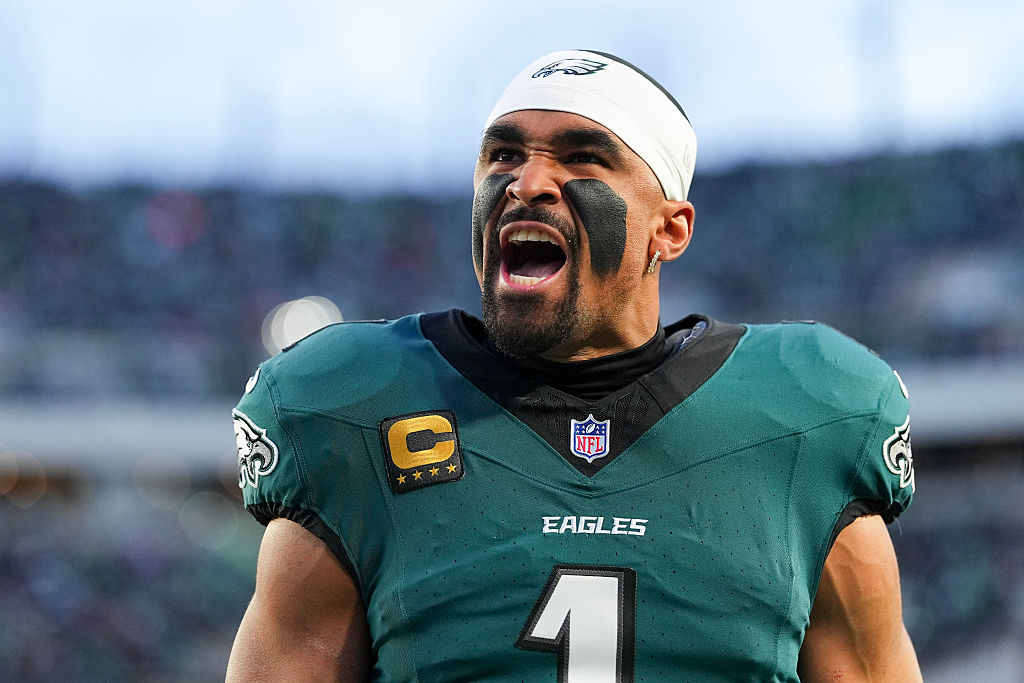
Black men’s bodies are the everyday casualty of capitalism and racism. We know it when our grandfathers continue to work after they’ve developed gout and when our dads ignore that nagging pain in their bodies in return for more hours and more pay. Jalen Hurts’ medical crisis revealed that many assume these hostile conditions only exist for working or lower class Black men. But the revelation with Hurts’ condition revealed that there’s no classing out of exploitation when you’re a Black man.
Earlier this month, medical specialists identified a blood clot in the Philadelphia Eagles quarterback Jalen Hurts’ calf, but the organization’s doctors cleared him to play and fly home. Subsequent testing revealed deep vein thrombosis and blood clots in both lungs, sidelining him for the remainder of the season. Some critics, including the NFL Players Association, argue that the medical team put team interest over player health. Others, including NFL Commissioner Roger Goodell, defended the medical staff’s decisions.
Jalen Hurts proves that wealth, accolades, and star power are not shields from Black men’s reality.
When confronted with the choice between possible profits and a man’s life, the institution exposed one of America’s foundational truths: working the Black man to death is both the foundation and inheritance of the United States.
The callousness toward players’ health has been normalized across sports.
Earlier in the 2026 season, Kendal Daniels of the Atlanta Falcons suffered a neck/head injury so severe, he was cut out of his jersey. After being removed from the stadium, the game went on. Daniels was cleared for, and returned to practice less than a week later.
This culture creates mindsets where many believe pushing through physical pain represents strength. For others, the underlying belief is clear: for Black men, their physical needs come second to the bottom line. Countless historical examples corroborate the latter.
Throughout history, racism has repeatedly placed profits over Black men’s lives. Working grueling hours, often under the hot sun of chattel slavery, Black men often endured severed limbs, genital castration, and flesh wounds from severe beatings. And still, they worked.
The normalization of Black pain became central to financial gains and advancement in this country. This persisted after the Civil War and the Emancipation Proclamation. Every decade has its stories: sharecropping, coal mining, laying train tracks, constructing buildings, ammunition loaders, and grave digging. Black men have worked the most dangerous jobs and were often worked to death.
Online, cardiologists and other doctors argue that playing with blood clots could have killed Hurts. But even in death, the game must go on.
Hours after Kobe Bryant’s death, games continued. Cameras recorded players in visible duress, clearly struggling with the death of an icon. Some players and fans protested, others argued playing was the embodiment of “Mamba mentality” to keep enduring.
With this precedent, I am not shocked Jalen Hurts chose to play after learning about his blood clots. Pushing through physical and mental pain has always been a part of the game.
In 2020, Hurts played in the Senior Bowl eight days after his grandfather’s death, missing the funeral entirely. An outlet lauded his decision saying, “[he] has constantly shown an ability to overcome and adapt with a great attitude.”
The expectation that Black men play and work through all pain begins young.
I’ve seen this reflected even within my own adolescent son’s reality. At my toddler’s pee-wee flag football practice, I’ve observed the belief system taught in real time. Black boys cannot have water because they “won’t be able to get it in a real game.” Caregivers refuse to comfort boys with tears in their eyes, because “it will toughen them up.”
These moments teach boys that they are not allowed to hurt, to have needs. A 2024 study found that beginning in PreK, adults are less likely to recognize pain in Black boys than their peers.
When adults struggle to recognize Black boys’ pain, and those who do recognize it celebrate their endurance, they grow into men who prioritize performance before themselves.
Some questioned Hurts, wondering if he exaggerated his condition or was using the situation to scapegoat his performance this season. Even after playing through prior physical injuries and emotional pain, Hurts still had more to prove.
Jalen Hurts will be out for the rest of the season. Hopefully he receives the rest and care he needs. Not to return to football, but to continue to live a long and prosperous life with his wife and loved ones.
Black men deserve a society that values their lives over their potential earnings. They deserve quality medical care, breaks to address their physical and mental health, and support when they do.
The game and the job can wait. Their lives cannot.