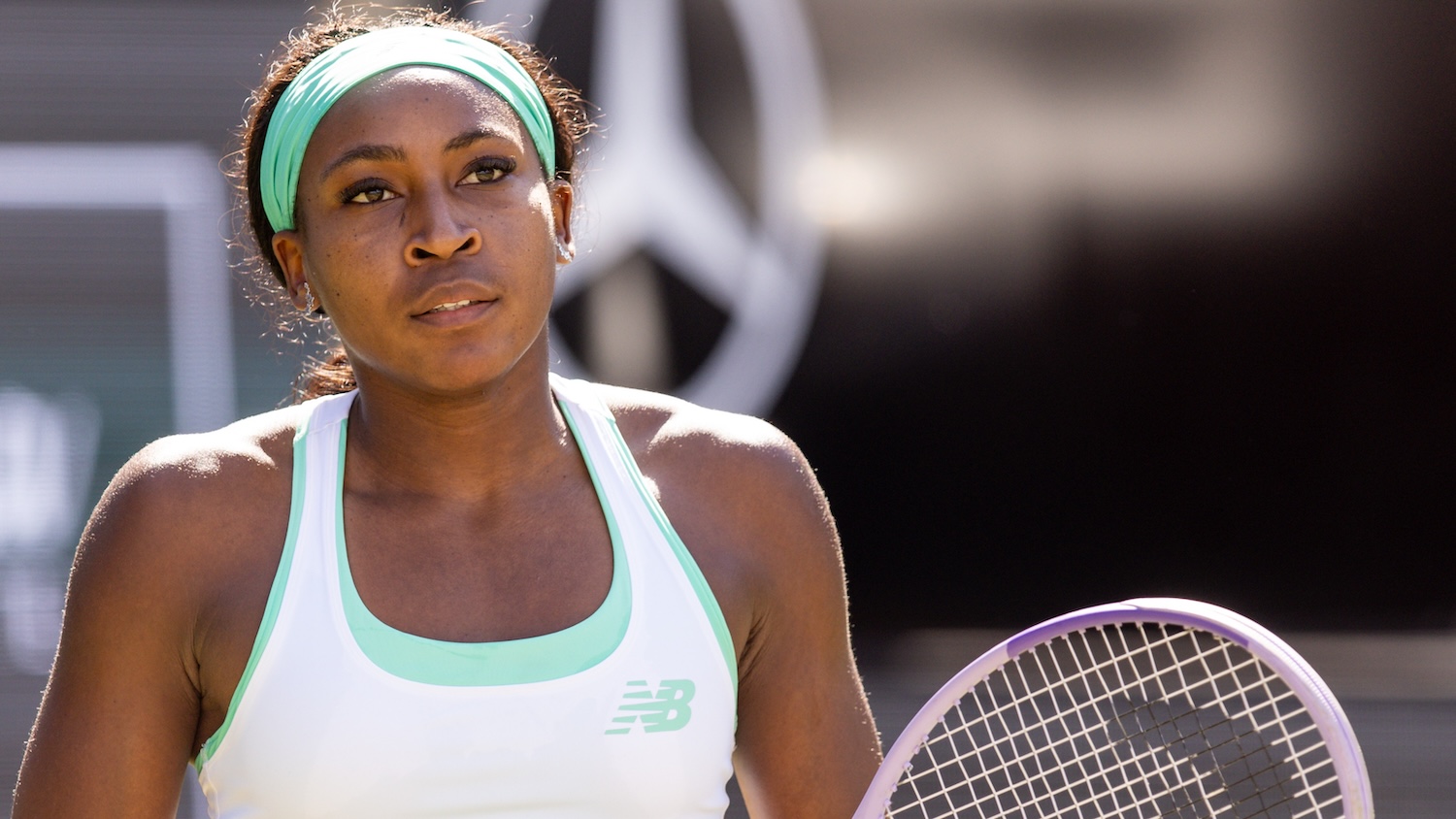
Her father, Corey, played basketball at Georgia State. Her mother, Candi, ran track at Florida State. And they both gave up their own athletic careers so Coco Gauff could chase hers, moving the family back to their hometown of Delray Beach, Florida, where a young Coco could train.
“Having my parents make that sacrifice for me means everything to me,” Gauff said. “It reminds me why I’m out there competing, and when the moments get tough, I remember how many people, not only my parents but also my family, my brothers, and my village, stood behind me and made changes in their own lives to support me and my dreams.”
Her parents probably didn’t put it this way out loud at the time, but there was more going on than tennis. They were thinking about the broader world we live in, and where, through their sacrifices, she could end up.
Like many of us familiar with the art of navigating the duality of living in this world as a Black woman, Gauff grew up moving through mostly white spaces, a reality of competitive tennis she’s navigated since she was a kid in the juniors. This happened long before anyone outside her family knew her name. The move from Atlanta to Florida alone was its own culture shock, so her parents signed her up for track and basketball too, sports where she’d be surrounded by kids who looked like her. She didn’t think much of it then. Kids don’t, usually.
“Now that I’m 22, I know they were doing this to make sure that I was in spaces where I saw people who looked like me,” she says. “They didn’t want me to lose myself in environments where I didn’t see people who looked like me very often.”
She found the rest of her footing in Delray Beach and Boynton Beach, and in the Black church she grew up in. “Growing up in a Black church allowed me to reconnect with my culture and with who I wanted to be as a Black woman and athlete navigating predominantly white spaces,” she says.
That foundation is what’s carrying her through a strange season, honestly. Gauff came into the 2026 French Open as the defending champion, which is the title she’d won the summer before in three sets over world No. 1 Aryna Sabalenka.
This year ended sooner than she wanted, and now she’s gearing up for Wimbledon, which kicks off June 29, at the tournament where her career first broke open as a teenager but where, somehow, she’s still never made it past the fourth round.
Gauff credits something off the court for getting her through a year like this: how deliberately she’s learned to take care of her body.
“I think the biggest difference is that I’ve become a lot more intentional about fueling,” she said. “When I first came on tour, I was younger and would kind of rely on feeling good and just playing. Now I understand how much nutrition affects performance and recovery, especially over the course of a long tournament. I’ve learned that you can’t wait until you’re hungry; you have to stay ahead of it.”
When she’s not mid-tournament, Gauff’s mornings start around 7:30 with prayer, then skincare, then the court, which she’s lucky enough to have at home. Breakfast is light, spotlighting the occasional eggs and toast, or fruit, before practice. But the most important element of her wellness routine? Sleep, sleep and more sleep, according to the tennis star. “I know sleep is important because of tennis, so when I’m not in a tournament, I stay up late. I still make sure I get my full 9-10 hours of sleep.”
With Wimbledon a week out, all of it tightens, though. “I definitely become more intentional [heading into a Grand Slam] because it’s such a long tournament,” she explains. “Early in the tournament, I don’t always feel hungry, but how I fuel myself in those first few days can really affect how I feel physically by the second week.”
Gauff recently became Naked Smoothies‘ first-ever Chief Smoothie Officer, a fitting title for someone who’s eaten fruit at every match for years, going back to a homemade fruit salad she’d pack for changeovers.
Protein, specifically, is used to carry a certain image in fitness culture, something for bodybuilders and gym bros chasing bulk and stacked bodies. Now, it’s all anyone can ever talk about on social media (seriously, how are people getting 150+ grams of protein per day?).
Gauff sees that narrow idea breaking down now, especially in conversations among Black women about what it actually means to take care of a body. “I think people are realizing that protein isn’t just for bodybuilders, it’s something that can help everyone feel their best,” she said. “I’ve always been someone who seeks balance. I don’t think nutrition has to feel restrictive or complicated.
She continued, “I also think more women are having conversations about what fueling our bodies really looks like, and that’s a positive thing. For me, it’s less about following trends and more about finding what helps me feel strong, energized, and ready to perform at my best.”
There’s a longer view underneath all of this, too, and it circles back to what her parents gave up in the first place. A tennis career can swallow your twenties whole while you’re living through it, and Gauff knows hers won’t last forever. “Being a professional athlete feels like such a long period while you’re in it, but in hindsight, it’s such a short span of your life. I want to make sure I’m taking advantage of the window I have, and I want to be as healthy as I can for as long as possible.”
Years later, Gauff can see what her parents were protecting. “There’s no right or wrong way to be a Black woman or a Black person in this sport,” she said.
“I constantly aim to be my authentic self. By doing this, maybe one day, if there’s a girl who may or may not even look like me but feels similar to me in terms of belonging in certain spaces, she can see that it’s okay to be herself.”