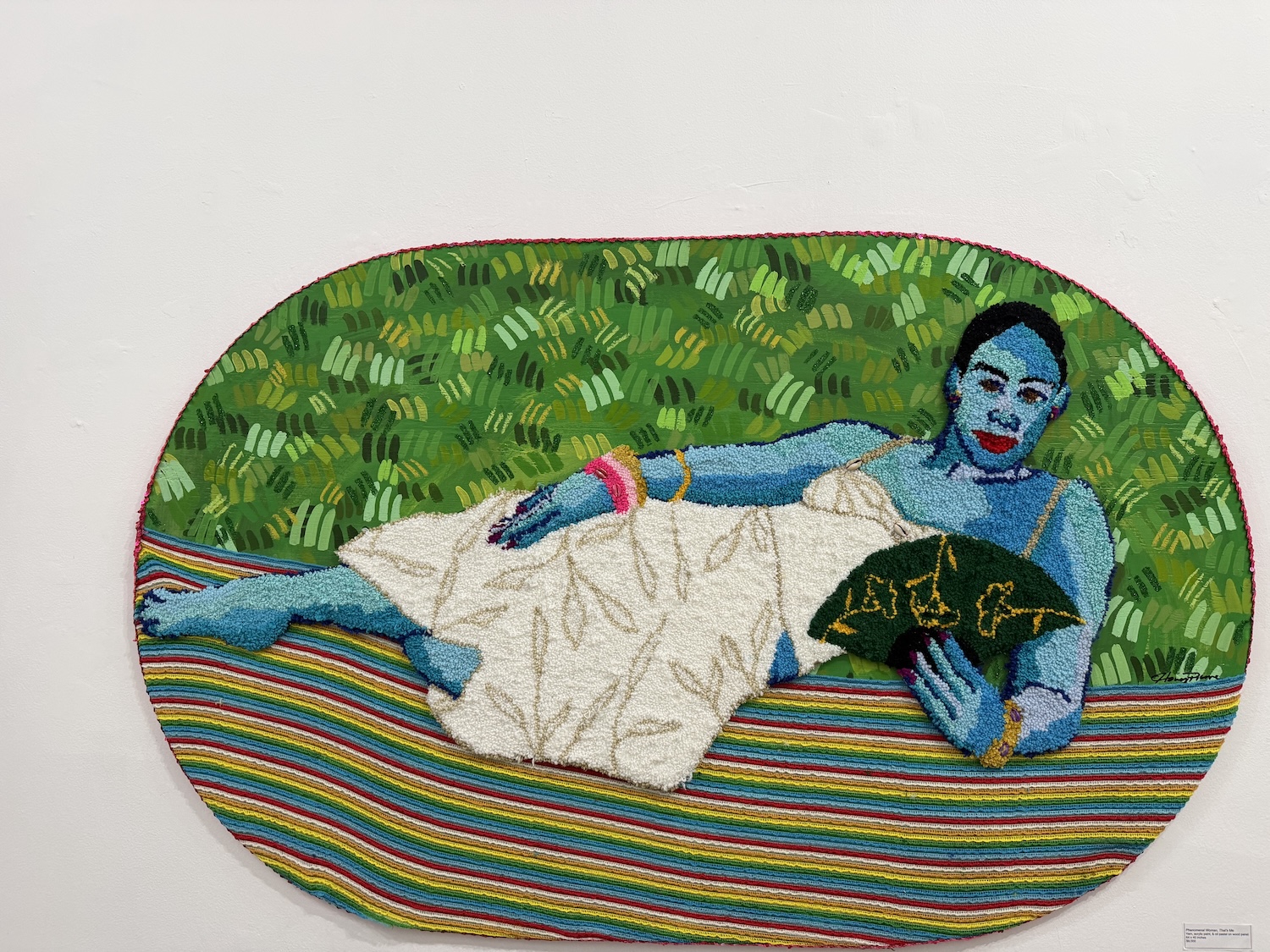
The first thing you notice about Honey Pierre’s paintings is their vibrancy. The subjects, at different stages of rest and play, are drenched in strong, saturated colors, and their skin tones are varying shades of blue. That choice was born out of necessity.
“There’s a lack of diversity in brown yarn. There are literally only five shades, and three of them are dusty. I wasn’t going to make us dusty!” Pierre, also known as Cassandra Hickey, declared.
“My mom and my family had questions about it until I took them to the stores with me and showed them what I was dealing with. They were like, ‘Yeah, just use blue.’ That’s how it came about—a lack of diversity in the color wheel at the craft store.”
The artist will reveal more about the necessities and motivations behind her work at an artist talk at HOMME Gallery in Washington, D.C., on September 20. Her exhibition, Here We Are, is on display there through September 26.
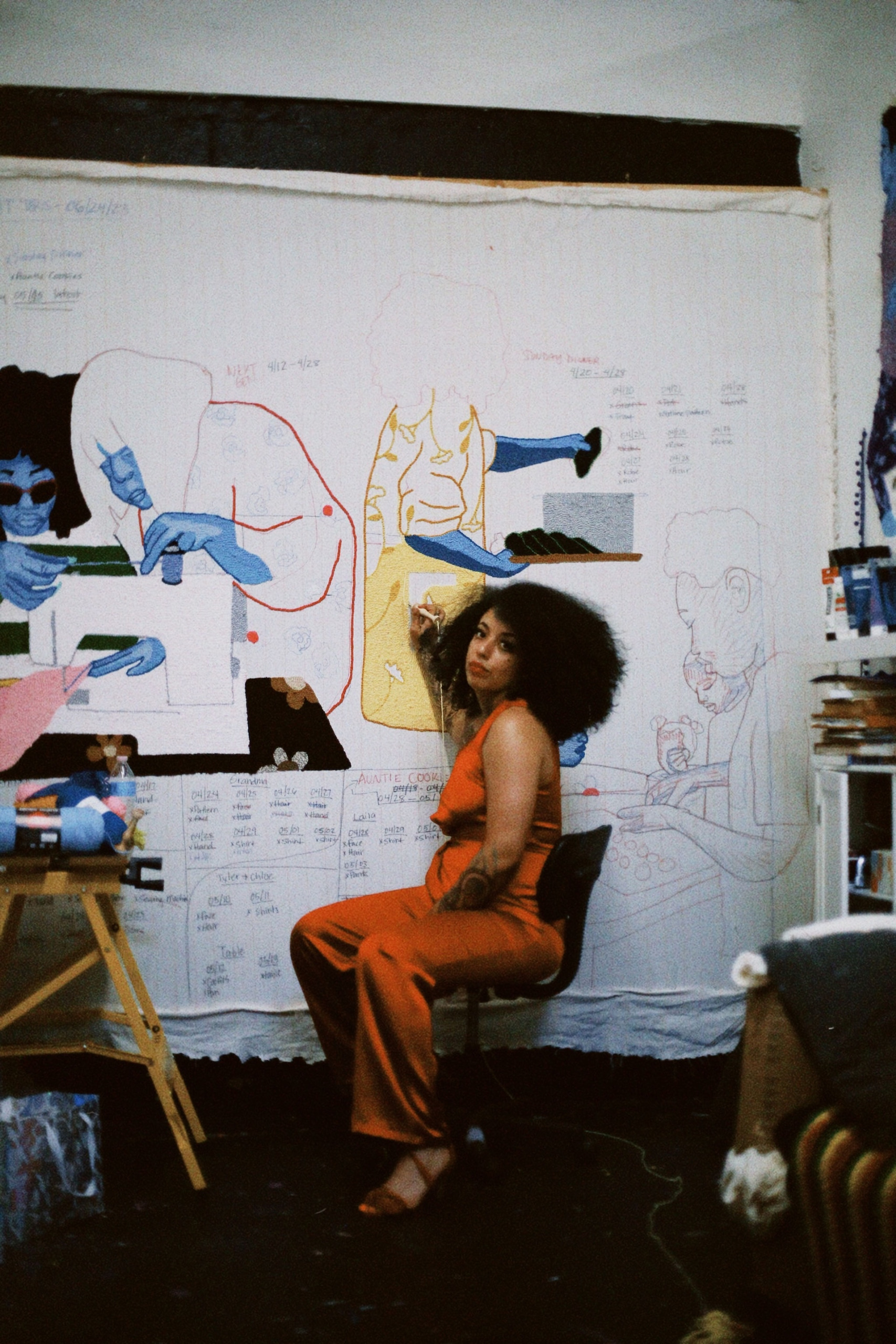
Pierre took some time out of her schedule to talk with EBONY about her work, her choice of textiles and why her artistry is also designed to help Black men prioritize their mental health.
EBONY: How has the exhibition in D.C. gone so far?
Honey Pierre: Every city has a different vibe when it comes to how they receive art, even textile art, because it’s becoming more prominent in the art industry. People have received it well, and there have been a lot of good comments about it. The work has been getting collected and acquired, so it’s a good time.
How did you come up with the idea for Here We Are?
Ever since Trump got back in office, D.C.’s energy has changed. I interviewed about 20 to 30 people about how they were feeling mentally about their communities, and one thing that kept coming up was them describing what’s keeping them mentally stable, their pocket of joy and happiness. For me, I wanted to show that even during these uncertain times, we can still keep our spirits up and relax. Even in these high-stress moments when people want us to be all frantic and lose our minds, it’s no, let’s just find some peace. A lot of my pieces are figures in the grass, because we are the first generation to really have the choice to do that: to not react and just sit still.
What other settings do you use to depict people at rest and peace?
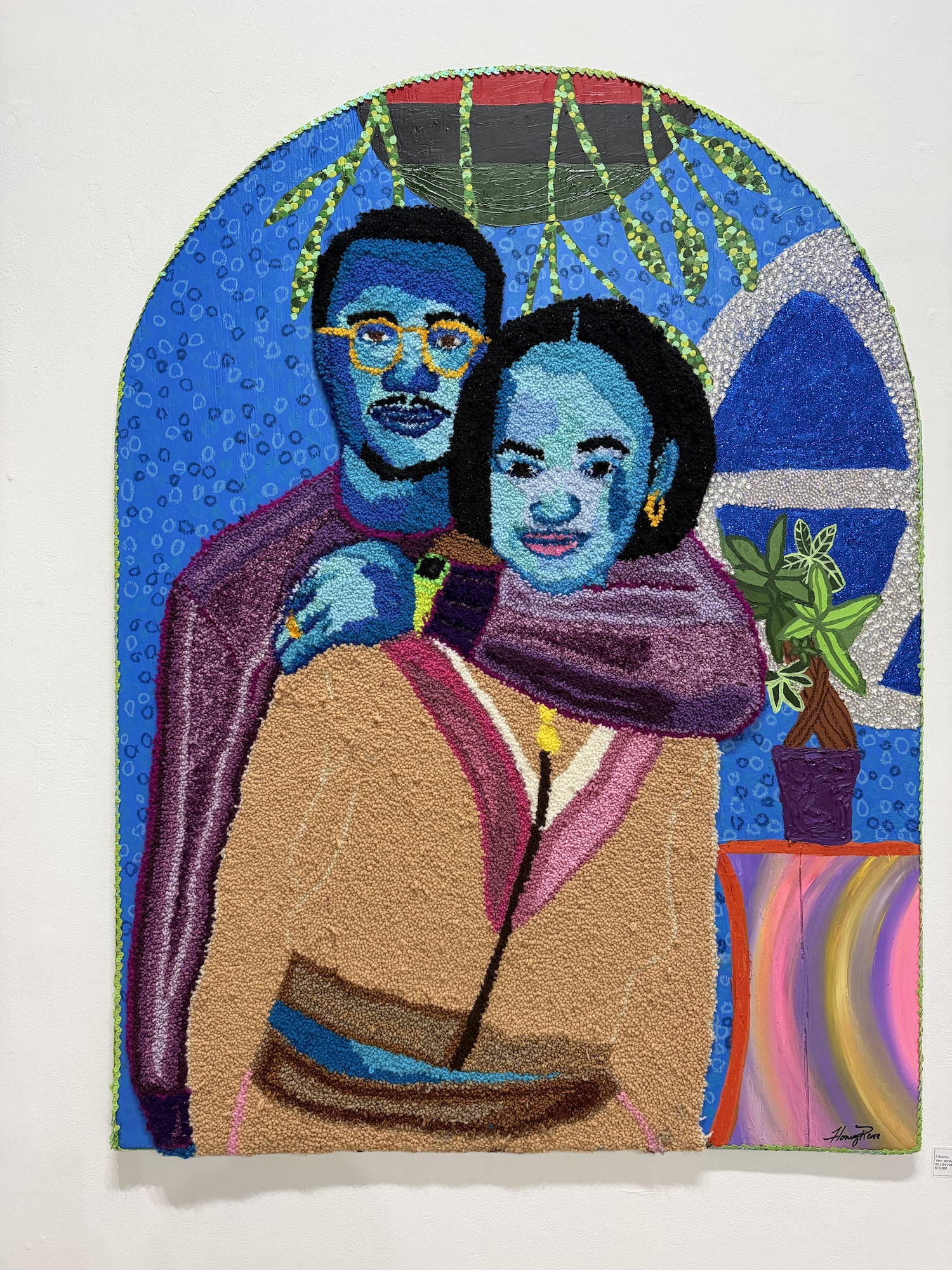
There are a couple of pieces that go to everyday themes with our partners, like a slow drag in our living room and just having an intimate moment. We can enjoy being pregnant and not have to worry about maternal health because the healthcare system doesn’t care about us. We can love our partner without fear. Those were the main topics I wanted to show and talk about.
How do those themes play a part in what inspires your work?
What mainly inspires my artwork is just everyday life. Mental health has played a big role: showing that it’s okay to have stillness and it’s okay to find your own peace and preserve it. I’m working on that a lot myself.
Tell me more about your art style.
It’s called punch needle, and you do it with a single needle. It’s a little bit quicker than looming, but punch needle is a very meditative practice. All my figures are punch needle fiber, and I do mixed media for the backgrounds on the wood panels, like painting, fabric or gemstones.
The medium you use really is about slowing down, rest and restoration. How does that shape your art-making?
Honestly, over the last few years, my bodies of work have been teaching me to just let the stories come to me and not force it. Even this body of work, I expressively wrote about it all when I was at a residency in the mountains last year. I did the interviews and talked to friends, but none of this work came from me trying to force it. I’ve not been trying to force stories or do what’s trending or any of that. I just let it come to me now.
You feature men prominently in your work, and we know how challenging it can be for Black men to find rest in this country. Why was it important for you to depict that?
I have so many men in my family who just don’t prioritize rest. Even my partner doesn’t, and I’ve been making him prioritize it now. It’s important that they see, know and accept that it’s okay to do that. It’s just a challenge because it’s a generational thing. They have been taught to go, go, go.
With a few of my artworks, like in this show, there’s one called “It’s Okay to Dream, My Brother.” I wanted men to see themselves in that piece particularly because I feel like a lot of them don’t slow down to actually dream. I don’t hear that often, and I wanted a piece just for them to think about: What are your actual desires for your life?
I made a piece two years ago called “Recharge.” It’s a man with a book on his chest, eyes closed, in the grass, hands behind his head. I kid you not, all the men came up to me after the exhibit and told me how much they appreciated it.
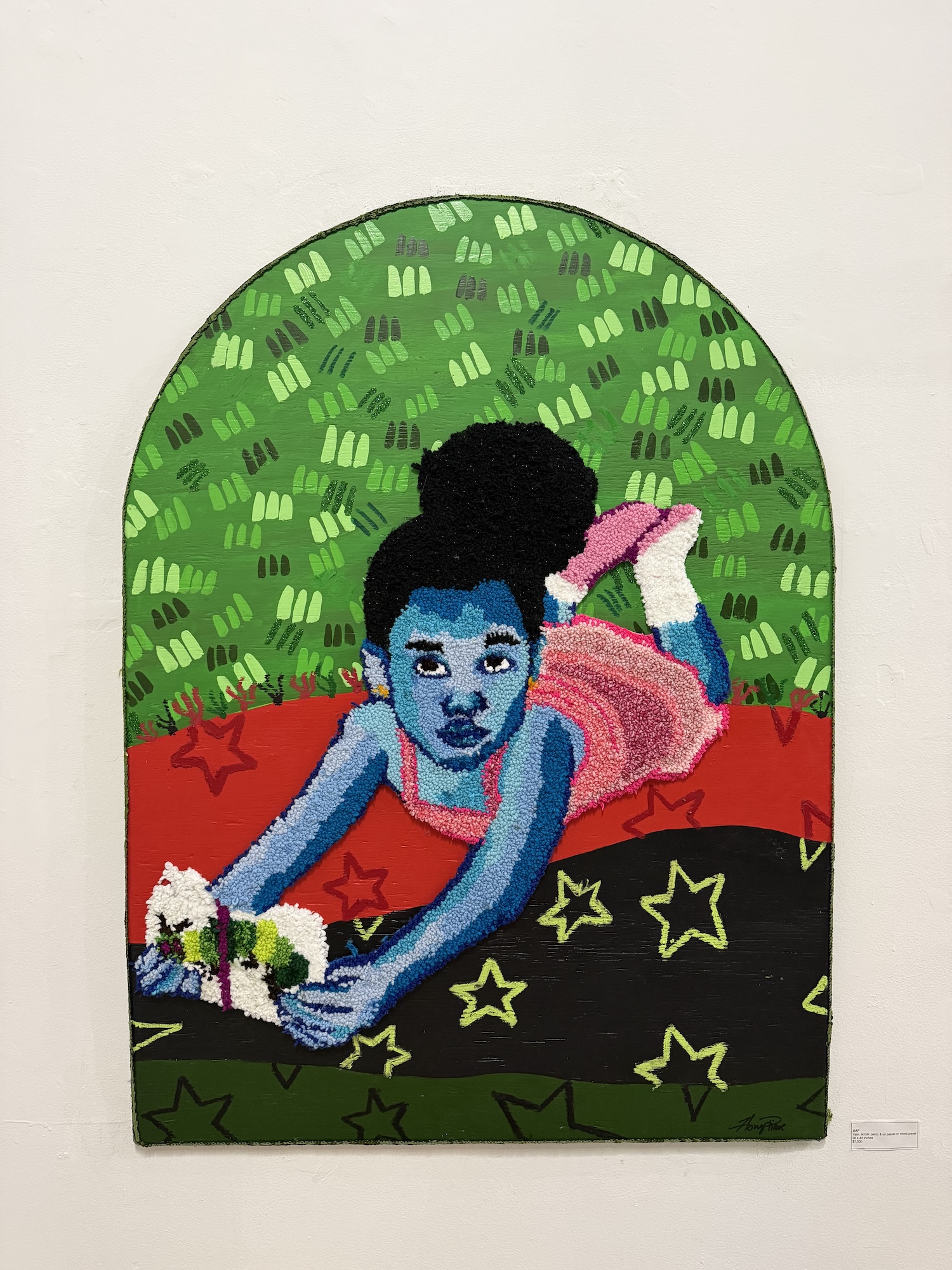
Your subjects are saturated in bright, bold hues. How do you approach color?
I’ve always been into color theory. I really started getting in my bag with it back in 2018. I always give this advice to any of my mentees or workshop students: Get a whole bunch of cheap paint, start mixing your own colors and figure out what your brain chemistry leans toward. We all perceive color differently, what pairs correctly, and the emotions connected to it.
You spoke about the lack of diversity in yarn. Has that changed, or is it still lacking?
Oh, it’s still lacking. One of my main goals in this next decade is to collaborate with a yarn company to create vibrant brown yarns, because I feel like that needs to happen.
What do people need to know about the art world today?
One main thing I would want people to know—and this is just me coming from being on different boards—is to support your local art nonprofits. They need our support more than ever. If I could say anything to anybody, it’s to really support your local art nonprofits. Go to the programming, donate if you can, be a community member or volunteer. They need help. With federal and state funding getting cut, our local cities have to fund nonprofits, and the arts are always the first to get cut for a multitude of reasons.
Creating art is the most radical thing to be weaponized because there’s freedom of expression. It’s history, and us documenting what’s happening right now. Support your art nonprofits, specifically Black art nonprofits. If you’re in a position to help out, it will really help. It doesn’t just help the nonprofit; it trickles down to local artists who are trying to get stipends and funding to stabilize their practices.
You recently moved to New York to continue your career.
I’m at the Textile Arts Center in Brooklyn, New York. You know when you feel it in your spirit that it’s time to go to the next level, whether in your personal life or your career? For me, it was both. I’d been in Atlanta for eight years. I definitely have roots here, and I’m going to keep watering them. But I do need to expand my knowledge and just try new things.
Here We Are runs at HOMME Gallery through September 26.