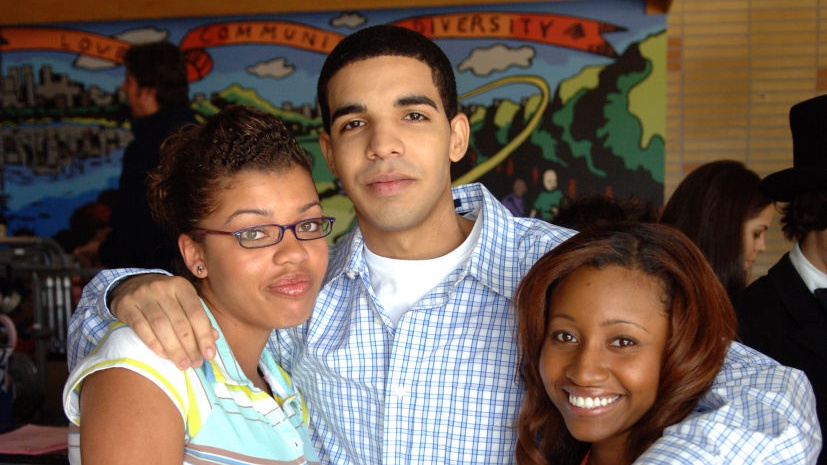
“Degrassi: The Next Generation” walked so Netflix’s “Forever” could run. While shows like “Moesha,” “Sister, Sister,” and “A Different World” helped shape the portrayal of Black adolescence and romance on television, the Canadian teen drama added another dimension. Beyond introducing the world to Drake, “Degrassi” gave audiences Hazel Aden and Jimmy Brooks, an often-overlooked Black teenage couple. It was one of the first times a television show portrayed young Black love in depth.
The show premiered in 2001 and gained a reputation for teen characters handling mature situations that similar shows often softened or skipped altogether. While there were parties and crushes; there were also pregnancies, eating disorders, drug use, sexuality, and other uncomfortable parts of high school.
In the midst of this, Jimmy played by Aubrey Graham aka Drake and Hazel played by Andrea Lewis became one of the show’s most memorable couples. 25 years later, Lewis says she recognizes their relationship in a way she could not fully understand while living it.
“I got to see just a couple being a couple,” Lewis told EBONY. “You got to see a boyfriend loving his girlfriend and just wanting to treat her well.”
They were Black teenagers but their relationship was not built around explaining their Blackness to the audience. They were simply two students figuring out whether they liked each other, whether they could make this work, and what happened when they couldn’t.
The Impact of Degrassi Letting Teenagers Look Like Teenagers
When “Degrassi: The Next Generation” arrived, its cast was unusually close in age to their characters. That closeness allowed the young cast to bring some of their own experiences into the work as the writers wanted to truly reflect the lived teenage experience.
The actors could push back during table reads if a line did not sound realistic. Lewis said that helped the series maintain a sense of authenticity, even in heavier storylines.
Other teen series had already explored adolescence. A show like “Saved by the Bell” offered a lighter version of high school life, while sitcoms such as “Sister, Sister” and “Moesha” centered Black teenagers and families. “Degrassi” operated differently and that realism helped the franchise travel well beyond Canada.
The original “Degrassi Junior High” was already a Canadian television success, drawing more than 1 million viewers during its late-1980s run.
By the time “The Next Generation” arrived, it hit the ground running. In its first season, the series averaged about 365,000 viewers ages 12 to 20 in Canada and became the country’s most-watched domestic drama.
In the United States, “Degrassi” found another audience through Noggin’s teen programming block, The N. By 2003, it had become the block’s highest-rated show. A 2004 episode drew roughly 300,000 viewers and ranked No. 1 among Noggin viewers ages 12 to 17.
Jimmy and Hazel Were Allowed to Be Human
What separated them from other iconic Black teen romances was the way Jimmy and Hazel’s relationship unfolded. They went to prom, had disagreements, Jimmy tried to do thoughtful things for Hazel, sometimes they were on the same page and sometimes they were not. There was no requirement for their relationship to become a lesson about Black love every time they appeared.
“It was just like, yeah, of course, these two,” Lewis said. “It’s like the jock and the cheerleader, but also, like, in the friend group and all of these things and not being treated just like, well, they’re both Black. They should date.”
The distinction has become easier for Lewis to recognize as an adult.
“If you had had this conversation with me when I was a teen, I probably would have been very surprised and been like,’ really?’” she said. “But at the same time, now in my adulthood, I can recognize why it was significant and important.”
The end was important too. Jimmy and Hazel did not live happily-ever-after but Hazel was allowed to walk away, showing viewers – and Black girls specifically who saw themselves in Hazel – that if something is no longer making you happy, you have the full autonomy to leave.
Lewis said that was meaningful because young women are often shown as the person who keeps holding on, even when a relationship is no longer working.
“I do think that was the interesting thing about the Jimmy and Hazel dynamic was they both had a sense of themselves,” Lewis said. “And I think at the same time, you saw possibly an element of respect between both people that’s like, this is not it.”
Lewis says her and Graham were genuinely disappointed when their characters split. The audience, however, kept remembering them.
“Young Black girls always need to see love,” she said. “And then they always also need to see a girl who has a sense of self and knows that she can move on.”
Degrassi’s Legacy 25 Years Later
Degrassi was in a world of its own because it showed the reality of being a teenager in high school, race aside. The high school journey was never easy but it had its pockets full of joy and many learning lessons.
“You really do have to learn where you kind of fit in and what your voice is and who you feel comfortable with and why,” Lewis said.
The show understood that teenagers were still becoming people. That meant getting your heart broken, figuring out a boundary or realizing you needed to leave someone you loved.
Jimmy and Hazel had such an impact on viewers and the future of Black teen love on screen, not because they were perfect, because they weren’t. Lewis knows that now.
“I think that we can all say, wow, that was really significant Black love,” she said. “And I didn’t even recognize that.”
She paused over what that meant.
“It gave me a sense of representation at a time when I didn’t even know I needed it.”
The audience did not always have the language for what it was watching either, it just knew it looked familiar.