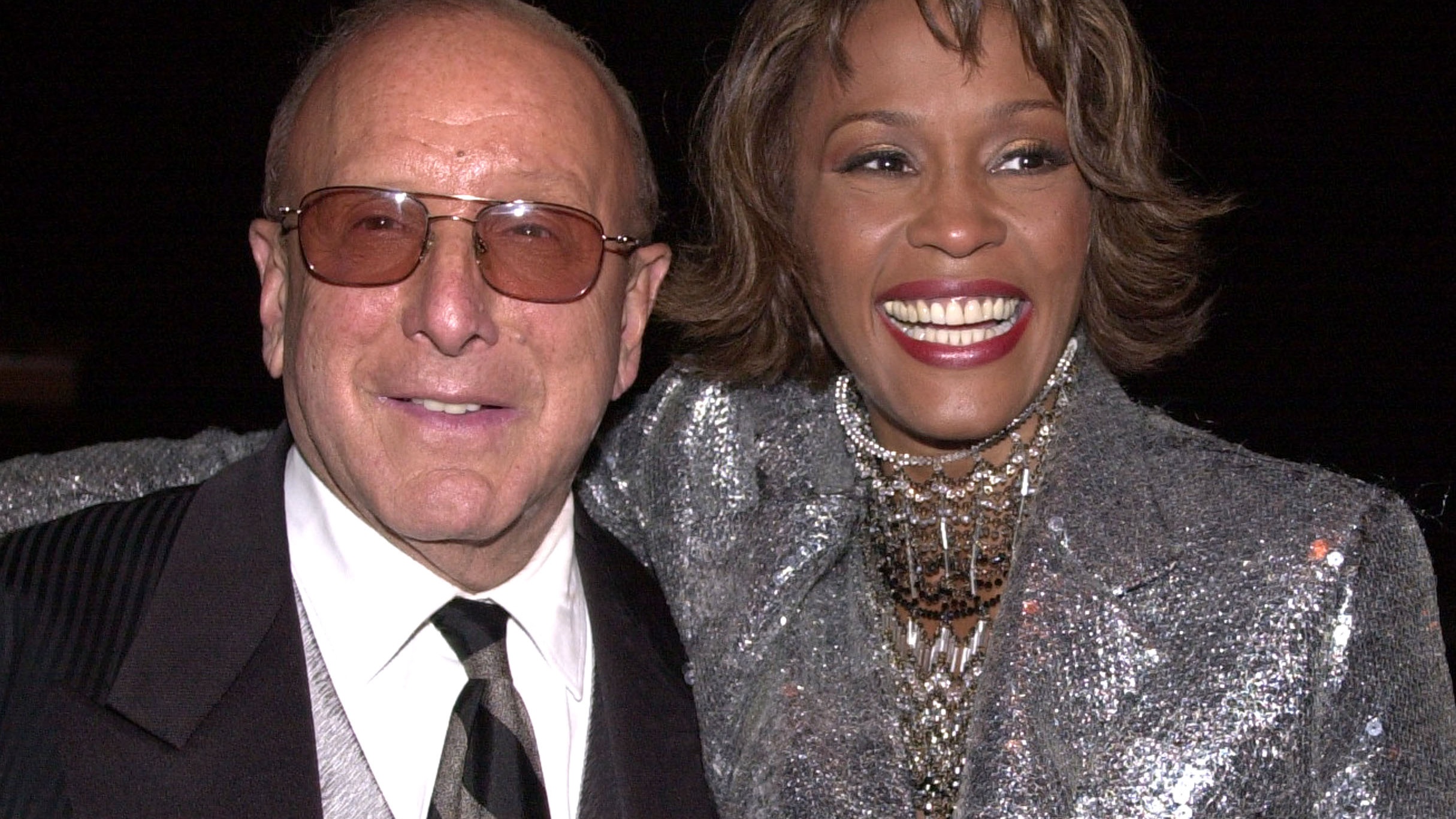
The death of renowned record exec Clive Davis divided the internet this week, leaving little room for “holding opposites” —the idea that two truths can both be correct. The former head of Columbia, Arista and J Records changed the sound of the world by bringing us artists as diverse as Aretha Franklin, Whitney Houston, Miles Davis, Sly Stone, Alicia Keys, Jennifer Hudson, Phyllis Hyman and Earth, Wind & Fire.
Because of Davis’ distribution deals with Black music labels run by L.A. Reid, Babyface and Sean “Diddy” Combs, the world also knows the Notorious B.I.G., Usher, OutKast, Toni Braxton, TLC and many more.
Despite accomplishments, one look at the vilifying comments on any social media post celebrating his long-standing run and influence in the music industry revealed a lesser-known parallel legacy, raising questions about events from Davis’ professional life that have long sparked debate about his decades-spanning career.
Whitney Houston’s Death and the Grammys
One day before the 54th annual Grammys, Whitney Houston lost a longtime battle with cocaine addiction, accidentally drowning in her bathtub at the Beverly Hilton Hotel in Los Angeles. She was officially pronounced dead by paramedics that afternoon. Downstairs at the same hotel, festivities were underway for the prestigious pre-Grammy party of Clive Davis, one he’d been throwing every year since 1976. Rather than cancel the party, he eulogized Houston at the start of the event, claiming “Whitney would have wanted the music to go on and her family asked that we carry on.”
The decision struck most of the public as extremely bad taste for anyone, much less for someone whom Houston claimed as an “industry father,” a mentor who had guided her since discovering the singer and signing her at 19. As Houston’s addictions worsened over the years, Davis staged an intervention at his home in 1997 after her non-fatal overdose and wrote her a letter in 2001 to seek rehabilitation: “You need help, and it must begin now…” But many felt he should have noticed earlier and provided far more help than he did.
The Harvard Report on Black Music
In the late 1960s and early ’70s, much of the blackest music on the airwaves worldwide came directly from the Black-owned record labels Motown and Stax. Largely clueless about how to rake in more dollars from Black audiences, Clive Davis—president of Columbia Records in 1972—commissioned a report from Harvard Business School entitled “A Study of the Soul Music Environment.” Although the whitepaper led to the creation of Black music divisions at Columbia and elsewhere, including the widespread hiring of Black record execs, the report was also seen as a sort of sinister corporate playbook for pimping African American culture for profit, and Davis was responsible.
TLC’s Bankruptcy
R&B trio TLC filed for bankruptcy in the summer of 1995, less than a year after Davis released their multiplatinum magnum opus, CrazySexyCool, on Arista Records. The album ultimately sold over 12 million copies, but the biggest girl group in music history suffered under an exploitative contract where everything from music videos, travel, food and styling was “recoupable”—that is, owed back to the label as a loan. The deal, initially signed with the management and production company Pebbitone, was primarily the result of their relationship with LaFace Records, the Black-owned label merely distributed by Davis’ Arista. But the sour situation still reflects poorly on Davis, who was presumably privy to the contract.
Phyllis Hyman’s Career
Phyllis Hyman’s biggest hits—1979’s “You Know How to Love Me” among them—are beloved by hardcore R&B lovers, but most believe the statuesque Philly native never got the mainstream flowers she deserved. After she released two albums on Buddah Records, the label was absorbed by the Davis-run Arista in 1978. A sultry, jazz-tinged vocalist, Hyman formed her own career vision as a balladeer; Davis served her radio-friendly, pop crossover material instead. The clash reportedly led to Davis sidelining her as non-priority at his label, pouring resources instead into a then-teenage Whitney Houston. When Hyman committed suicide in 1995 at the age of 45, supposedly of bipolar-related depression, her diehard fanbase largely blamed Davis.
Still Cherished
Despite his polarizing legacy, Davis still has many who are touting his work. Regarding his death, Verdine White of Earth, Wind & Fire told EBONY, “Clive heard about us, came to see us perform and signed us to Columbia Records. That was our big break. He was getting ready to take Columbia to the next level, and he believed in us. Clive really put the finances behind us. Clive was revolutionary and innovative. He did things no one else ever did. He brought us on the scene,” Columbia, with Clive, put a lot of money behind us and gave us the kind of exposure that most African Americans never really got. When it came to EWF, he went all in.”
Davis’ death ultimately reminds us that legacies are often complicated and refuse simplification, and that both the triumphs and the wounds should be remembered together.