If you read The Odyssey in high school, walking into Christopher Nolan’s adaptation carries a specific kind of feeling. It is familiar the way a half-remembered dream is familiar. You know the bones of it: Odysseus. The Trojan War. The long, brutal journey home. But Nolan’s version makes you feel like you are actually in it. I caught the film in Dolby Cinema at AMC, one of the next best options to IMAX 70mm, which has been and will be sold out for weeks. Even in the format I saw, the scale of it was staggering.
What You Need to Know
For the uninitiated: The Odyssey follows Odysseus, King of Ithaca, played by Matt Damon, as he attempts to find his way home after the decade-long Trojan War. The journey should be straightforward, but along the way, he and his men encounter Polyphemus the Cyclops, a son of Poseidon whose cave becomes one of the film’s most terrifying sequences; the sorceress Circe, the Sirens, giants, curses from the gods, and enough tragedy to decimate his crew before he ever sees Ithaca again. Back home, his wife Penelope, played by Anne Hathaway, holds down the kingdom while fending off suitors convinced her husband is dead. His son Telemachus, played by Tom Holland, sets out to find him.
The film opens, somewhat unexpectedly, with Travis Scott, which was an interesting choice from Nolan.
The most remarkable thing about the film is how it was made. Nolan is famously known for committing to practical effects over CGI in his films, and in this case, he turned The Odyssey into a movie that feels uncomfortably real in a way that no amount of digital rendering can replicate.
The Cyclops sequence is the clearest proof of concept. To give Odysseus and his men a genuine sense of scale while filming inside Nestor’s Cave in Greece’s Peloponnese region, Nolan and his crew built a 60-foot puppet that they used for many of the shots. To make the puppet come alive, Nolan recruited actor Bill Irwin — who previously voiced and operated TARS in Interstellar — who was present on set in the cave, providing live dialogue, performance cues, and terrifying vocalizations. When you are watching Odysseus and his men look up in genuine terror, it is because something terrifying was actually in the room with them.
The Circe transformation scene — in which Odysseus’s men sit down to eat and slowly find their faces being molded into pigs — is equally unforgettable. The team built pig animatronics that Circe star Samantha Morton could move and manipulate with her hands, with clever editing and camera angles making it look like she is really morphing the men into pigs.
How Nolan Got it Right
Damon as Odysseus was a choice I did not know I needed until I was watching it. His emotional depth in this role genuinely impressed me. He plays exhaustion, grief, and stubborn survival with a specificity that a flashier actor might have buried. This is a man who has watched his entire crew die. Damon makes you feel every one of those losses.
Lupita Nyong’o plays two roles: Helen of Troy and her sister Clytemnestra. Her Helen arrives bearing the weight of a war started in her name, and her face carries a scar administered by Menelaus after the fall of Troy — punishment for her infidelity, a deliberate stripping away of the beauty that launched a thousand ships. It is a brutal, specific detail and Nyong’o carries it with extraordinary control. The dual casting also means we see two women shaped by the same war in entirely different ways — Helen hollowed by it, Clytemnestra hardened into something dangerous. It is the film’s most layered performance.
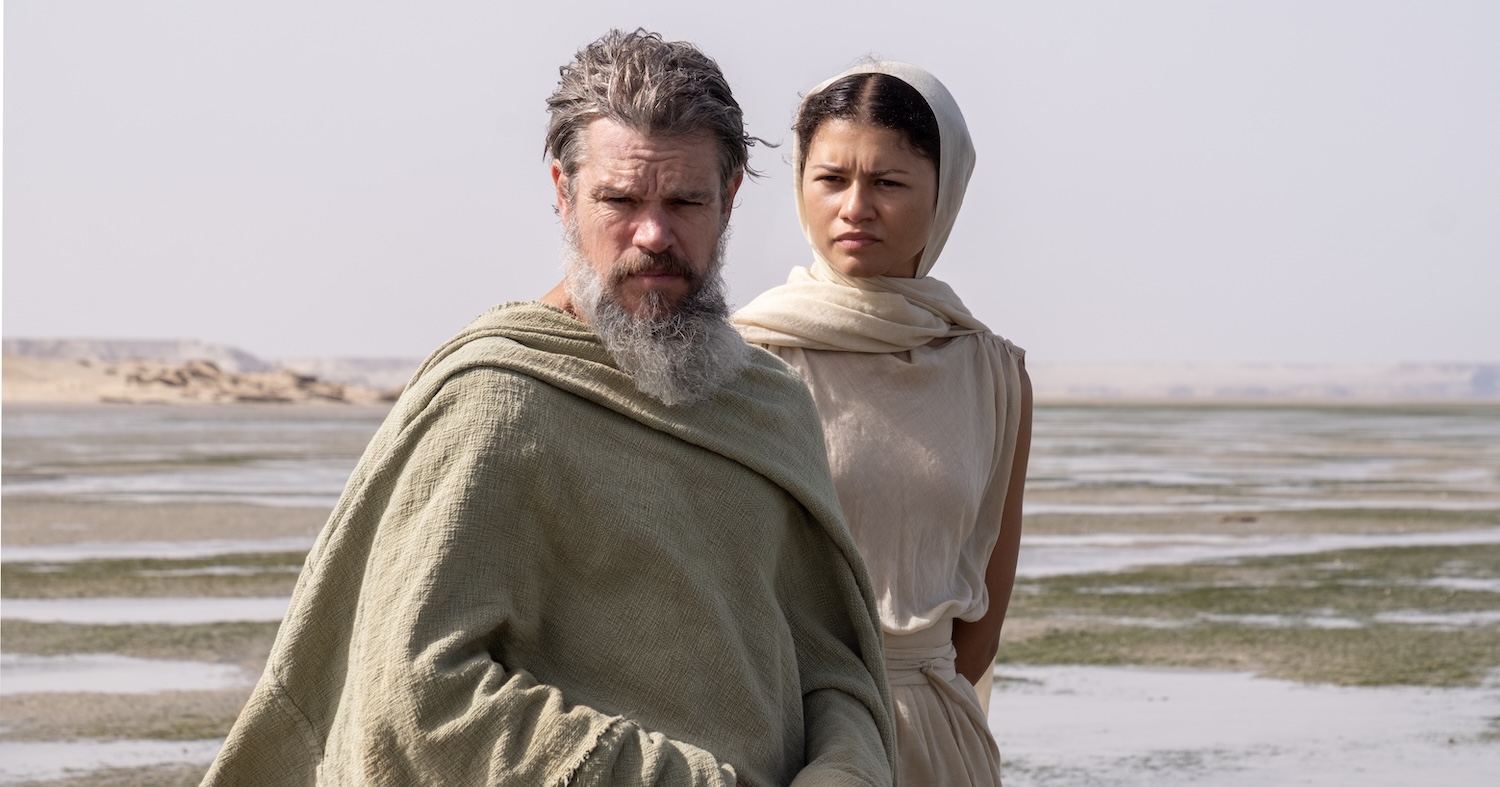
Zendaya as Athena, taking the form of a servant girl in Troy to serve as Odysseus’s voice of reason, is another departure from the source material that proved to be a perfect choice. The gods in this film do not appear as divine beings on golden thrones. Instead, Nolan mainly gives the gods a presence through nature and his characters’ beliefs, and Athena appearing in borrowed skin is a perfect expression of that philosophy.
Then there is Anne Hathaway’s Penelope. I walked in wanting her to bring something closer to Queen Gorgo from 300 — that particular brand of regal, barely contained fury. She does not deliver that. What Hathaway brings instead is something a bit more calculated and conservative. Penelope in Homer’s text is defined by patience and cunning, not power and sexuality. She survives by being underestimated. Hathaway plays that restraint with precision, and the more I sat with it, the more I understood that the conservative choice was the right one. Penelope is not magnetic. She needs to be immovable.
Tom Holland brings more dramatic range to Telemachus than his previous roles might suggest. He plays the young prince’s determination and vulnerability with a maturity that holds its own against Damon. Charlize Theron as Calypso is a different kind of force; the immortal sea nymph who keeps Odysseus captive on her island for seven years is seductive and melancholy in equal measure, and Theron makes you understand exactly why a man might lose a decade of his life there without fully meaning to.
The changes Nolan makes from the source material — and there are several significant ones — cluster noticeably around the storylines of Black women: Lupita’s scarring, Zendaya’s Athena taking the face of a servant. I do not think that is accidental. Nolan’s inspiration for the film reportedly came in part from Emily Wilson’s 2017 translation of The Odyssey, the first English translation by a woman, which brought new attention to the female characters the original text had long marginalized. The fingerprints of that influence are all over this film.
The score from Ludwig Göransson, who won an Oscar for Best Original Score for Sinners, deserves much praise. The score during the Trojan horse sequence is magnificent. The build-up to the gates opening had me gripping my armrest. Even more so, the score during the final fight sequence gave the action room to breathe and stretch out, while also keeping your heart rate elevated.
By the time the credits rolled, I became more than just a fan of this film. This is undoubtedly the best film of the year thus far, and I can bet we’ll see production and the cast clean up nicely during awards season.