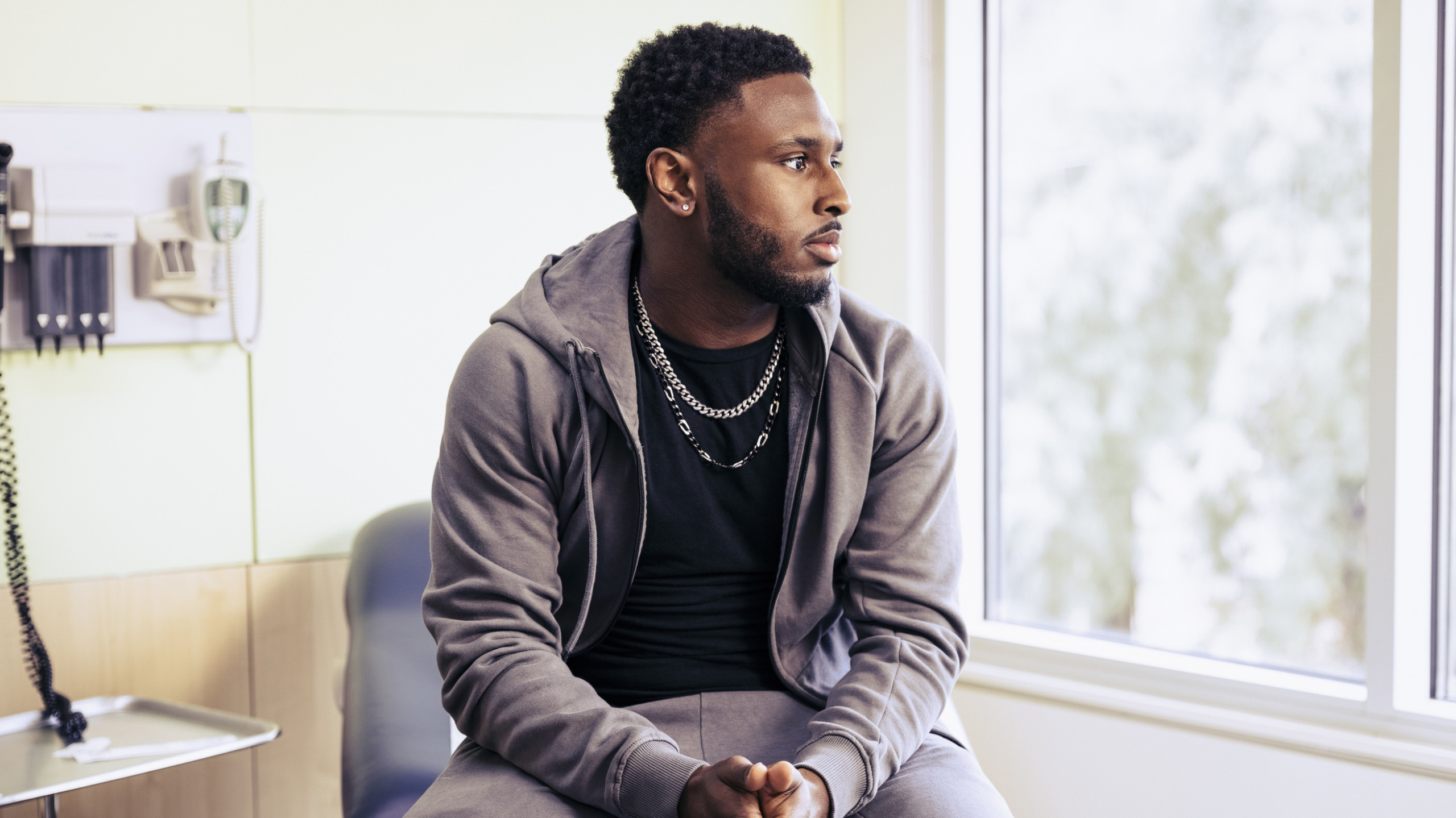
With less than 30% of Black men who are considered to have a mental health condition receiving care, according to the National Center of Health Statistics, spaces that cultivate conversations about men’s wellness have begun carrying the responsibility of providing insight and perspective to the demographic. While it’s been helpful for some, for others it can feel like a temporary acknowledgment rather than a consistent practice. Recent conversations on the topic have raised the question of whether Black men are truly given the opportunity to expand on “I’m fine.”
It’s no secret that the stressors of previous generations differ from today’s. Between mass layoffs across industries and the increase in chronic loneliness within society, Black men’s emotional suppression often becomes the norm when trying to handle other responsibilities in comparison to taking care of themselves first. Similar to Black women, this dissociation can often look like overworking or active avoidance of conversations tied to the issue at hand. The bright side is that newer generations of adults are more open to therapy and other therapeutic practices than their parents and grandparents. This openness has allowed more progress in mental health, but there is still more to be made.
For multi-niche influencer Mark Nichols, whose platform actively discussed mental wellness and peace-protecting practices, he believes that identifying the areas where you’re not feeling the strongest or areas that are bringing distress can help to support mental wellness in the long run and aid future versions of yourself to avoid overexerting that many Black men get caught up in. While the execution of resolve may vary by circumstance, acknowledgment is the first step toward change.
“I think I had to unlearn people pleasing. Something I used to associate my worth to is what I could provide to people or I guess I would associate my worth to how useful I was and I feel like society often puts that burden on a ‘good man’. They say being a good man is being a provider, somebody that’s able to make sacrifices, and goes out of their way to in a way uphold the household and I feel like all those qualities are extremely important but when it comes to wellness, I think it’s very important for you to be able to take care of home first […] Before I’m prioritizing showing up for other people or being there for other people, how do I feel? How comfortable am I,” Nichols told EBONY.
On a larger scale, traditional Black masculinity has not made conversations about mental wellness a priority. Contrary to older generations, Gen-Z and Millennials have chosen to actively combat this by seeking out more professional and digital mental health resources for support. In turn, this has allowed less emotional internalization to occur while introducing a new way of handling emotions. Beyond there being only so many diverse or diversity-trained mental health care providers, there is also a gap in resource finding and education for mental health concerns in the Black community.
After reflecting more on how he personally believed that anxiety and depression show up in Black men, Mark revealed how his perspective broadened after attending Morehouse College and being introduced to both resources and lack thereof between other institutions systemically and academically.
“I started to not only realize how much of an uphill battle our livelihoods are, but more importantly how isolated we can become because these resources aren’t communicated to us and I feel like because we grow up in these households where we almost are in a way judged based on the value we add to other people instead of talking about the value we add to ourselves and how that can permeate to the people around us because I honestly and truly believe that how you pour into yourself is how you’re going to pour into other people. That’s why I believe anxiety and depression hit us a lot harder because we do sometimes hold the weight of not only our plight and our problems, but we also carry the plight of the stigmas, stereotypes, and things that are perpetuated onto us that are dishonest,” he said.
Despite today’s young to middle aged adults being more open to conversations about mental health and seeking support, this has not changed the historic stigmas around mental health. If anything, it’s given them more of a spotlight for many to draw the line in the sand of where they truly stand. The notion of “man up” or “pray about it” has been pushed for men to not address their true emotions and associate these emotions with not being considered strong or with what some may consider to be feminine qualities. Upbringing can also play a role in someone’s comfort level in sharing more of how they’re feeling emotionally and who they choose to confide in.
There is also a difference in how masculinity and emotional sharing is treated for different Black men based on their sexuality. In situations where Black queer men tend to lean deeper into their emotions, straight Black men often divert away to avoid being associated with being seen as less manly or the aforementioned notion of being considered feminine. Terms like “sassy” and “no homo” have grown in prevalence among Gen-Z and Millennials, which has actively continued gender roles tied to emotions that previous generations have upheld.
Social media has also pushed many adults to be influenced to pursue endeavors that they don’t truly feel passionate about because it’s trendy or seems like a fast-tracked way to grow and make money. From a mental health perspective, this could also introduce questions of self-identity in the long run and lack of true self satisfaction. “I think everybody feels like they have it all figured out, and with social media I feel like the big issue nowadays is everybody wants to be a billionaire by 25, and it’s constant comparison. […] When it comes to self care and my routine, I ask myself what’s your purpose and I think my first year of post-grad which I feel like a lot of people go through, I went through a post-grad depression and I felt like I was lost. I was delayed by my job for a year that later turned to two years, and because of that I was working a part-time job and was also starting social media. I started social media in 2024. Little did I know that was going to be my purpose,” he said.
As societal norms continue to shift around mental health, paying attention to what personally aligns with you is what will make the larger difference in the grand scheme of mental wellness. As physical wellness is prioritized, so should mental wellness.