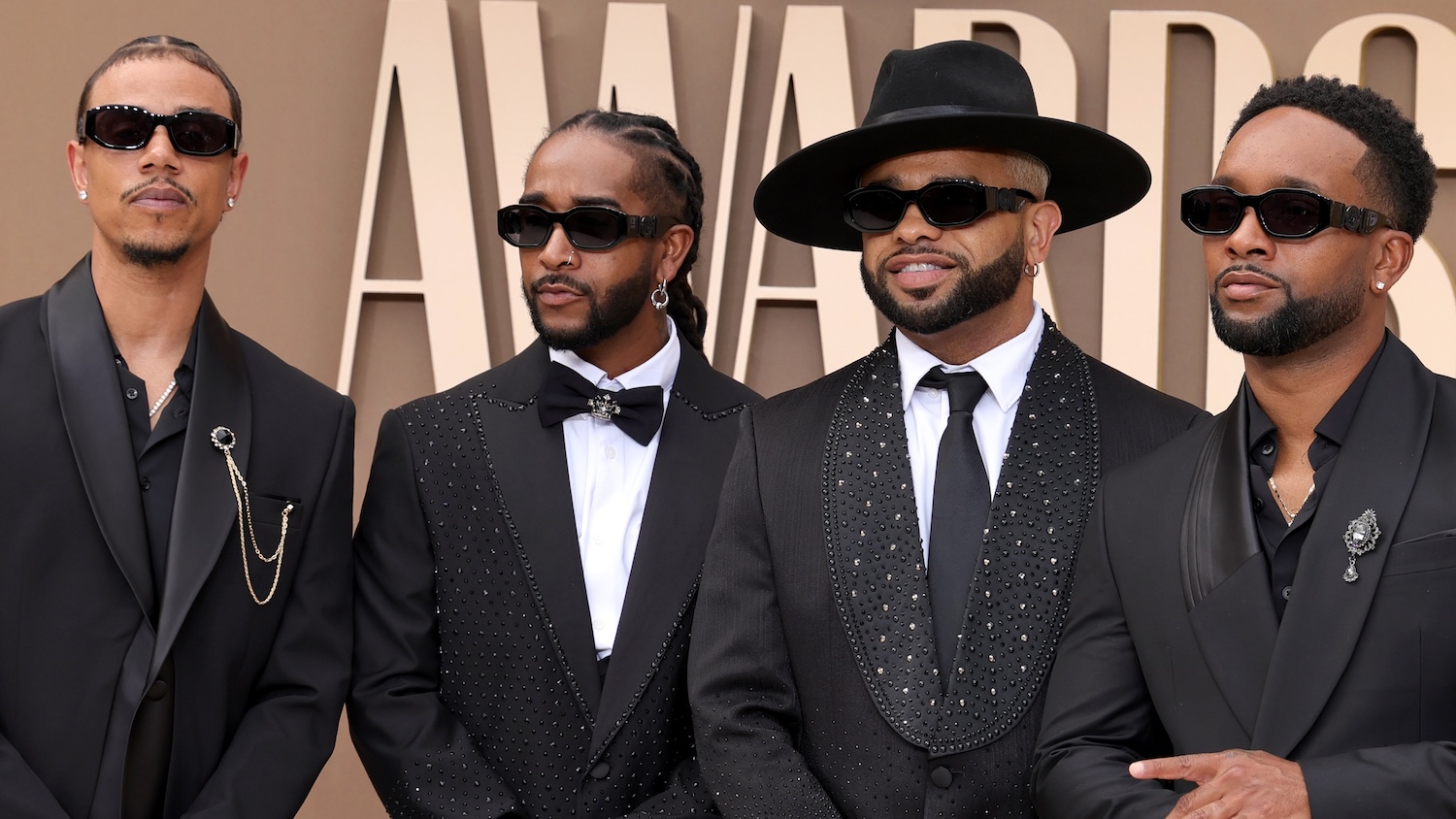
There’s something about a thoughtful comeback that reels us all back in. Initially, that’s what I thought of B2K’s first single in 20 years, “Mileage.” After sitting down with the men who make up the widely adored R&B group, I realized their resurgence might not be as simple as a comeback; it felt more like fateful timing. As we talked about their collective career and the intentionality behind their reconciliation, it became abundantly clear that despite what they’ve gone through with one another, the brotherly bond never left them.
B2K’s forthcoming album, Eclipse, is a testament to that bond. During EBONY’s conversation with the group, they didn’t cower when faced with difficult questions. They doubled down on the journey that led them here and offered insight into how each of them contributed to conceptualizing an album that honors their signature sound while honoring the men they’ve ultimately become.
EBONY: A lot of fans will have the question: Why is B2K releasing new music now? And how did you all coordinate your respective lives to collaboratively conceptualize and complete an album after a 20+ year hiatus from making new music?
J-Boog: I don’t think it’s a “why now.” I think it’s really based on us all maturing into a place where we can reconcile and fix the relationship issues that we had amongst us. Obviously, a lot of things we were dealing with were public, but through God’s will and His timing, I think it all came together when it was supposed to.
Omarion: For the moment that we had as a group, it was a short runway. We didn’t always get to be fully present and appreciate the opportunity to put out music and create together on a level where we could explore our creativity as a unit. Going back down this memory lane has, in a very serendipitous way, brought a lot of revelation to us and our fans.
We’ve all matured through this business. You see people overcome things, but you don’t always get to hear them talk about it for real. For us, it’s something we worked on together. It truly created this bond of music and brotherhood. For people to still be interested in that story after 20-plus years is amazing. It’s a high honor, and it’s deeper than just coming back together as a collective to make some money. It’s way deeper than that.
Timing has an interesting way of preparing you for things that you need to know. I think the music is deeper than the project itself. Coming back together is deeper than just making music and making money. It’s an extension of all our lives, memories, and the times we’ve shared through music. It’s time to do it again.
J-Boog: I think part of it was that Omarion was willing to take some time out. Obviously, he’s been doing his solo career and has been successful. He was able to put some time on the calendar for us to come together. I have my producing and film work, Fizz has all the things he does with youth sports, and Raz has his production work in Atlanta.
We all collectively agreed to take some time away from the things we were pursuing individually to deliver this album because we always felt that we owed it to our fans. We did leave abruptly, with no clue or hint that it was coming. We didn’t publicly talk about taking time away from B2K. It just exploded in front of everybody, and it really wasn’t by our design.
It wasn’t the plan for Omarion to go solo, either. This is a perfect opportunity for us to come back, clarify things, and give the fans at least one more project because they’ve supported us collectively and individually for over 20 years. We owe that to them, and we’re excited to deliver this album.
In what ways have your relationships grown to the point where you all decided to get back together and start producing music again?
Raz-B: I would have to chime in and say that Boog and O said it best. It was bigger than us. Being able to have a platform as a young urban group and come together to show forgiveness and love is something we need. That’s part of the legacy: the brotherhood, the love that we have, and what we showed in You Got Served.
The fact that we were able to check our egos at the door, respect each other’s boundaries, and make a fire album is something I’m so thrilled about because it’s been one of my dreams. It’s a full-circle moment and a great way to close out the chapter. But I truly believe there’s so much more to B2K. I genuinely feel like we’re entering a new era of B2K. We all sound amazing on the album. Hearing our voices together is incredible, and I’m thrilled for everyone to get Eclipse on November 6.
Lil’ Fizz: I also feel like we’re an example of healing for people. When we first came out, our first video dropped around the time 9/11 happened in 2001. People were going through a really hard time, and we gave them something to see: love, laughter, and camaraderie through those hard times. We gave people something they could look to and say, “Man, I need that.”
This time around, social media has torn people apart and put us against each other. Us being an example of healing, coming together, brotherhood, and showing love just makes sense. I think that’s part of God’s timing, too.
Were there any specific musical influences or life experiences that inspired Eclipse? How were you all able to merge your ideas and experiences?
Omarion: We’re getting to truly produce the album we’ve always wanted to produce. When we were young, we were singing about grown-man things. Now we’re grown men having real grown conversations, so the music hits on a lot of other levels. This is the album we always wanted to make.
A lot of the topics and things we’re discussing, like the single “Mileage,” are adult conversations. Not everybody wants to talk about their mileage, but it’s a real conversation. If you have experience, you appreciate someone else with experience.
Raz-B: It was easy for us all to come together. We’re all experienced, grown men. When we’re sitting around the room thinking about a beat and listening to different tracks, we want to convey a conversation.
Especially living in a very salacious world, being grown isn’t just about talking about provocative things. There’s an essence to R&B, and it’s about love. I feel like it was important for us to convey that through songs like “Mileage.”
The state of R&B has evolved so much since your last project, Pandemonium!. What approach did you all take to ensure your signature sound was honored, while also meeting the vibe of today?
Raz-B: LA Reid spoke on that. He loved the fact that it was still B2K, but it had a very mature yet youthful sound to it. I believe we owe that to our kids.
Lil’ Fizz: I think, as well, that with Omarion being solo for 20-plus years and me staying in the studio, I stay in the studio all day, every day. Just keeping that consistency of being in there means you grow with time.
Omarion: I would also say authenticity. We’re not trying to bring any concepts to the table that we don’t have a great understanding of. Because we’re mature, we want to have high-level conversations, not just about love, but about opposing views and learning how to respect each other’s boundaries and appreciate that. The music has depth, and it’s coming from all our experiences. We’re able to truly articulate how we feel towards women and what it is that we would like to do.
Can you tell me about the decision to release “Mileage” as the lead single off of the album?
Raz-B: That record just felt magical. You knew it when it was happening in the room.
Omarion: I feel like “Mileage” painted the perfect picture of where we are now. It also felt like the essence of R&B, with a touch and sprinkle of new vibes. It felt like a real record.
There are a lot of fun records out there, but we wanted to cut through with a real record. I feel like it was definitely the right song.
I was talking to my son, and he was saying that a lot of kids around his age don’t know how good music is. They don’t know certain artists, so they kind of listen to one genre or one class of artists. Obviously, I’m a musician, and I play all sorts of music.
We came into the era when music was transforming from analog to digital, and that’s what’s really special about artists like us. We’re able to bring nostalgia to the table because we came through at that time. We wanted the audience to know we’re serious. We aren’t here to play with music or just do a little hook. We want you to dance, but we’re here to have a conversation.
What is your hope for this album as artists, and for the fans who have enjoyed and supported your music over the span of your careers?
Lil’ Fizz: I want it to fill that void of the essence of R&B and give people something that puts their ears at ease. My son is 16, and I don’t hear anything but NBA YoungBoy coming out of his room. So when I hear our album. and I’m playing it in the house, I’m like, “Yeah, this is what I need.” I’m older now.
J-Boog: To add to that, this is a celebration. I know a lot of our supporters talk to each other. They’ve been to shows together. They cry together and have gone through breakups together. Hopefully, with this album, they can listen to it together. They can party together, have drinks and brunch together. It’s a piece to celebrate those memories again.
To create those memories again and just be excited about it and enjoy it because we enjoyed making it. I think you’ll hear that in the music, and hopefully it hits the mark that everybody needs, truthfully.
Omarion: For me, my wish is that everyone is reminded why we came together, why we celebrated together, and why we loved together. I hope people learn from one another, build each other up, and realize how we’re all interconnected through the invisible emotions, feelings, and understandings of music. Music is a sacred art.
I also hope this inspires the next generation in a profound way and brings the group era back. Obviously, there are some groups out here, but I would wish that this inspires more. Whatever is meant for us, that’s what’s most important. That’s what I’m wishing to accomplish with this album: to go where we’ve always been going, and that’s to the top.