Amari Carter took us to church on this good Sunday morning, and she came prepared with the choir and the church fans to prove it. Inside The Penthouse at The Standard East Village, a gospel choir sang beautifully as models moved through the room for Carter’s Spring/Summer 2027 presentation, The Weight of a Sunday Dress. Church fans were passed around to guests, immediately recalling the ones tucked into pews across the South, ready for a Sunday service when the sanctuary got a little too warm. It could have easily veered into nostalgia for nostalgia’s sake, but Carter was interested in something more complicated: the expectations, rituals and quiet rules Black girls inherit long before they are old enough to understand them.

For Carter, those memories are personal. Born in Florida and raised in Georgia, the womenswear designer learned to sew from her grandmother, the woman she credits with giving her the dream of becoming a designer in the first place. Carter later attended London College of Fashion and received an early break through Diet Prada, which helped introduce her work through the British Fashion Council showrooms during London Fashion Week. She launched her namesake brand in 2018, and while she previously participated in the Black in Fashion Council showcase, Sunday marked her first solo New York Fashion Week presentation. The collection felt appropriately intimate for such a milestone, less like Carter introducing herself to New York and more like inviting the city into the world that made her.

That world begins with getting dressed for church. If you grew up in a Black Southern household, you know Sunday clothes were never simply clothes. They came with instructions. Sit up straight. Speak to every elder. Don’t run around. Don’t talk too much. Look presentable because how you behaved and how you looked reflected not only on you, but your entire family. As Carter explained during our conversation ahead of the presentation, the collection considers “the weight of putting on church clothes on Sunday” and how presentation becomes intertwined with identity. “It’s not just the symbolism of clothing, but it’s truthfully how you represent who you are as a person,” she said. “And honestly, how you represent your family.”
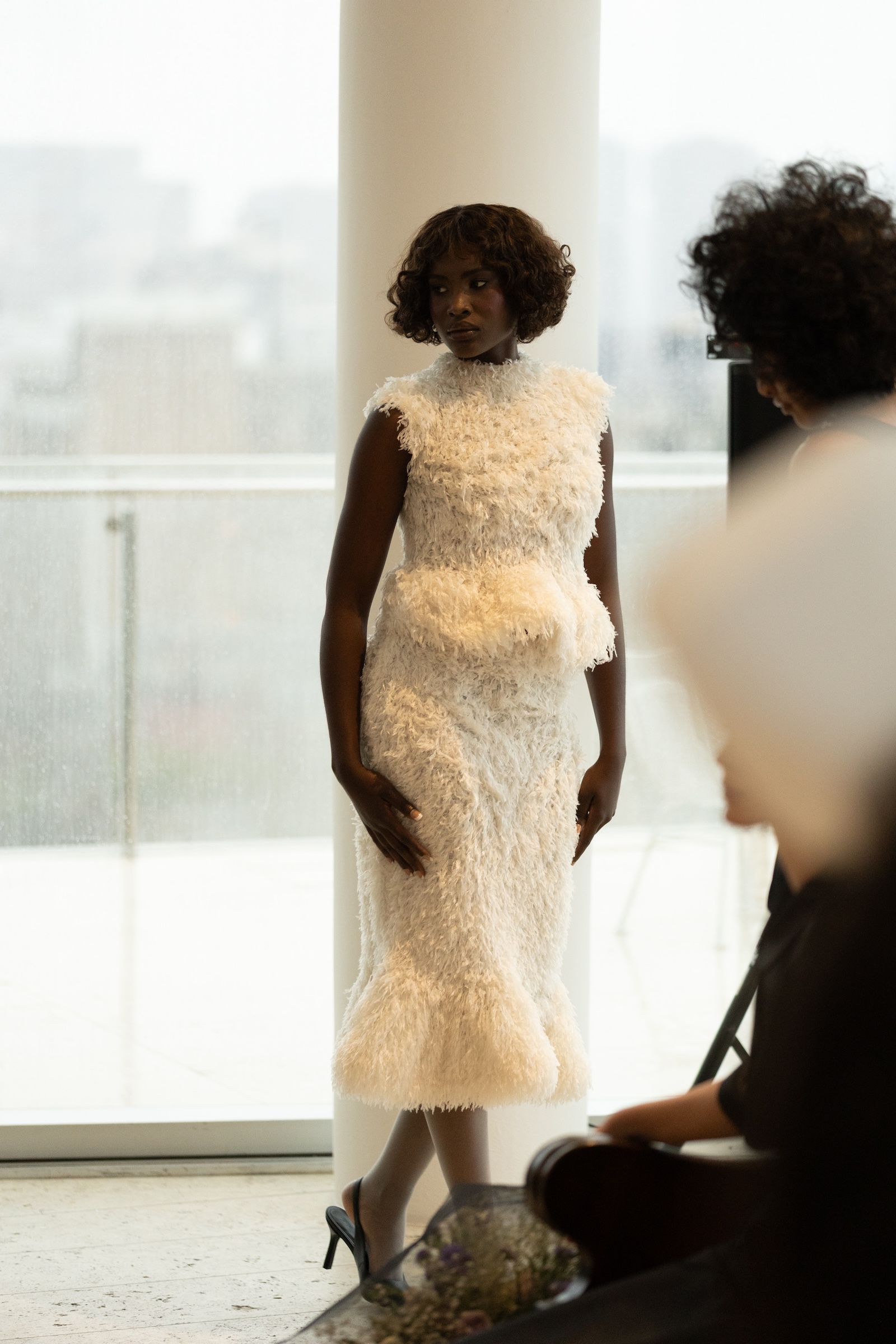
You could see Carter working through that tension in the clothes. A black satin floor-length skirt was paired with a cropped jacket and corseted bodice, its lacing exposing the torso beneath the kind of polished silhouette that might otherwise suggest restraint. Another look stripped the idea down even further with a barely-there black top and low-slung mini, allowing sensuality to exist alongside the collection’s more mannered codes. In white, texture became especially important. A fitted top plunged low at the neckline before meeting a fuzzy mini skirt, while a sculptural sleeveless dress used feathery texture and exaggerated volume through the waist and hem to transform the familiar Sunday best into something stranger and more contemporary.

There was glamour here, but Carter understands that Black church glamour has never been particularly quiet. Hair was sculpted, curled and pinned into styles that recalled the preparation that happened before service even began. Pearls appeared at the neck. Silhouettes hugged the body, exposed skin and played with the idea of modesty rather than simply obeying it. Carter’s references come partly from an extensive family photo archive stretching back to the 1920s, but she isn’t interested in reproducing those photographs literally. She is examining what gets passed down through them: the hair, nails, dresses and gestures, but also the standards Black women were expected to carry alongside all that fabulousness.

Motherhood pushed Carter to reconsider those traditions. “My daughter is the best mirror of that,” she told me. “I want to be great for her. And I see all of those traditions in myself and now I’m bringing traditions to her.” What she doesn’t want to pass down is the expectation that girls should simply be seen and not heard. “I want her to be seen, and I want her to be heard,” Carter said. That distinction becomes one of the collection’s most compelling ideas. Carter isn’t rejecting where she came from. She is deciding which pieces of it deserve to travel forward.

That question of inheritance extends beyond family and into Carter’s experience as a young Black designer. During our conversation, she spoke candidly about an industry that loves the arrival of emerging Black talent but isn’t nearly as enthusiastic about helping those businesses survive once the initial excitement disappears. “Everyone is so excited. ‘Oh my gosh, a Black designer. It’s so amazing.’ But the hardest thing is longevity and sustaining your brand once the excitement dissolves,” she said. Carter believes Black designers are rarely afforded the same room to stumble, evolve or simply take their time that established luxury houses receive. It makes her insistence on designing outside the algorithm feel particularly important. “I put my blinders on,” she said. “You don’t want to design for the algorithm because you’re not going to make them happy anyway.”

Perhaps that is why The Weight of a Sunday Dress worked best when it felt most specific to Carter. Southern Blackness has contributed endlessly to the way America dresses, speaks, eats and sounds, even when those origins are flattened or conveniently forgotten once they travel north. Carter isn’t sanding those references down to make them more universally legible. The church fan is allowed to be a church fan. The gospel choir is allowed to sing. The women in her family are allowed to be the fashion references. The rituals of getting dressed, doing your hair and making sure you were sharp before walking into Sunday service are treated as worthy design language in their own right.

By the final looks, Carter had moved beyond the Sunday dress as something a girl is told to put on and toward clothing as something a woman chooses for herself. “Before we’re told how we’re supposed to act, how we’re supposed to talk, what we’re supposed to do,” she explained. “And now I’m reclaiming back our choice.” Carter wants these clothes to become heirlooms, pieces worn enough to accumulate their own memories before eventually being passed to a daughter, goddaughter or niece. It brings the collection full circle. The inheritance remains, but the rules can change.

On a Sunday morning in New York, Carter reminded us that going back home doesn’t have to mean going backward. Sometimes maturity is realizing that the traditions you once wanted to escape contain the beginnings of your own language. The Weight of a Sunday Dress takes the discipline Carter inherited from the women before her and loosens it just enough to make room for pleasure, sensuality and self-determination. The choir sang, the fans moved and the clothes carried their history without being swallowed by it. For Carter’s first solo NYFW outing, that felt like a testimony worth hearing.