The term “quiet dismissal” was the corporate buzzword of 2025, and for the Black women who are part of the 300,000 unemployed, it led to a new era of female founders. As AI-driven automation began to optimize middle management and DEI initiatives were quietly folded into the shadows, a demographic that has always been the backbone of American labor found itself at a crossroads.
A new formidable movement has risen: Forced Founders. They didn’t necessarily set out to leave their 401(k)s and health insurance behind, but when corporate America signaled that their seats were no longer reserved, they didn’t just find new chairs—they built their own tables. For Shanna Watkins, Co-Founder and CEO of Sensori, the path to entrepreneurship was paved with a reckoning. Despite a successful career in PR at AT&T and LTK, Watkins realized that corporate spaces often functioned like “white sororities” where Black women were perpetual outsiders.
“My very first role out of college made me feel out of place,” Watkins told EBONY. “I was one of the few Black people in the office… I quite literally felt like it was a white sorority, and I was an outsider.” The emotional toll peaked when she found herself doing DE&I communications just as those very programs were being dismantled. “It was so emotionally draining to facilitate the eradication of programming that mattered to me,” she said.
Watkins represents a generation of women realizing that “safety” in corporate America is often a ceiling. She launched Sensori—a functional, botanic-forward, non-alcoholic beverage brand—alongside co-founders Darean Rhodes and Ashlyn Knox. By July 2025, the pull of her own creation became undeniable. “Every moment building it was intoxicating in the best way,” she said. “Misalignment can’t foster success.”
Similarly, Alyssa Ashley, the force behind In Real Life Skin, found her vision was simply too large for the cubicle. Ashley spent nearly a decade in corporate communications, beginning as HBO’s first college ambassador. This led to a career supporting major campaigns for Oprah’s 2020 Vision Tour, Novartis Pharmaceuticals, and FIJI Water. She earned PR News awards and was noted by Forbes as a dominating PR representative—yet despite her impact, advancement never followed.
In 2024, while working at a visible company facing public controversy, she was positioned as a shield to protect the corporate reputation during a volatile period. “I recognized the pattern,” she said. “Tasking me to spearhead digital marketing and website creation with no background in it was a test of endurance rather than an opportunity.” Instead of resisting, she mastered those tools at night to build her own exit, fueled by the literal stress of supporting a company through viral conspiracy theories and high-pressure crises.
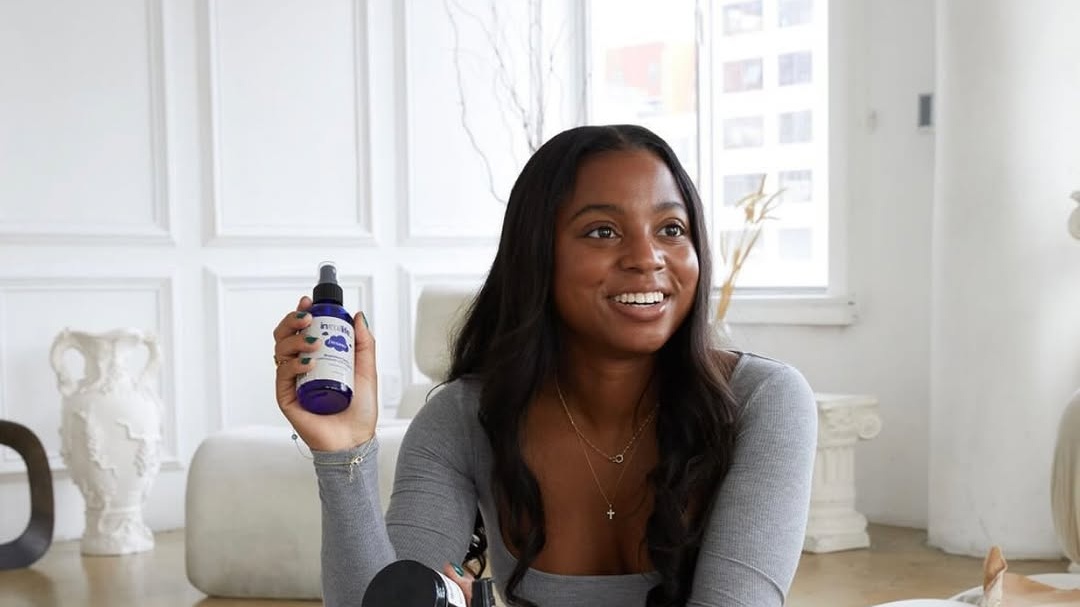
Returning home exhausted, Ashley turned to the magnesium and neurocosmetic-inspired formulas she had been making since she was a young girl to decompress. This personal necessity birthed In Real Life Skin in December 2024—a West Indian-inspired, wellness-focused brand designed to bridge inner well-being with outer beauty. Two weeks after launch, she filed formal complaints regarding discrimination and workplace misconduct; a subsequent three-month investigation led to a settlement that allowed her to fully invest in her own economic future.
“I understood that if I wanted to see that vision come to life, I would have to build it myself,” Ashley said. Now focused on barrier recovery and stress relief, her brand proves that breaking the cycle of generational stress starts with how we care for ourselves.
One of the greatest myths of entrepreneurship is that you need a massive injection of venture capital to start. For the Forced Founder, waiting for permission from a bank isn’t an option. Unlike the corporate sterility they left behind, these founders are building villages of commerce. This isn’t just about B2B transactions; it’s about emotional connection and sisterhood. “A village of commerce means people feel emotionally connected to what you’re building,” Watkins said. “When people feel a part of it, they don’t just buy—they share, they advocate.” This movement is reshaping the definition of stability.
The Forced Founder isn’t just surviving a layoff; they are hacking a system that was never designed for them to win. As of February 2026, the all-in bet has paid off for both founders. Shanna Watkins has transformed Sensori from a viral build-in-public project into a powerhouse, selling over 5,000 cans in its first 115 days and securing seed funding between $100k and $200k. Recognized as a “Black-owned brand to watch in 2026,” Sensori is now a leader in the alcohol-free alternative space for Black women.
Meanwhile, Alyssa Ashley’s In Real Life Skin is making waves with hero products like the Timeless Hydrating Dew Gel-Cream and Dreamer Magnesium Spray. By utilizing natural ingredients to target “stressed skin,” Ashley has struck a chord with a generation of overstimulated professionals. Her brand is currently expanding rapidly, proving that her “too ambitious” corporate ideas were exactly what the market was starving for.
Their success serves as a living case study: when the corporate table is retracted, the Black woman-led “village” doesn’t just survive—it scales. Success in 2026 is no longer defined by the title on someone else’s business card. It is defined by the freedom to walk into a room and know that the table belongs to you because you built it from the ground up.