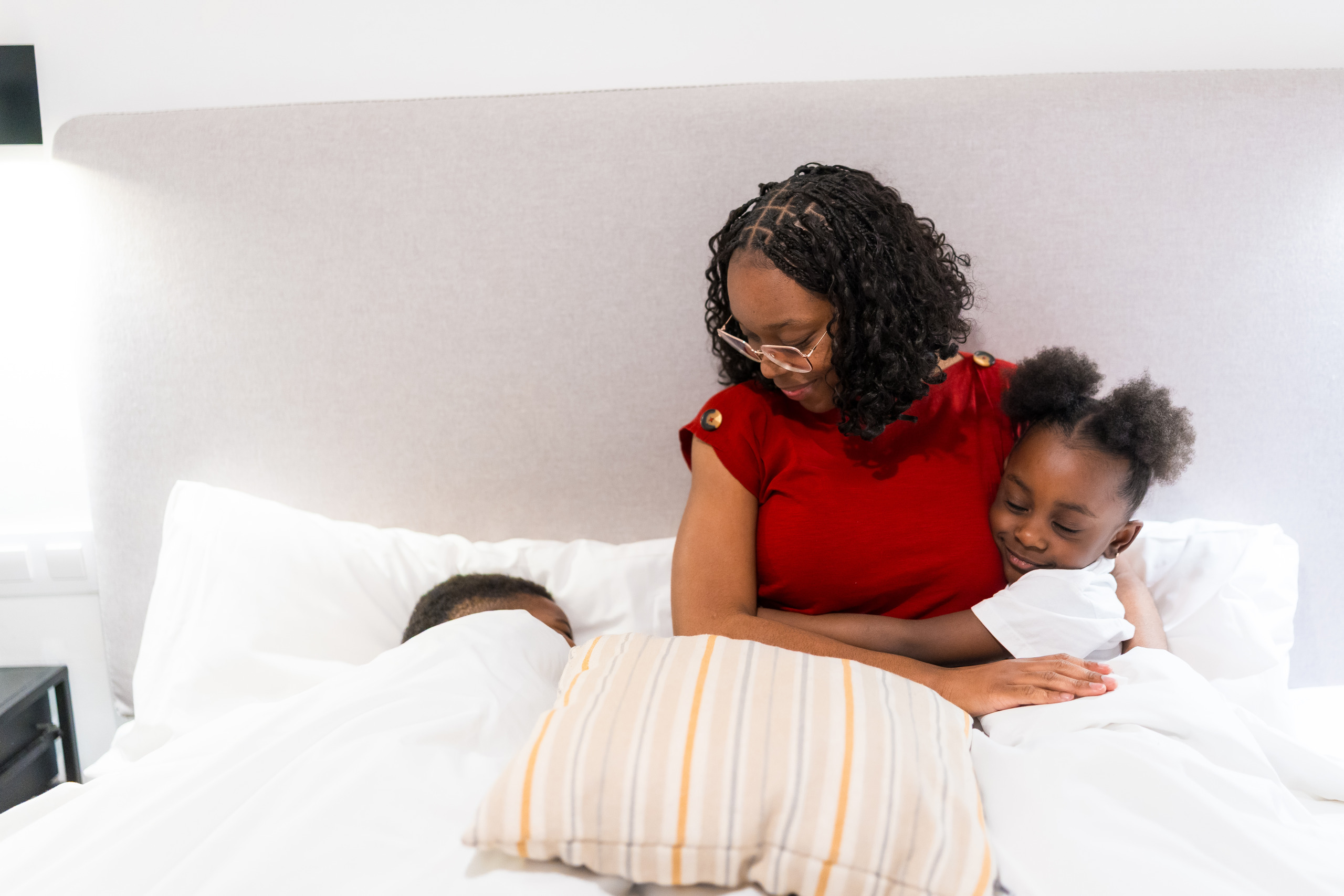
We are in a sleep deprivation crisis, and the effects are especially concerning for children. According to a 2019 study conducted by researchers from the American Academy of Pediatrics, almost 50% of children ages 6 to 17 aren’t getting enough sleep. According to Harvard, grade-school-age children need 9 to 12 hours of sleep, and teens need about 8 to 10 hours, though this can vary depending on the child’s activity level.
Too much screen time can be a culprit, and not establishing a proper wind-down routine can also be a problem. Lack of sleep can lead to poor behavioral outcomes, such as inability to concentrate, decreased motivation, higher instances of anxiety and depression, hyperactivity, poor school performance, and more.
We checked in with Dr. Melissa Munro Boyd, a clinical psychologist, officer in the U.S. Army, and children’s book author with a focus on teaching children about wellness and social-emotional skills, to chat about the importance of sleep and how parents can help their children, and by extension, themselves, get on track to better rest.
EBONY: What can you tell us about what the data is saying about sleep deprivation in children and how it’s having negative effects?
Dr. Melissa Munroe Boyd: There’s a lot in life that can seem like it’s out of our control, but our sleep is one area that we’re able to regulate. It affects our mood, concentration, and attention. And so, for kids, they often don’t set those boundaries for themselves, so parents or caregivers need to put those boundaries in place, because you can see how it impacts their focus, their social skills in school, and their impulsivity.
There’s a lot of research showing that lack of sleep and poor sleep quality impact impulsivity. It’s related to symptoms such as depression and anxiety, and so again, it’s just not getting sleep, but just a routine in place. A good bedtime routine and getting quality sleep so that kids feel rested and able to start that new day with a fresh mind.
Pediatricians will discuss sleep training when children are babies, but then, as they get older, it’s easy to go off schedule. So, is it important that parents keep sleep training or scheduling in mind even for older children?
Yes, as much as possible. You generally need more sleep when you’re much younger, but even in elementary age and middle school, high school, you still need that routine in place because your body develops a cycle, and you have the expectation that your body has time to rest, recoup, and restore.
So, when that’s not as established, it can again impact your brain function, behavior, and mood. So, having that in place is important. On weekends or days off school, you generally want to keep their bedtime within 30 to 60 minutes of their routine. You want to adhere to that as much as possible.
With regard to using devices and tablets, having some restrictions on them is important as well. What they’re watching, what they’re listening to, the blue light, all of that impacts brain functioning, impacts their processing speed, their attention. So, just be mindful of how much you’re allowing them to use those and the time frame.
If they have a bedtime of 9:00, try cutting that off between 7:30 and 8:00, and I generally encourage families to do that together. So, if you’re telling your daughter to put it away, try to make it a family routine where you put your devices away and model behavior your child can see: you’re able to take breaks yourself.
So we can create a routine together so they don’t feel that going to bed is FOMO? My daughter feels like she’s missing out on everything.
Yes. Having her part of the game plan with some ideas that she can share, like what she wants to do before bed, what book she’s picking out, if she picks out her clothes at bedtime, so that there’s something at bedtime that she’s looking forward to. It’s not just about calling her to hop in bed; there’s a routine to it so she doesn’t feel like going to bed is a punishment.
So, that she will understand that it will help feel better the next day. I know we generally use alarm clocks to wake up, but even setting one as a signal to wind down can be helpful, too.
What are your thoughts on melatonin as a sleep aid or any of those types of things?
Using it to help restore that sleep cycle is helpful, so maybe for two weeks, and then taking a break. But if you’re just using it continuously, then it may not be as effective. That, in addition to other things like having some calm-down activities that you’re doing before bed, such as journaling before bed, or something that’s not so busy, because generally, if a child is having difficulty sleeping, it’s because their mind is busy, so something that helps their body to be relaxed.
So, that’s where journaling can help, or even drawing or doodling before bed. I think doing calming activities, in addition to melatonin, can really help to get that routine in place. The other thing I want to mention is making sure the room environment is comfortable.
So, how their bed is set up, you know, there’s, like, creating an atmosphere where they feel relaxed, but often not just in our bedrooms, but in our houses. When we have a lot of clutter that can play a role in increasing stress and anxiety.
So in summary, you’re saying get a routine together, model good behavior, and have them be a part of the routine too?
Yes. One is developing a routine by having some things that can help them relax in place. Again, that could be reading, writing, something in place that the child can look forward to. Two, modeling good behaviors.
A child might think that if it’s not a big deal for mom or dad to stay up late, then they can stay up late too. Then the third piece is for children to see sleep not just as punishment, but as something that can help them feel better.