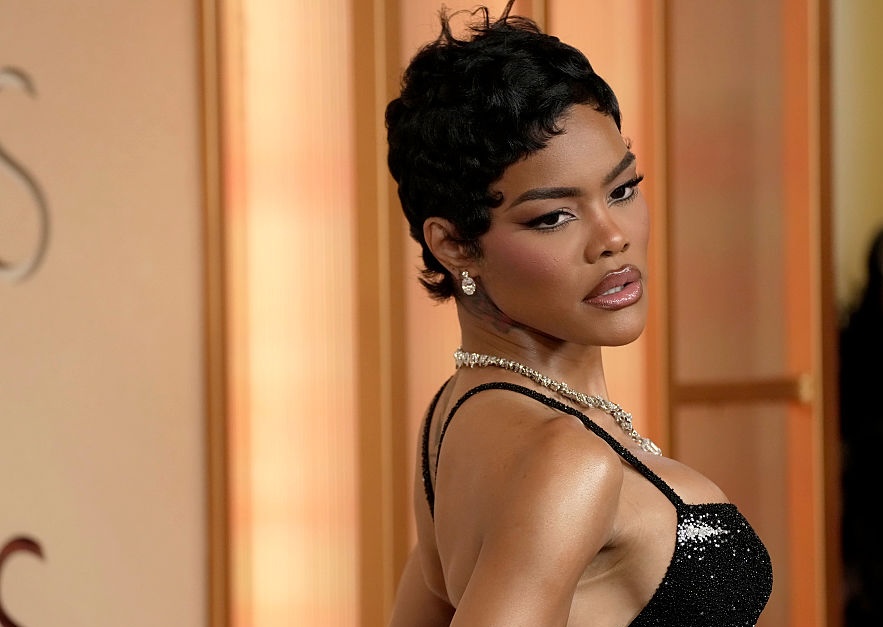
Teyana Taylor didn’t take home an Oscar at the 98th Academy Awards, but you wouldn’t have known from her reaction.
When another actress’ name was called, Taylor jumped to her feet, giving the biggest round of applause to the night’s winner. It was a moment of pure grace and happiness from Taylor. But for some, that was the problem.
Across social media, people questioned why Taylor would show such enthusiasm for someone else. Taylor met the moment with an answer that spoke volumes.
The world holds so much misery that miserable hearts forget the face of happiness.
They grow comfortable being sore losers, so when they see real sportsmanship it unsettles them! like holy water touching a demon. Because clapping for someone else’s victory requires something many… https://t.co/FxDGDhJseL— TEYANA M.J. TAYLOR (@TEYANATAYLOR) March 16, 2026
On X, she wrote, “The world holds so much misery that miserable hearts forget the face of happiness. They grow comfortable being sore losers, so when they see real sportsmanship, it unsettles them! like holy water touching a demon. Because clapping for someone else’s victory requires something many people never learned…how to win with grace & pure joy, and how to lose with grace, chin up & dignity.”
It seems people feel a certain way when Black women publicly express joy. There’s even a name for this type of gal: the Bubbly Black Girl. And that isn’t always meant as a compliment.
Scroll TikTok, and you’ll find Black women sharing how others want them to tone it down. One content creator, ItsmeUnique, states, “Being a bubbly Black girl is not for the weak, you’ll have women mugging you down because you’re trying to have a good time.” Adds fellow content creator, ItsYaa: “People don’t understand that a Black girl can also be bubbly. It throws them off sometimes.”
I find some commonality in their statements. I’m a self-titled BBG. Bubbly? Quirky? Happy-go-lucky? A little dorky? Yep, all words in my personality vocabulary.
Walking the streets of New York City, I know when to stay alert. But when something sparks joy inside me, I light up. It leads to a “Wow, you’re working that outfit,” cheer or calling out “puuuup-py” and “look at that little boo boo” when I see cute dogs and babies in the street. And I’m smiley. Like all the time. Why? Just because that’s my baseline.
For those of us who move through the world this way, tapping into life’s happy moments — especially around someone else — is a natural instinct. Sharing our enthusiasm isn’t a weakness; it allows us to revel in a joyous moment they are experiencing, which in turn brings happiness back to us.
Being a BBG bucks the stereotypical archetypes that Black women are expected to fall into: the strong one, the angry one, the self-sacrificing one. Any deviation from these roles can be read as something else, mainly whiteness.
Mainstream culture has repeatedly defined quirky, uninhibited joy with white characters. We’re not supposed to be the ones who are intriguing, approachable and even desired in our joyous state.
But joy is also based in our culture. Our mothers and mothers before them bathed us in cheer and warmth at home, in the church, and at cookouts. We’ve stood proudly in our beaming lightness through some of the most challenging times in history, and even today, as people try to dim it.
It’s not our job to fulfill perceived notions of Black womanhood. As it’s been said, we are not a monolith; it takes work to see and treat people as individuals, and we’re just living our individual truths.
So we’ll keep bopping to that latest alt song that hits our feed, singing show tunes like we’re headlining Broadway, and striking up conversations in the strangest of places as we reach out to have real human connections with others. We’ll keep clapping loudly for others basking in their happy moments.
We are full of joy and whimsy. And we’re not afraid to speak our mind if anyone tries to take that from us.