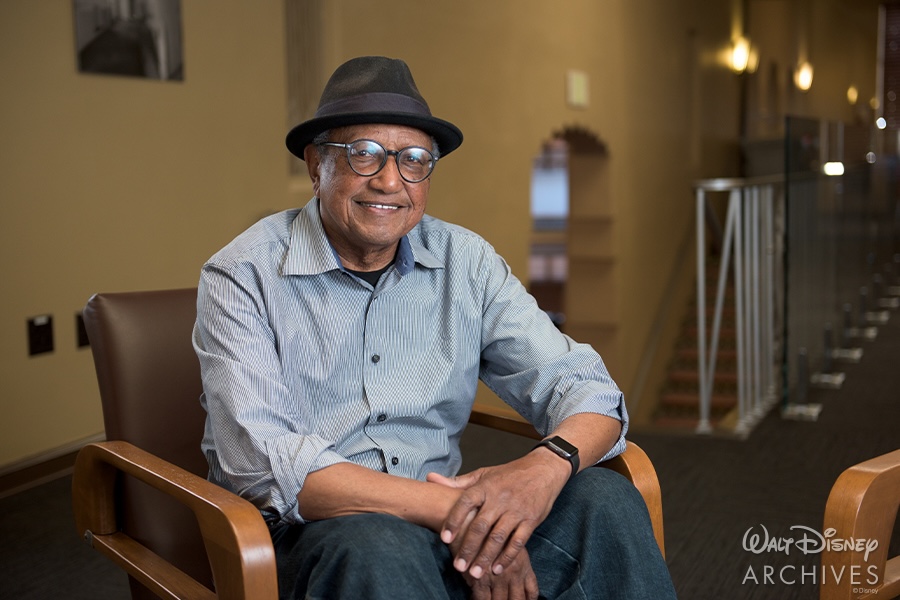
Whether you grew up watching The Jungle Book, crying through Mulan or laughing at Monsters, Inc., chances are you spent part of your childhood in a world Floyd Norman helped build. Over a career spanning more than seven decades, this pioneering animator, story artist and Disney Legend has contributed to some of the most influential animated projects in history, shaping the medium and breaking barriers at every turn.
This November, Norman, Disney’s first Black animator, will receive an honorary Oscar, recognizing his groundbreaking career and the role he played in shaping some of our most beloved animated projects.
Norman joined Disney in 1956, becoming the first Black artist hired into a long-term creative role at the company. He worked as an in-betweener and assistant animator on Disney’s fairy-tale classic Sleeping Beauty, his first major studio feature.
After serving in the military, Norman returned to Disney, where his credits and influence expanded. His sketches and storytelling skills caught the attention of Walt Disney himself. Norman contributed animation work to the groundbreaking Mary Poppins before joining the story department on The Jungle Book, the last animated feature personally overseen by Disney’s founder.
Norman briefly left Disney to co-found Vignette Films, one of the first Black-owned animation production companies, with animator Leo Sullivan. There, he worked on the original Fat Albert special, created animated segments for Sesame Street and helped design the iconic opening sequence for Soul Train. Afterward, he worked as a writer, storyboard artist, and designer on classic Saturday-morning cartoons for Hanna-Barbera, including Scooby-Doo, Josie and the Pussycats and Captain Caveman. He returned to Disney in 1973 and continued working on a variety of projects.
During the 1980s, Norman joined Disney Publishing, where he illustrated children’s books and worked on the daily Mickey Mouse comic strip. In the mid-1990s, he returned to Disney Animation’s story department, lending his expertise to some of the studio’s biggest hits. His storytelling talents also took him to Pixar, where he contributed story work to Toy Story 2 and Monsters, Inc., helping bridge the gap between Disney’s golden age and the computer-animation revolution. In 2007, he received one of the company’s highest honors when he was named a Disney Legend.
Norman continues to work in a variety of creative roles for Disney and beyond. In 2020, he returned to Sesame Street to create new animation for its 50th season. In 2024, he received a credit on Disney Jr.’s Ariel, helping bring a new version of the beloved fairy tale to young audiences.
Norman, who turns 90 on June 22, is still adding credits to a résumé that stretches from Walt Disney’s era to the streaming age. Here are some of the most iconic and memorable projects from his extraordinary career.
The First Disney Years
“Sleeping Beauty” from Sleeping Beauty
Sleeping Beauty (1959): For Norman’s first Disney feature, he worked as a clean-up and in-between artist on the studio’s fairy-tale classic.
One Hundred and One Dalmatians (1961): He served as an assistant animator on the groundbreaking film that introduced Disney’s Xerox animation process.
The Sword in the Stone (1963): For Disney’s adaptation of Arthur’s journey to become king, Norman worked as an assistant animator
Mary Poppins (1964): He contributed animation work to Disney’s innovative blend of live action and animation.
The Jungle Book (1967): On the last animated feature overseen by Walt Disney, Norman joined the story department and helped shape the film’s narrative.
Vignette Films Accomplishments
Soul Train animated opening
Hey, Hey, Hey, It’s Fat Albert (1969): Norman co-created the original animated special that launched the classic franchise.
Sesame Street (1969): One of television’s most influential children’s programs, he created educational animation for the long-running series.
Soul Train (1971): Norman helped to design the animated opening sequence for the groundbreaking music program.
Hanna-Barbera Era
A Flintstones Christmas Carol sequence
Josie and the Pussycats (1970–1971): Norman worked as a writer, designer and storyboard artist on the hit musical cartoon series.
Captain Caveman and the Teen Angels (1977–1980): He contributed story and design work to the Saturday morning favorite.
Scooby Goes Hollywood (1979): He worked as a layout artist on the animated television special.
Scooby-Doo! in Arabian Nights (1994): He served as a storyboard artist on the feature-length special.
A Flintstones Christmas Carol (1994): For this holiday adaptation of the Dickens classic, he created storyboards.
A Disney Renaissance & Pixar
Toy Story 2
The Hunchback of Notre Dame (1996): Norman returned to Disney Animation as a story artist during the studio’s renaissance.
Mulan (1998): He worked in the story department on one of Disney’s most acclaimed animated films.
Toy Story 2 (1999): Joining Pixar, he was an additional story artist on the groundbreaking sequel.
The Tigger Movie (2000): He contributed to story development for this theatrical adventure.
Dinosaur (2000): He helped shape the story of Disney’s ambitious CGI-live action hybrid.
Monsters, Inc. (2001): On Pixar’s beloved monster comedy, Norman worked as an additional story artist.
Cinderella II: Dreams Come True (2002): He contributed story work to the sequel to Disney’s classic fairy tale.
Kronk’s New Groove (2005): He served as a story artist on the spin-off of The Emperor’s New Groove.
The Legacy Continues
Disney Jr.’s Ariel premiere episode
Sesame Street 50th Anniversary (2020): Norman returned to the children’s educational series to create new animation for the landmark season.
Mickey: The Story of a Mouse (2022): He appeared as himself in the documentary celebrating Disney’s most iconic character.
Disney Jr.’s Ariel (2024): He received a credit on the preschool reimagining of The Little Mermaid.
The Greatest Gift (2025): Serving as a character designer, this latest project extended Norman’s remarkable career into a seventh decade.