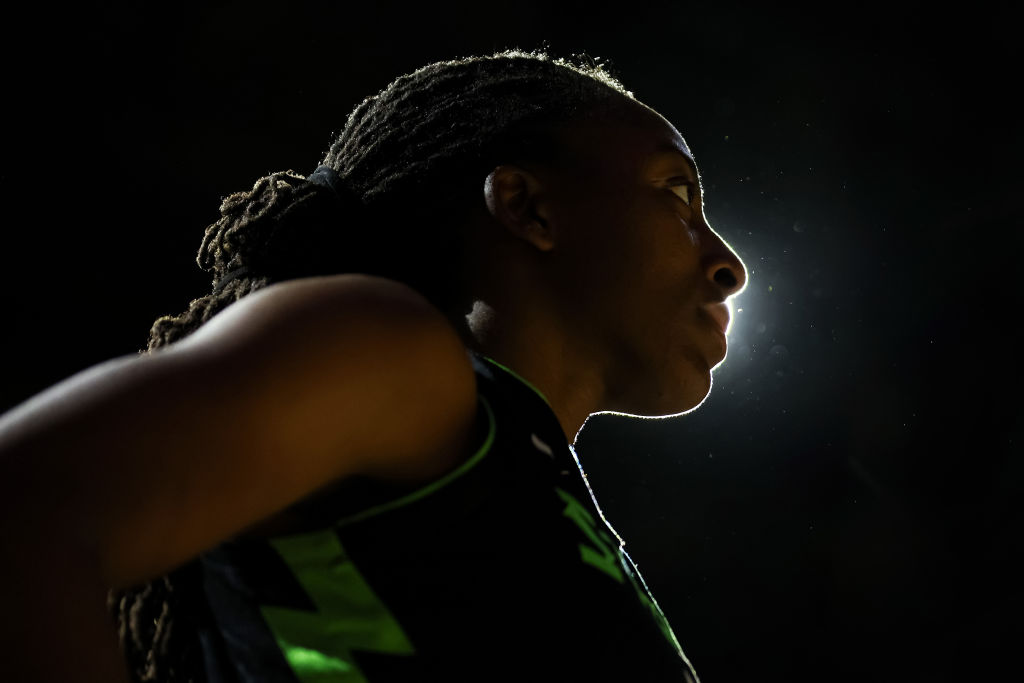
There is a temptation, in telling stories about leadership, to go looking for the dramatic confession, the sleepless nights, the private breakdown, or the monologue that explains how history was made. Nneka Ogwumike, president of the Women’s National Basketball Players Association (WNBPA), does not really give you that.
What she gives instead is something more practical, and maybe more revealing.
Ogwumike knows what the WNBA looked like before the recent negotiations. She knows it as the No. 1 pick in the 2012 draft, a former MVP, a WNBA champion, and a multiple-time All-Star.
And, for the past several years, she has sat in the seat of president for the labor group that helped push the league to a new seven-year collective bargaining agreement. A deal that will reshape player salaries, benefits, and working conditions through 2032.
So, when Ogwumike talks about what this deal means, she is not doing it from afar. She is speaking as someone who has lived nearly every version of the modern WNBA: the cornerstone player and the union leader. And now, as reported by ESPN, the franchise icon will return for her 13th season in purple and gold with the Los Angeles Sparks.
When asked what it felt like to help guide players through one of the biggest labor negotiations in league history, Ogwumike did not cast herself as the hero. She talked about the standard she felt responsible for upholding. She talked about calling and texting players one by one, learning how different people communicate, and making room for them to say what they actually needed.
“I was cold calling people,” she said.
The stakes of the WNBA’s new deal were never symbolic. Nearly unanimously approved by players and ratified by the league’s Board of Governors, it is expected to lift the 2026 salary cap to $7 million from $1.5 million in 2025, raise the year-one maximum salary to $1.4 million, and push average salaries above $583,000. It also expands family-planning support, mental-health benefits, retirement contributions, player-experience standards, and recognition payments for retired players.
For stars, that means money the league has never offered before. For everybody else, it means something just as important: the middle of the roster gets stronger, the floor gets higher, and rookies entering the league now have a clearer shot at a sustainable professional life than the women who came before them.
That’s where Ogwumike comes into focus.
Speaking from Houston, where she spends the offseason, Ogwumike wasn’t interested in taking a victory lap. When addressing her role as president of the union, she did not begin with ambition. She started with the people who poured into her: family, coaches, teammates, and mentors who, in her words, “spoke life” into her.
Ogwumike describes herself as somebody who tries to “stay out the way” and be “an asset and not a liability,” someone who has at times even underestimated what she could contribute.
That is not fake humility. It’s how Ogwumike sees the work.
It also explains why she is so careful when she talks about the players’ association itself. The word president can lead to assumptions that the whole operation had one face, one name, one person for the public to project onto.
Ogwumike insisted we resist that sentiment.
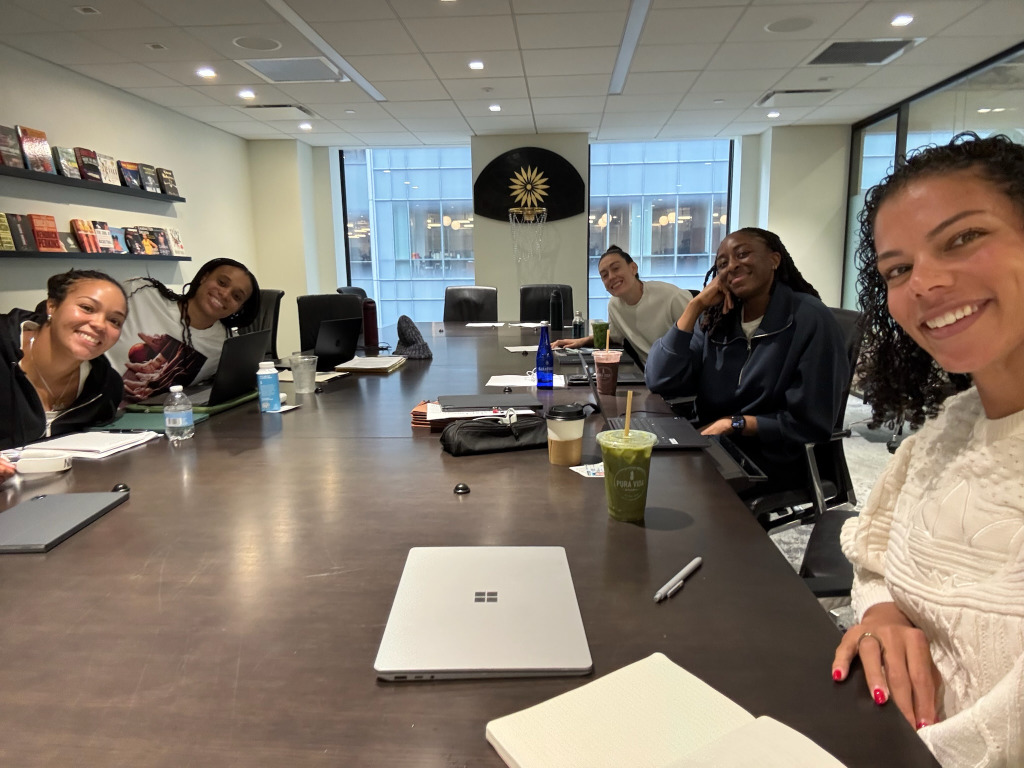
The WNBPA, as she explained it, is a board of player representatives, an executive committee, staff and delegation. Her job was not to act alone. It was to help carry out what the players want, alongside first vice president Kelsey Plum, treasurer Brianna Turner, secretary Elizabeth Williams, and vice presidents Alicia Clark, Napheesa Collier and Breanna Stewart.
Even though this was a team effort, the process does not always go as smoothly as one would hope.
At one point, an open letter from Stewart and Plum fed the perception that the union might be fractured. Ogwumike saw that moment differently. “There were many moments in the process,” she said, “that called for us to consider the importance of meaningful participation and engagement.”
What mattered most was maintaining an environment that welcomed “open expression and varying perspectives” in service of a transformational deal. What read publicly as tension, she framed as part of the work.
Still, this kind of work gets personal.
Ogwumike said the 2020 negotiations taught her that lesson the hard way. Back then, she threw herself fully into the CBA talks and the work of helping shape the WNBA’s bubble season, admitting that she may have overstretched herself to the point that it affected how she performed on the court.
This time, she said, she was better. Better at trusting the executive committee. Better at delegation. Better at understanding that leadership did not require her to physically carry every piece of the load herself.
The details of how she managed that are telling.
During the offseason, Ogwumike trains from 4 a.m. to 9 a.m. She starts with a lift in her garage to activate and then gets to the gym early so she can finish while you’re still trying to figure out breakfast. This gives her the rest of the day for CBA business.
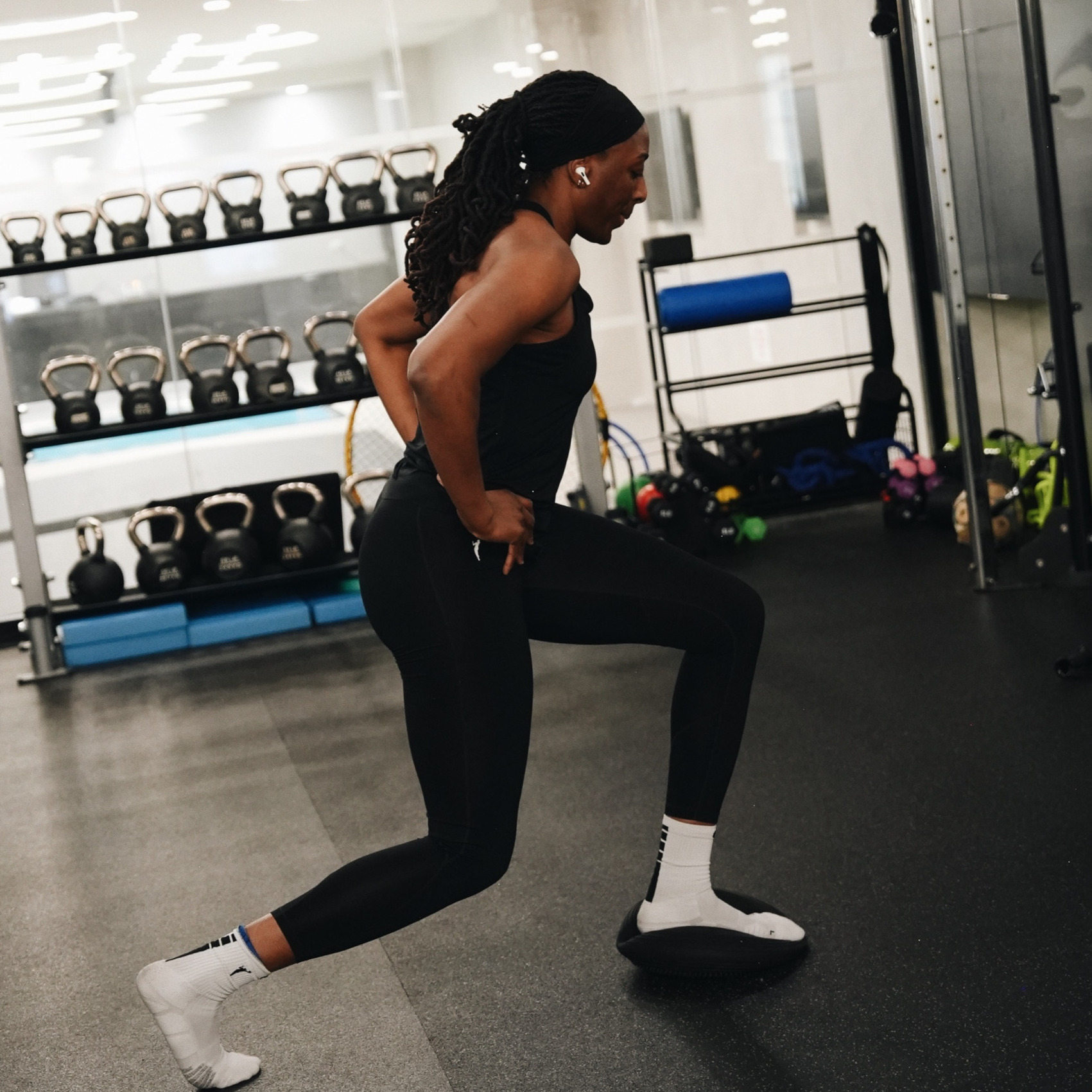
Training and negotiating. Training and negotiating. Even when she joked that those eight days of 100-plus hours of negotiations threw her routine off, the point was clear — structure was part of how she kept herself together.
So was her family.
Ogwumike laughed when sharing that her family is always “on 10” when it comes to defending each other. If you watched her younger sister, former WNBA player and ESPN analyst Chiney Ogwumike, cover the negotiations on air, you could already see that family instinct at work.
But the older sister knew when to engage in certain conversations and when to leave things alone before her sibling went into full protector mode. “What mattered most was knowing that my whole family had my back while I kept my own boundaries intact,” she said,
If there is a place where her voice really changes, though, it is not when she talked about herself. It is when she talked about former players.
One of the more meaningful pieces of the new agreement is the recognition payment for veterans and retired players. According to the WNBA, these payments range from $30,000 to $100,000 based on years of service. It is not a pension, and Ogwumike is clear that the union still wants to build toward more. But it is a tangible acknowledgment that the women who laid the groundwork for today’s boom should not be left out of the league’s growth.
Putting the team ahead of herself, Ogwumike specifically credited Alicia Clark, Brianna Turner and Erin Drake on the union staff for helping think creatively about what that retired-player structure could look like. She talked about the hard conversations behind it, the effort to figure out what was possible now while still building toward something bigger later.
Then she got to the part that mattered most, hearing from former players afterward. “We weren’t going to leave the CBA,” she said, “without being able to show for something that these players left and gave the foundation for.”
Then came a slight crack in her cool measured exterior as she remembered, “Chiney was going crazy,” Ogwumike said, when she realized she would be receiving a $50,000 legends-fund payout. To which, Ogwumike immediately informed her sister that she could pick up the next check at dinner.
That little exchange does what good details are supposed to do. It translated policy into life. It reminded us that labor wins do not only live in announcements and salary charts. They show up in texts, in laughter, and in the kind of family jokes that say more than any press release ever could.
For years, women’s basketball has been asked to prove itself over and over again. The outside and naysayers have asked it to justify its audience, its relevance, its stars, its economics, its place in the sports conversation.
This agreement does not end all of that. But it does change the terms. It says the players at the center of the league’s growth are no longer negotiating from the same old floor. It says the next generation will enter a league with more leverage, more support, and an honest chance of a sustainable professional life.
Even now, Ogwumike sounds less finished than grateful. “There is still more to do,” she stated. “Still more to enjoy.”
And when asked where this moment belongs alongside the rest of her career, there was no hesitation. “Right next to the championship ring,” she declared. Congruent measures of achievement, on and off the court.
And that might be the clearest way to tell this story.