
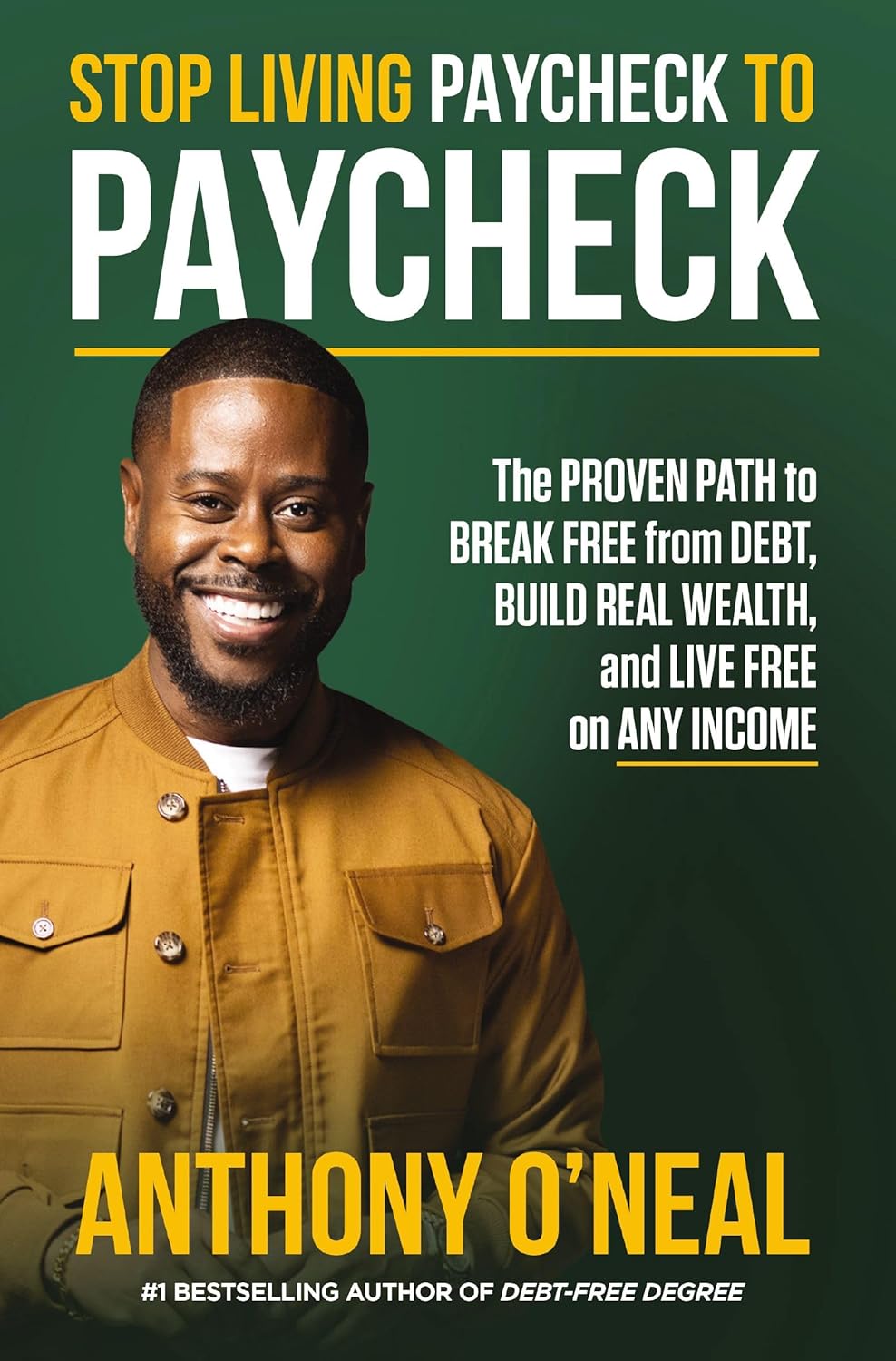
“Everything in these pages is designed to lead you toward freedom — freedom to be present with your family, freedom to build a career that means something, freedom to be generous, and freedom to enjoy nice things without stressing about how you’re going to pay for them later,” Anthony O’Neal declared.
He’s talking about his new book, Stop Living Paycheck to Paycheck. Inspired by the report, O’Neal was moved to help Black Americans stop spending mindlessly. “Zero doesn’t mean homeless or jobless; it means no buffer. Nothing left over after the bills are paid,” he explained with a sobering statement. “We spend more than we earn … you can’t escape a trap you refuse to admit you’re in.”

With his “Escape Plan,” a five-phase structure of building a strong financial house, he’s determined to break the cycles. “Our culture also teaches us that the look of wealth is wealth. And most people chase that look straight into debt, trying to prove something they haven’t built yet. That’s “fake it till you make it,” and it’s exponentially destructive,” he shared. “We’ve got to make finances a priority because we can’t afford to wait on a system to save us, and we can’t afford to keep performing wealth instead of building it.”
Read on for an excerpt from the book to begin your path to the ultimate gift: financial freedom.
_____________________________________
The year stopped me in my tracks: 2053.
It was a regular weekday, and I was doing some research for my podcast, The Table with AO. Then a headline reached out and smacked me across the face: “Median Wealth of Black Americans ‘Will Fall to Zero by 2053,’ Warns New Report.”
I thought, What? That can’t be right. That can’t even be close to right—can it?
The report, called “The Road to Zero Wealth,” was put together by the Institute for Policy Studies. Sure enough, the authors worked through census data and lots of other information, including net-worth figures from the Federal Reserve Board’s Survey of Consumer Finance. They tracked the downward movement of wealth and net worth in Black households, then projected what the future will be like if those trends continue.
The results were bleak. By the year 2053, they predicted, the median wealth of Black Americans would fall to $0.00. The same thing would happen to Latino Americans twenty years later in 2073.
Just to be clear, having zero net worth doesn’t mean being homeless or jobless. It doesn’t mean having an empty bank account. No, the report was talking about wealth in terms of savings, investments, and other assets that can be put to use whenever needed. Wealth is the money left over after all the bills are paid and all the debts are subtracted.
That distinction is critical. To use the language of the report:
Wealth is the buffer families need when faced with unexpected economic shocks like a lost job or a broken-down car. Wealth is also the capital available to families to take advantage of economic opportunities, like buying a home, saving for college or investing in the stock market. Ultimately, wealth can be the difference between a family maintaining and strengthening their economic status or flailing in economic insecurity.
So you may have a college education or a graduate degree, but if you’re carrying student loans everywhere you go, you don’t have wealth. You can have a good job and a good salary, but if you spend more money than you earn, you don’t have wealth. You can have a beautiful BMW or even an Escalade sitting on 24s, but if you financed your ride with a monthly interest payment, you don’t have wealth. You can have an apartment packed with TVs and laptops and nice furniture and nice clothes, but if you bought all that stuff with a credit card and you’re only making the minimum payments, you don’t have wealth.
That’s bad news. Because if you don’t have wealth, you’re living paycheck to paycheck. Which means you’re one problem away from financial disaster.
Many people today are stuck in that reality, and they come from all demographics—Black, White, Latino, Asian, young, old, single, married, and more. They’re not just what we think of as “poor people” either. Millions of Americans in the middle class have a low or negative net worth, which means they’re living paycheck to paycheck.
I was shocked by the report because it showed me how things are getting worse, not better. More and more Americans are being dragged into the trap of living paycheck to paycheck.
Most of this book is dedicated to showing you how to get out of the trap. But before we go there, I think it’s important to take a step back and ask ourselves why. Specifically, why are so many of us stuck in this cycle? Why are we living paycheck to paycheck?
In my experience of listening to thousands of people talk about their financial houses (or lack thereof), the answer can be boiled down to three main factors: destructive decisions, a corroded culture, and misguided mindsets.
Destructive Decisions
Let’s start with some brutal honesty. The main reason why so many people are stuck living paycheck to paycheck is because we as human beings often make poor choices. We buy things we can’t afford. We spend more money than we earn. And we keep doing it year after year after year until we move from being in debt to being in crisis.
Here are some facts we have to deal with if we want to take an honest look at our financial situation.
For starters, I mentioned in the Introduction that 77 percent of Americans would find it “somewhat difficult” or “very difficult” to meet their financial obligations if their paycheck was delayed by just one week. That’s a bad situation, and I can empathize because I’ve been there. But that’s also a bad decision. Not having enough savings in the bank to cover a delay in getting paid—or worse, not having enough to cover an emergency or any other unexpected expense—is a choice.
Now, some people might hear that and think, A choice? It sure ain’t my choice not to have any money in the bank.
Yes, it is. It’s a choice only you can make—you and your spouse, if you have one. Because you are the ones who choose how to spend whatever money you earn in a given week, month, or year.
But Anthony, it’s not my decision to get paid this little. If I had a bigger salary, I’d have a bigger savings.
No, no, no. That’s a lie I told myself a hundred times back when I was living paycheck to paycheck. A thousand times! I know it makes us feel better, but it’s still a lie.
Why do I say it’s a lie? Well, right around 35 percent of households that earn under $50,000 a year are living paycheck to paycheck. That’s a big percentage, but that also means 65 percent of households that earn under $50,000 a year don’t live paycheck to paycheck. They’re in the same salary range, but they manage to save for the future and build up a financial cushion.
There’s more. Among households that earn between $75,000 and $100,000 a year, more than 20 percent still live paycheck to paycheck. We find the same thing when we look at households earning more than $150,000 a year: About 20 percent live paycheck to paycheck. They spend most of their money just to cover the essentials.
See, it’s easy to get trapped in a mindset that says, “I can’t be financially responsible because I don’t earn enough money.” The problem is people tend to maintain that way of thinking no matter how much they earn. When they get a raise at work, they raise their spending. They never build the margin that’s necessary for a strong financial house.
Of course, there’s a bigger problem out there, which is families and individuals who don’t just spend everything they earn in a week, month, or year; they spend more than they earn. Sometimes way more. That’s another bad decision.
Back in 1999, American consumers carried a total of $478 billion in unpaid credit card debt. Which . . . is a lot of money. You could buy all thirty-two NFL teams for less than $300 billion. And it’s not just the amount of money we owe to creditors—we’re also paying huge interest rates on that money. We owe more and more every month even if we don’t buy anything new.
Okay, so in 1999 we owed $478 billion. Twenty years later, Americans were carrying about $770 billion in unpaid credit card debt. And just five years after that, in the third quarter of 2025, the number skyrocketed to $1.23 trillion. Trillion! As consumers, we are paying monthly finance fees on more than a trillion dollars in debt.
That’s not a bad decision. That’s a terrible decision. It’s killing us. It’s killing our families. And it’s getting worse every year.
Right now you might be thinking, Anthony, you don’t know my story. You don’t know what I’ve gone through. You don’t know all the reasons why I’m struggling financially.
That’s true. I don’t know everything you’ve experienced, and there are many valid reasons why people get stuck behind the eight ball when it comes to their finances.
Life hits hard. Illness and injuries often come out of nowhere, and medical bills drag us down like quicksand. I’ve seen it happen. Systemic racism is a reality that affects millions of Americans, including my own family, often in ways that are difficult to address or avoid. There are mental health issues. There are natural disasters. There are people who get downsized for no other reason than corporate greed.
So let me be clear: I’m not saying every dollar of debt is the result of poor financial decisions. I understand we all face challenges that are outside of our control, and many of those challenges have huge and harmful impacts on our financial health.
At the same time, I do hope you can take a step back and ask yourself some honest questions. Am I spending more than I should based on what I earn? Do I have a plan for my money, or am I just winging it month to month? Have I taken any real steps to prepare for life hitting me with something I didn’t see coming?
Adapted from Stop Living Paycheck to Paycheck: The Proven Path to Break Free from Debt, Build Real Wealth and Live Free on Any Income. Copyright © 2026 by Anthony O’Neal. Published by Thomas Nelson. Available wherever books are sold.