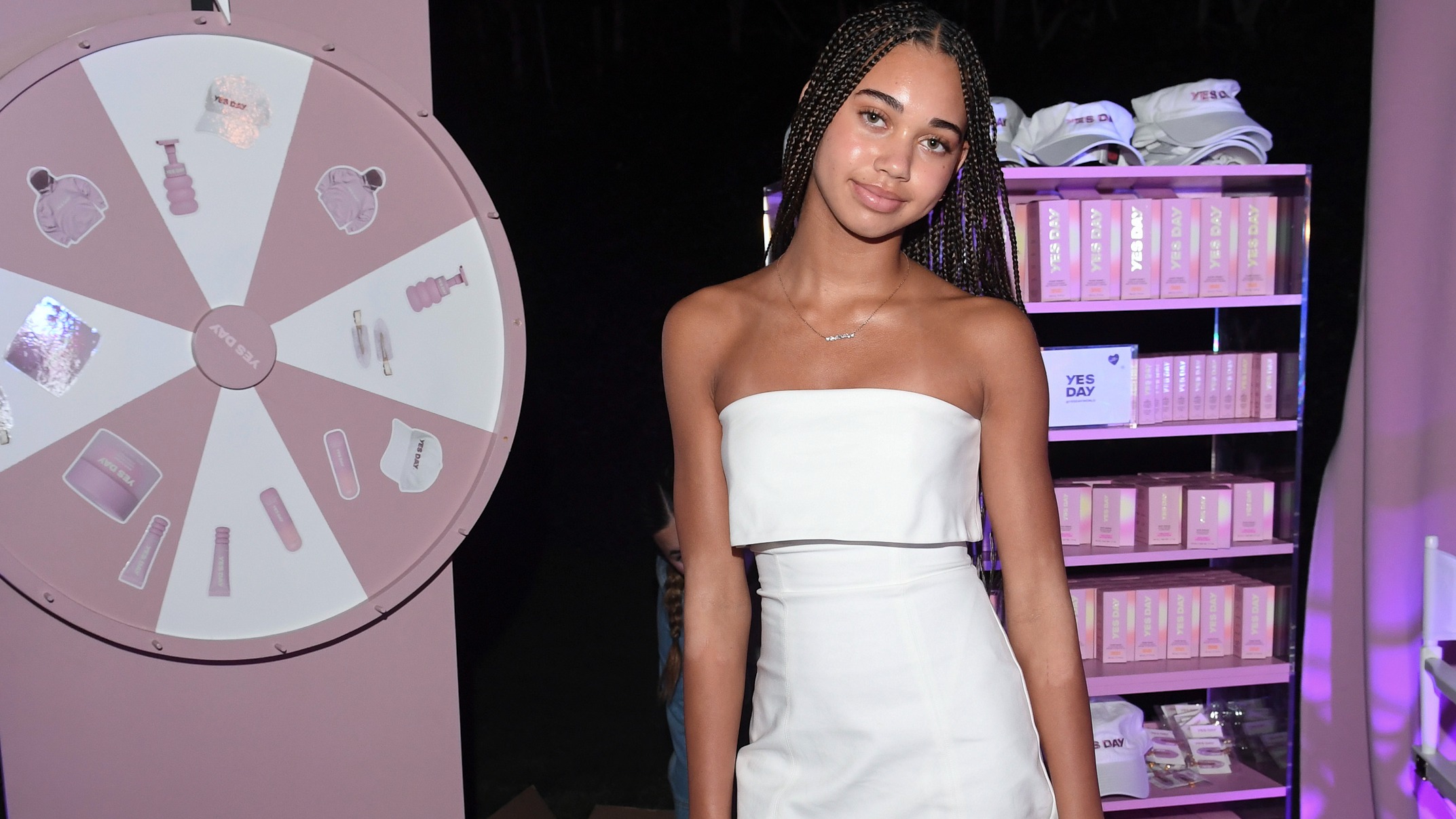
At 14, most teenagers are navigating high school, figuring out their personal style and discovering who they want to become. Coco Granderson is doing all of that while running a beauty brand. The founder of Yes Day has already accomplished what many aspiring entrepreneurs spend years working toward, including developing her own skincare line, getting products into customers’ hands and earning a spot on EBONY’s 2026 Power 100 list as a Generation Next honoree. Not bad for someone who still has homework.
For Granderson, the recognition is exciting, but she’s still wrapping her head around the company she’s building and the people she’s finding herself alongside. “I didn’t think I would make it this far this quickly,” she tells EBONY. “To be honest, I didn’t realize what a big deal it was to be on the list until I saw the other honorees in my category. It’s so cool to be named next to all of these incredible young people. I’m a fan of all of them!”
Her journey into beauty began the way it does for many young girls: sleepovers, face masks and an appreciation for anything with cute packaging. Skincare quickly became more than an occasional activity with friends. It was a ritual, something she looked forward to at the end of the day. However, as her interest grew, so did the realization that the beauty industry wasn’t necessarily creating products with girls her age in mind.
“I’ve always been obsessed with skincare,” she explains. “I started with face masks at sleepovers with my friends, and I’d try anything with cute packaging. It was fun, but it was also my self-care.”
The problem? Many of the products she gravitated toward contained ingredients that weren’t suitable for her young skin. Her mother began examining ingredient lists after noticing irritation, and their trips to Sephora revealed a gap in the market. Products marketed toward children felt too juvenile, while adult skincare formulas weren’t always appropriate for younger consumers. Granderson wasn’t interested in choosing between the two. She wanted something that reflected her generation without compromising on the formulas.
“My friends felt the same way,” she says. “We needed something just for us, with clean formulas and cool packaging, so I created Yes Day.”
It’s a particularly interesting moment to enter the beauty industry. Younger consumers are becoming increasingly interested in skincare, thanks in part to social media, where elaborate routines and expensive products have become a form of entertainment. Yet the growing fascination with beauty has also sparked conversations about whether children need the same products being marketed to adults. Granderson’s approach offers a different perspective. Rather than encouraging girls to adopt complicated routines before they need them, Yes Day champions simplicity.
“You don’t need a 10-step routine to be beautiful,” she says. “All you need is a simple, easy routine to glow and feel confident.”
That philosophy extends beyond the formulas. Yes Day’s packaging includes affirmations such as “Feeling Good Looks Good on You” and “You Shine Through,” reminders that beauty shouldn’t begin and end with what someone sees in the mirror. Granderson even considered naming the company Simply Beautiful before settling on Yes Day. The message remains the same: confidence isn’t something that can be purchased in a bottle.
Of course, creating a beauty brand and actually selling it are two entirely different experiences. Granderson learned that lesson firsthand while working a Yes Day pop-up cart at The Grove in Los Angeles last November and December. After school and on weekends, she found herself pitching products to shoppers, some of whom weren’t particularly interested in hearing what a teenage founder had to say.
“I never imagined how hard it would be to sell my own products!” she admits. “I had to put myself out there, and I faced a lot of rejection at that cart. People said no or just ignored me. Honestly, I wanted to give up, but I kept going.”
For someone whose generation is often associated with instant gratification, Granderson is learning that entrepreneurship requires patience that can’t be accelerated by a viral moment. A cute product might attract attention, but convincing consumers to spend their money requires persistence and the willingness to hear no. The experience also changed her understanding of success.
“It’s not about what other people think. It’s about doing the work and loving what you do,” she explains. “It’s also given me so much more respect for the entrepreneurs who came before me in beauty.”
Some of that perspective comes from watching women who have already established themselves within the industry. Granderson counts her mother, Kelly Rowland and Topicals co-founder Olamide Olowe among her inspirations. Each represents a different relationship with beauty, from her mother’s minimalist skincare philosophy to Rowland’s consistency and Olowe’s ability to build a culturally relevant company without relying on celebrity status.
“They show me that you can build something meaningful by staying true to your vision, even if you are not a celebrity,” she says of Olowe and her co-founder.
That doesn’t mean everyone has always taken Granderson seriously. In fact, some of her earliest skeptics were other teenagers. When she first shared her plans to launch a beauty company, classmates and peers assumed it was little more than a hobby. She found encouragement in an unexpected place: rooms filled with adults.
“Fortunately, Ron Robinson and his team of cosmetic chemists always took me seriously,” she recalls. “I would show up to meetings full of adults (I was so nervous) and they always made me feel like my ideas mattered.”
The experience helped her recognize something established beauty executives spend considerable time and money trying to understand: the perspective of their youngest consumers. Granderson doesn’t need to imagine what girls her age want from skincare because she’s experiencing those needs in real time.
“Now I actually see being young as my advantage,” she says. “I’m the customer. I know what girls my age want because I’m one of them, and nobody can tell me that’s not real.”
Her instincts are already receiving industry recognition. In addition to her Power 100 honor, Yes Day’s Whip Dream Moisturizer was recognized at EBONY’s 2026 Beauty and Grooming Awards, an accomplishment that reinforced her belief in the products she’s creating.
“Seeing our Whip Dream Moisturizer recognized told me that what we’re making really works for girls like me,” she shares. “It made me feel even more seen.”
For a young Black founder, that visibility carries significance beyond an award or an impressive résumé. The beauty industry has spent decades evolving its relationship with Black consumers, creators and entrepreneurs, many of whom have had to fight for space on shelves that weren’t originally designed with them in mind. Granderson is entering the business with a different set of expectations. She isn’t waiting for someone to make room for her. She’s creating a brand that reflects her experiences and inviting other girls to see themselves in it.
Granderson also understands that her audience will evolve because she’s evolving alongside it. Acne, for example, has recently become part of her own skincare journey, inspiring ideas for future Yes Day products. She wants to continue developing formulas with input from her friends and community, ensuring the brand grows with its customers rather than leaving them behind.
As for her personal five-year plan, college is definitely on the agenda, possibly somewhere in Paris or another European city. Running Yes Day, however, isn’t something she intends to put on hold while pursuing her education. Her ambitions extend beyond the United States, with hopes of making Yes Day a globally recognized introduction to skincare.
“I want Yes Day to be the brand every girl thinks of when she starts her first skincare routine, not just in the U.S. but around the world,” she says.
She also wants the company’s growth to create opportunities for giving back, whether through product donations, school visits or community events that allow her to connect directly with girls who share her interests. For Granderson, building a successful business and encouraging the next generation of Black entrepreneurs aren’t separate ambitions. They’re part of the same vision.
At an age when many people are still being asked what they want to be when they grow up, Granderson has already discovered that she doesn’t need to have every answer. She can be a student, a teenager figuring out her skin and a beauty founder with international ambitions, all at once. Her story isn’t simply about getting an early start. It’s about understanding that an idea doesn’t become more valuable just because the person behind it gets older.
“The legacy I hope to build is that when the next girl walks into a store and asks if there’s anything made for her, the answer is yes!” she says. “For young Black girls especially, I want them to see that you don’t have to wait until you’re grown up to start something. If you have an idea, you can build it now.”