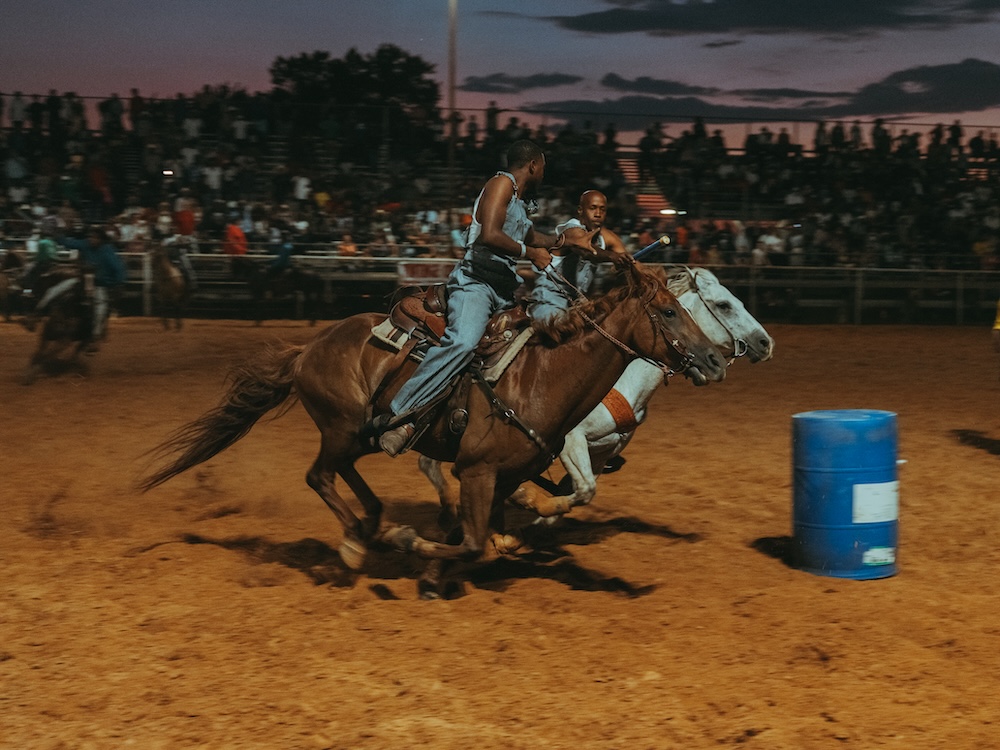
As the American West has often been painted in narrow strokes, Ivan McClellan is here to reframe the picture with a full brush of color. The visual artist and filmmaker has spent the last decade amplifying Black rodeo culture, best known for his long-running project and book, Eight Seconds: Black Rodeo Culture: Photographs. McClellan has traveled the United States documenting the lives of Black cowboys, cowgirls, and ranch hands.
In this world, he captures the grit, grace, and athletic prowess of Black cowboys and cowgirls, a community that has historically been erased from the mainstream cinematic and literary “Old West” mythos. His work encompasses more than just aesthetic documentation; he’s writing historical wrongs by reminding the public that an estimated one in four cowboys in the 19th century were Black.
Along with his work as a photojournalist, McClellan launched the 8 Seconds Rodeo. With the aim to elevate this culture through media and live events and encourage Next Gen to continue the legacy, past rodeo events have been held in Portland, Oregon, and Philadelphia. This year, he’s set to return to Portland in June.
Without question, McClellan is dedicated to celebrating the long heritage of urban and rural Black communities, where the Black rodeo is a sacred space where tradition is passed down through generations.
EBONY caught up with McClellan to discuss the erasure of Black cowboy culture throughout American history, his book, and why the Black rodeo is the quintessential space for Black joy.
EBONY: Do you remember your first memory about Black cowboy culture?
Ivan McClellan: Growing up, Mr. Wills, whose daughter went to school with me, had 15 head of cattle. He would be out there feeding them, and we thought something was wrong with him. It didn’t smell good over there, and I didn’t really think of him as a cowboy, because in movies and TV, they were all white folks. We just thought it was weird stuff that Black people shouldn’t be doing.
But I would go to the rodeo, the American Royal in Kansas City, where I grew up, and everybody there was white.
How was it for you to witness Black rodeo culture for the first time?
It wasn’t really until 2015 that I went to a Black rodeo, and it all just connected. I saw thousands of Black cowboys, many from Kansas City. It just hit me like a ton of bricks. I met a man named Robert Criff, and he had a beautiful blonde horse named Summertime. It turned out that he lived about a quarter mile from the house where I grew up and had a whole horse ranch in the field behind our house. So, it’s been a crazy journey and a real redefinition of home.
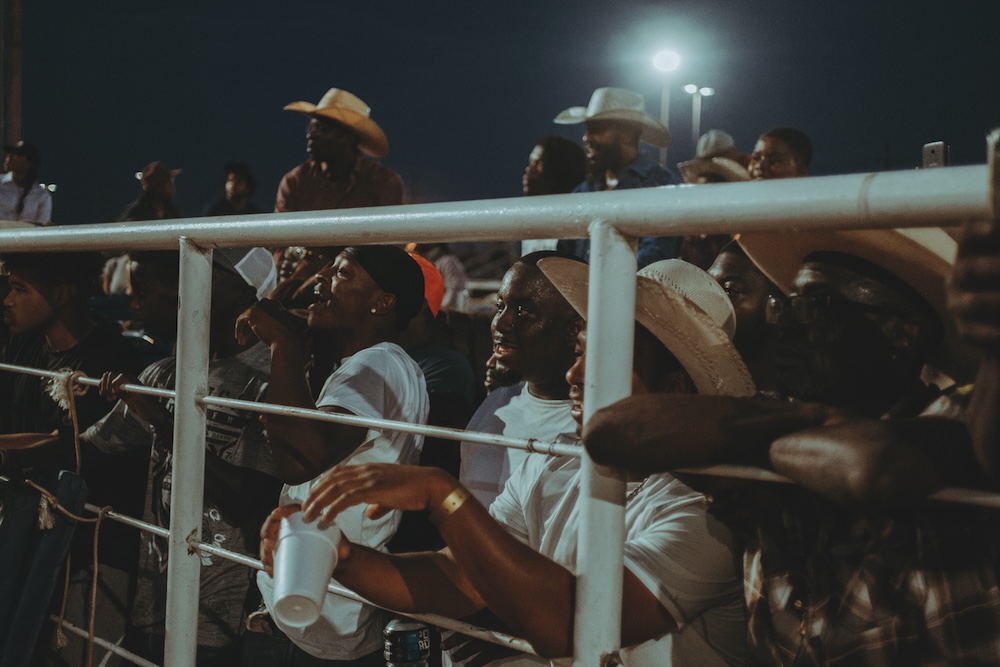
At that first rodeo, I saw Black women riding horses at 50 miles an hour, their braids blowing behind them and acrylic nails clutching the reins. I’m sitting there, and people are doing the “Cupid Shuffle” in their boots. I’m sitting there with a smoked turkey leg and a Strawberry Pop trying to take pictures. There were kids running around, young men on horses talking trash to other horse riders. They’re wearing gold chains. They’ve got grills. It was just astonishingly beautiful.
What was the moment that led you from watching the rodeos as a fan to documenting Black rodeo culture as an artist?
Eight Seconds is my photography platform. It came about because after three years of going to these rodeos obsessively. My wife was like, “What are we doing? This is super expensive, and you have to have a plan. You took these photos, and you didn’t even post them anywhere.” So, I started an Instagram account and needed a name. I called it Eight Seconds because eight seconds is how long you have to ride a bull or a bronco to get a qualifying score. You can either go home with nothing, or you can go home with thousands of dollars.
How was the process of curating your own rodeo?
I shot hundreds of rodeos. If there wasn’t a Black rodeo, I would go to a Mexican rodeo or a Native American rodeo. I wanted to be on the fences watching people do extraordinary things. In 2022, I started thinking I could put on one of these events, and I think I can do it better than anyone else is right now. I don’t know why I thought that, because I had never thrown a birthday party before. There were white athletes competing for hundreds of thousands of dollars, and these Black athletes were competing for 10s of thousands of dollars. There was a huge delta, and I believed we could elevate these Black athletes at rodeos.
We put on our first event in Portland, Oregon, back in June. It took about 8 months to put it together, and we sold 2,000 tickets. We loaded in 2 million pounds of dirt, and I had 30 athletes show up. They didn’t know what the hell was going on, but they supported me, and they wanted me to win. We gave away $60,000 in prize money that first year, and the vibe and the energy of that first rodeo were insane. It’s something that we’ll never be able to repeat.
I know that the Spirit of the Lord was over that event. I could feel it in the room, and everybody could. Although we didn’t know what we were doing, we had divine assistance, and it went off remarkably well. We kept doing it for the next couple of years, and it grew from 2000 people to 7000.
Philly showed up hard for the rodeo, which was our first on the East Coast. People were going crazy when the DJ dropped Meek Mill. It was very, very different. About 90% of the crowd there had never seen a rodeo, and it was incredible.
Did your work come to national prominence around the same time as Beyoncé’s Cowboy Carter was released? That timing was perfect for Black people to reclaim this culture.
Amazingly, I had photos from 2015 all the way through 2023. I was shooting photos up until the book, until the book publisher told me to stop. The book came out on the same day as Cowboy Carter. We sold out all of the books and almost every ticket to the rodeo because of the timing. It was an enormous blessing to be on the same track as someone as relevant and culturally impactful as Beyoncé. It felt like an enormous gift.
Lastly, with 8 Second Rodeo shows forthcoming, what other projects are you working on?
You’re the first person that I’ve talked about this with. But I have a new book coming out this year from our Italian publisher, Damiani. That book is a continuation of the first book. Every time that I release something, every time that I do something, I’m like, “I’m done.” But it’s like, God’s not done, and I keep going. So, the new book is coming out in June. It’s called Eight Seconds, Legacy in Motion. I think it’s really beautiful and a low-key way to experience the place and the people that really make this thing special.