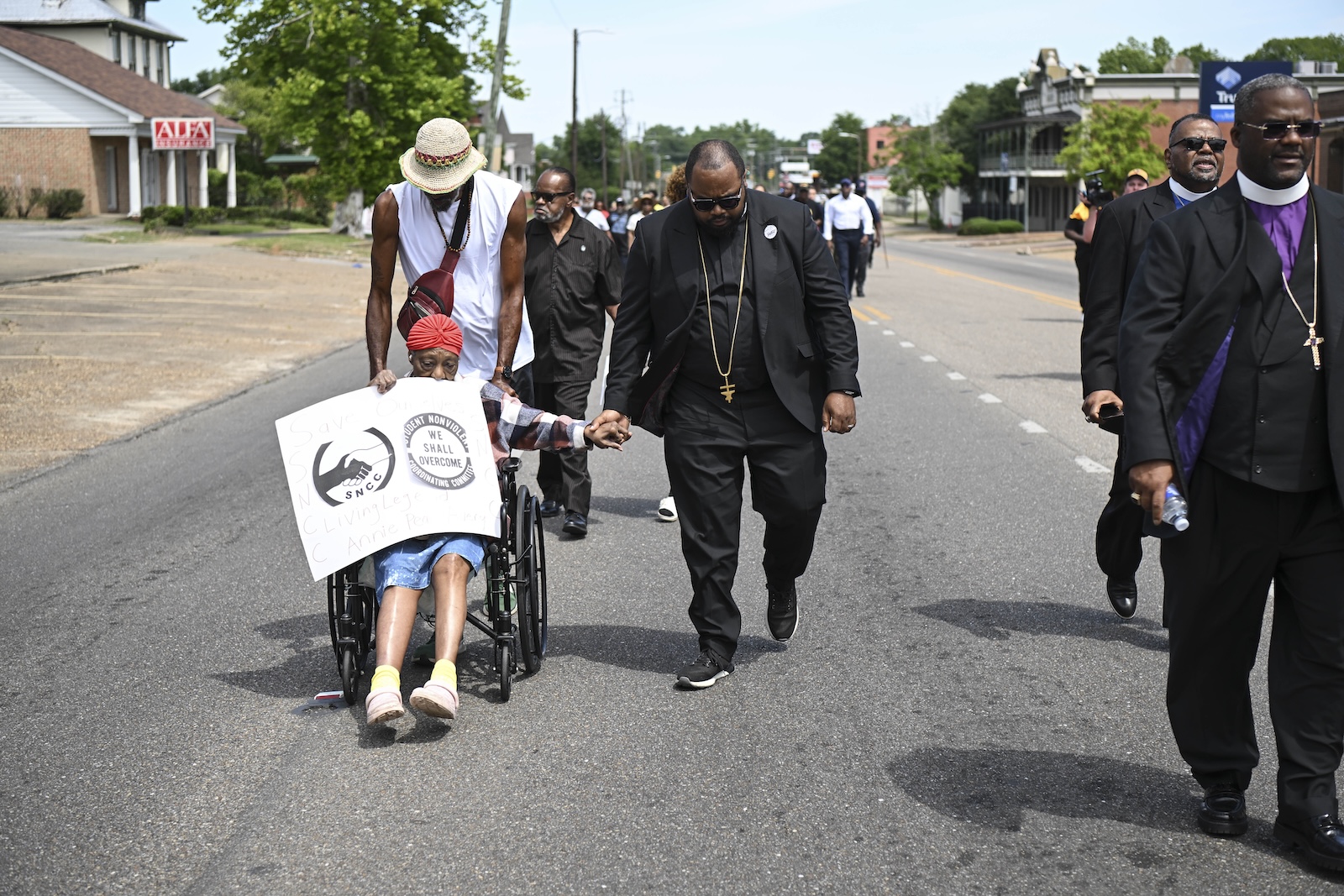
Hundreds of faith leaders and voting rights activists marched in silence across the Edmund Pettus Bridge on Saturday, May 16, returning to the site of one of the most visceral moments in the American civil rights struggle to sound the alarm over what organizers call a coordinated assault on Black political power.
The march, part of the “All Roads Lead to the South” National Day of Action, drew people from Tabernacle Baptist Church through downtown Selma before crossing the bridge the same span where law enforcement attacked peaceful demonstrators on March 7, 1965, in an episode the nation came to know as Bloody Sunday. That assault helped galvanize the political will to pass the Voting Rights Act, one of the most consequential legislative achievements of the civil rights movement.
Inside Tabernacle Baptist Church before the march, pastors, activists, rabbis, elected officials and community leaders spoke for more than an hour, repeatedly describing Selma as “sacred ground” in the ongoing fight for voting rights. The Selma march fed into a larger afternoon rally in Montgomery, where more than 5,000 people gathered at the Alabama State Capitol.
The demonstrations came in direct response to the Supreme Court’s 6-3 ruling in Louisiana v. Callais, which dramatically reshaped how racial discrimination claims under Section 2 of the 1965 Voting Rights Act are handled. But the ruling in Callais does more than reshape one state’s map. It marks a fundamental shift in the constitutional understanding of equality, voting rights and Congress’ power to enforce the Reconstruction Amendments.
The consequences following the ruling arrived almost immediately. Several Southern states initiated redistricting in the weeks after the decision, claiming that existing maps with majority-minority districts previously required under the VRA were now unconstitutional. Tennessee Republicans quickly drew and passed a new map that eliminated the state’s sole majority-minority House district. Florida legislators passed a redistricting bill the same day Callais was decided. Alabama filed an emergency motion asking the Supreme Court to allow its legislature’s map to be reinstated.
Civil rights organizations say the path forward runs through state legislatures, Congress and the courts calling on states to enact their own voting rights protections and urging Congress to pass the John Lewis Voting Rights Advancement Act and the Freedom to Vote Act.
But with the 2026 midterms approaching and new maps being drawn across the South, advocates warn that time is running short.