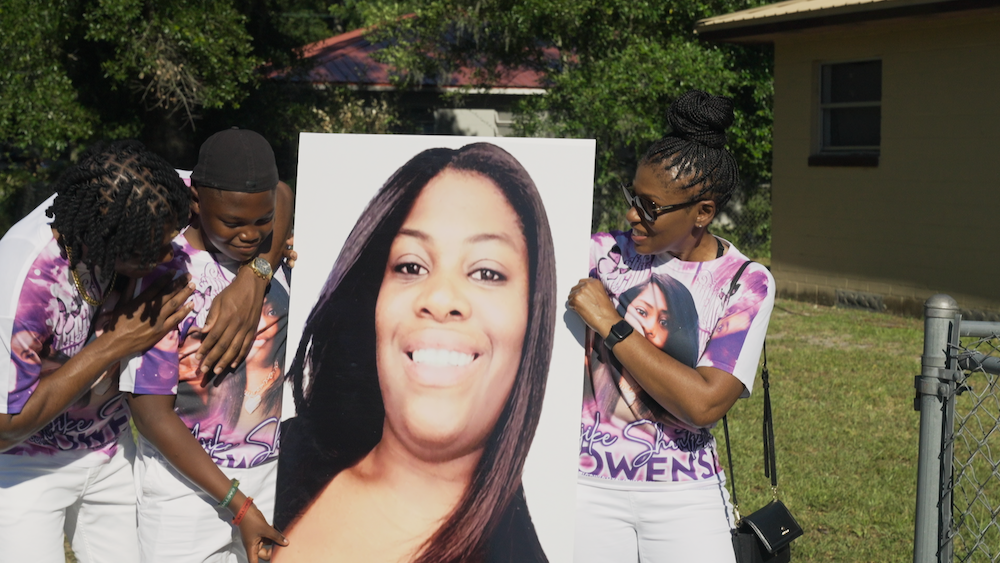
When news of Ajike Owens’ killing by her neighbor reached Geeta Ghandbhir, the filmmaker knew this was a story that needed to be told not just in Florida, but around the nation. That’s part of the story of how her latest documentary, The Perfect Neighbor, now streaming on Netflix, came to be.
“It felt painfully personal,” said Gandbhir, who was connected to Owens through her inner circle. “What started as a personal response slowly evolved into a commitment to tell her story in a way that honors her life and demands accountability.”
The director translated the shock of Owens’ death into an exploration of how the system of power—built on biased policing policies and broken gun safety laws—has not even begun to start a new chapter in protecting Black communities instead of harming them.
Gandbhir doesn’t shy away from the harsh reality of Owens’ case being deeply rooted in racism. The mother of four was shot and killed in July 2023 after confronting her neighbor for targeting her children with racist taunts while they were playing with other kids in their Florida neighborhood.
But instead of being seen as a woman stepping up as the protector of her children—a role many Black parents embrace—local police had yet to take action against the shooter days later due to the state’s “Stand Your Ground” laws, as if Owens was the aggressor.
It’s easy to forget the names of past victims when new headlines pop up on our screens. But the film’s mix of raw, hard-to-watch body cam and security footage reveals a pattern of Black communities in fear of a system unwilling to change.
“The pieces don’t just document tragedy,” Gandbhir said. “They create testimony.”
Producer Alisa Payne sees another kind of parallel. Owens’ mother, Pamela Dias, gave her blessing to produce the documentary and has stepped into the role of keeping her daughter’s fierce spirit alive.
“She sees this film as her Mamie Till (Emmett Till’s mother) moment,” Payne said. “Like Mamie Till, Pam wants the world to know what happened to her baby.”
The crew decided not to tap into the typical expert narration meant to help viewers break down footage.
“This approach is risky—you can’t lean on or soften things,” the director admitted. However, it was important to allow viewers to work through the layers of the story themselves to be motivated into action.
Will Owens’ story prove to be a breaking point in the slow progress in revamping the system?
That’s the ultimate goal for the team that pulled together to make the documentary. To Gandbhir, the story should serve as a wake-up call to folks who ask themselves, “Why do these things keep happening?”
The director hopes that watchers carry away a “call to action to reform gun laws and repeal Stand Your Ground Laws, and a commitment to resist systems that devalue Black lives.”
But beyond being a force for change, Payne and Gandbhir hope that Owens’ name will live on for years by making sure that she is remembered as a human being instead of a tragic headline.
She will be remembered as “an excellent young mother who died defending her children,” Payne said. “We have made this film to honor her legacy.”