
Somewhere in most of our girlhoods, there was a bathroom cabinet stocked with the same things: a bottle of Summer’s Eve, maybe a box of douches and the unspoken message that our bodies needed to be “fixed.” Nobody really sat us down and explained why. These products were just there, passed down as tradition and normalized before we were old enough to question them. Still, our mothers and others are not to blame; maybe they just didn’t have the information.
For a lot of us, our mothers were the entirety of our vaginal wellness education. Most conversations probably didn’t include insight on pH levels, the vaginal microbiome or the fact that the products we were taught to rely on were actually disrupting the very balance our bodies were trying to maintain. We learned to mask, not to understand. And for years, many of us paid the price in the form of recurring infections, unexplained irritation, and a low-grade sense of shame about something that was never our fault.
It wasn’t until I started doing my own research that I realized how much I didn’t know and how much of what I thought I knew was wrong. The vagina doesn’t need to smell like “flowers” or something “warm and inviting” — it needs to smell healthy, like exactly what it is: an organ. And sadly, a lot of the products marketed most aggressively to Black women are often the ones doing the most harm.
The cultural footprint of douching is not accidental. Research published in the American Journal of Public Health found that douching is more prevalent among African-American women than any other demographic — and has been linked to a troubling range of health consequences, including bacterial vaginosis, pelvic inflammatory disease, ectopic pregnancy, and even increased risk of HIV transmission. The same research notes that women were often douching in response to symptoms caused by infection, meaning the product marketed as the solution was frequently making the problem worse, and masking the signs that something needed medical attention.
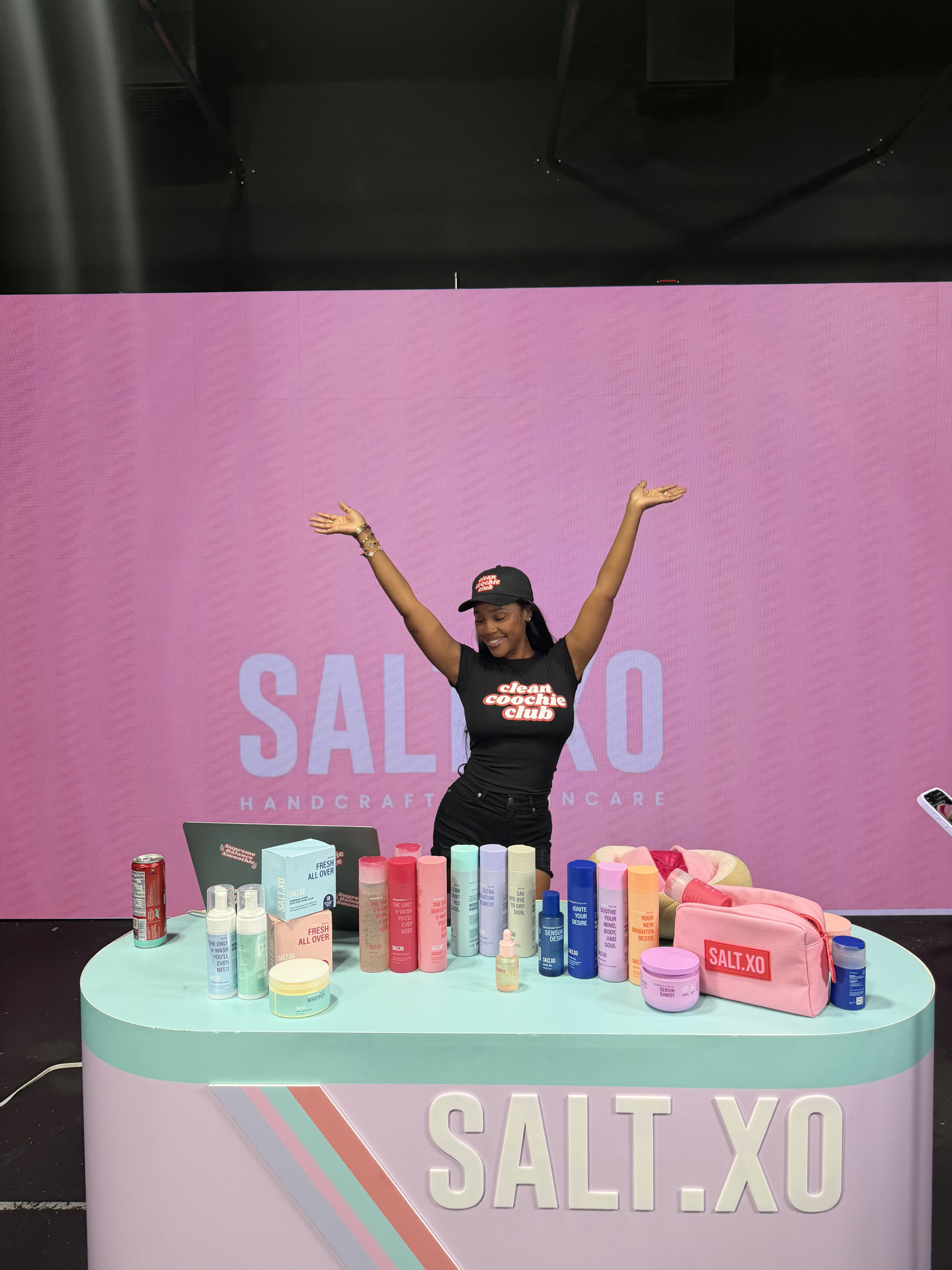
Douching doesn’t actually clean anything; it disrupts everything, but it’s ok. Most of us weren’t taught wrong on purpose; we were marketed to for the wrong reasons. So when EBONY connected with Jhalesa Seymour, founder and CEO of the vaginal wellness brand, Salt.Xo, it felt less like an interview and more like the conversation I wish I’d had at 12, when I entered womanhood.
In 2018, Seymour was a student at the University of Central Florida with $67, a dorm room, and a problem she was tired of navigating alone. Like so many women, she had struggled quietly with feminine health issues — the kind that doctors sometimes dismiss and that women are often made to feel embarrassed about. Instead of accepting that silence, she built something. “I created Salt.Xo, because I know what it feels like to struggle silently with feminine health issues. My mission has always been to create products that help women feel confident, balanced, and empowered in their bodies,” Seymour told EBONY.
What began as a small feminine care line has evolved into a nationally recognized wellness brand featured in some of the industry’s most notable publications. The special thing about the brand is its pH-balanced products, formulated with herbal ingredients and essential oils, free of harsh chemicals, and cruelty-free. In addition to its bestselling Yoni Gels and targeted products for moisture, ingrown hairs, discoloration, and libido, the brand recently launched a women’s probiotic featuring 50 billion CFU, Lactobacillus strains, and cranberry support.
This year, the line is also expanding its impact even further with a Wellness Tour, set to appear at Invest Fest in Atlanta this August. Beyond the accolades and product launches, Seymour is building a body of knowledge that too many women have been denied access to. Scroll down to see some key breakdowns to being real about vaginal health from the founder herself.

Prioritize Good Bacteria
“Your vaginal health starts in the gut,” Seymour said. “Our probiotics with Lactobacillus help maintain a balanced vaginal microbiome and support healthy pH levels.” If you’ve never heard the phrase “vaginal microbiome” before, you’re not alone. The vagina has its own bacterial ecosystem, and when that ecosystem is balanced, everything works as it should. When it’s thrown off by things like stress, diet, antibiotics, or the wrong products — that’s when problems start. Supporting your gut with a quality probiotic is one of the simplest, most overlooked things you can do for your vaginal health. I personally use one with over 50,000 Colony-Forming Units (CFUs).
Stop Over-Cleaning
Here’s the thing that most women didn’t learn until later on: the vagina is self-cleaning. It does not need your help. What does need gentle care is the vulva — the external area — and even then, less is almost always more. “Using harsh soaps, fragrances or heavily scented products can disrupt your natural balance and lead to irritation or recurring BV,” Seymour said. The products many of us grew up with actually are heavily fragranced, marketed as “fresh” and “clean,” and were working against our bodies the entire time. A pH-balanced wash designed specifically for the vulva is genuinely all you need.
Hydration and Nutrition Matter More Than You Think
“What you put inside your body shows up externally,” Seymour told EBONY. “Drinking water, eating balanced foods, and supporting your gut health can impact odor, discharge and overall wellness.” We talk constantly about what food and water do for our skin and our hair. Vaginal wealth deserves that same energy. If your diet is off, your body will show it, and that includes down there. Seymour also recommends adding Slippery Elm to your routine for additional vaginal hydration. It’s a small shift that can make a real difference.
Pay Attention To Recurring Symptoms
If you deal with Bacterial Vaginosis (BV), yeast infections or irritation on a regular basis, Seymour has a direct message: “Your body is trying to tell you something.” “Go to your OBGYN and ask for a panel. Toss out all of your scented washes. Find a fragrance-free laundry detergent for your underwear.” Too many women have normalized chronic symptoms because no one told them they didn’t have to. Recurring issues are not just bad luck; they’re a signal worth listening to. Getting a full panel from your doctor is the first step toward understanding what’s actually going on.
Choose Products Designed To Protect Your pH
Not all feminine care products are created equal, and many of the most popular ones are actively disrupting the very balance they claim to support. “Everything from cleansers to supplements should work with your body, not against it,” Seymour said.
This is all about relearning how to shop, actually reading ingredient labels and asking questions when unsure. You also need to choose brands that have actually done the work of formulating with your body in mind, not just your sense of smell.
What sparked my interest most in speaking with Seymour is that she didn’t wait for the wellness industry to include us; she created the inclusion herself. As a loyal Salt.Xo customer — whose friends introduced me to the brand years ago — I’ve seen firsthand how products like the Yoni Gel, Rejuvenating Oil, and Erotica Gel have become staples in my own wellness routine. That personal connection made this conversation especially meaningful because I’m a testament to the products working.
Now, the information in this article may not feel super groundbreaking or shocking. In many ways, it’s basic. But basic information about Black women’s bodies has historically been withheld, dismissed, or buried beneath marketing that prioritized profit over our health and education.
The silver lining is that the conversation is finally beginning to shift. Founders, educators, and women willing to challenge stigma and discomfort are helping create space for more honest dialogue around wellness and intimacy. While many of us should have had access to this information at 12 — or whenever we first entered womanhood — learning it now is still a powerful place to begin.