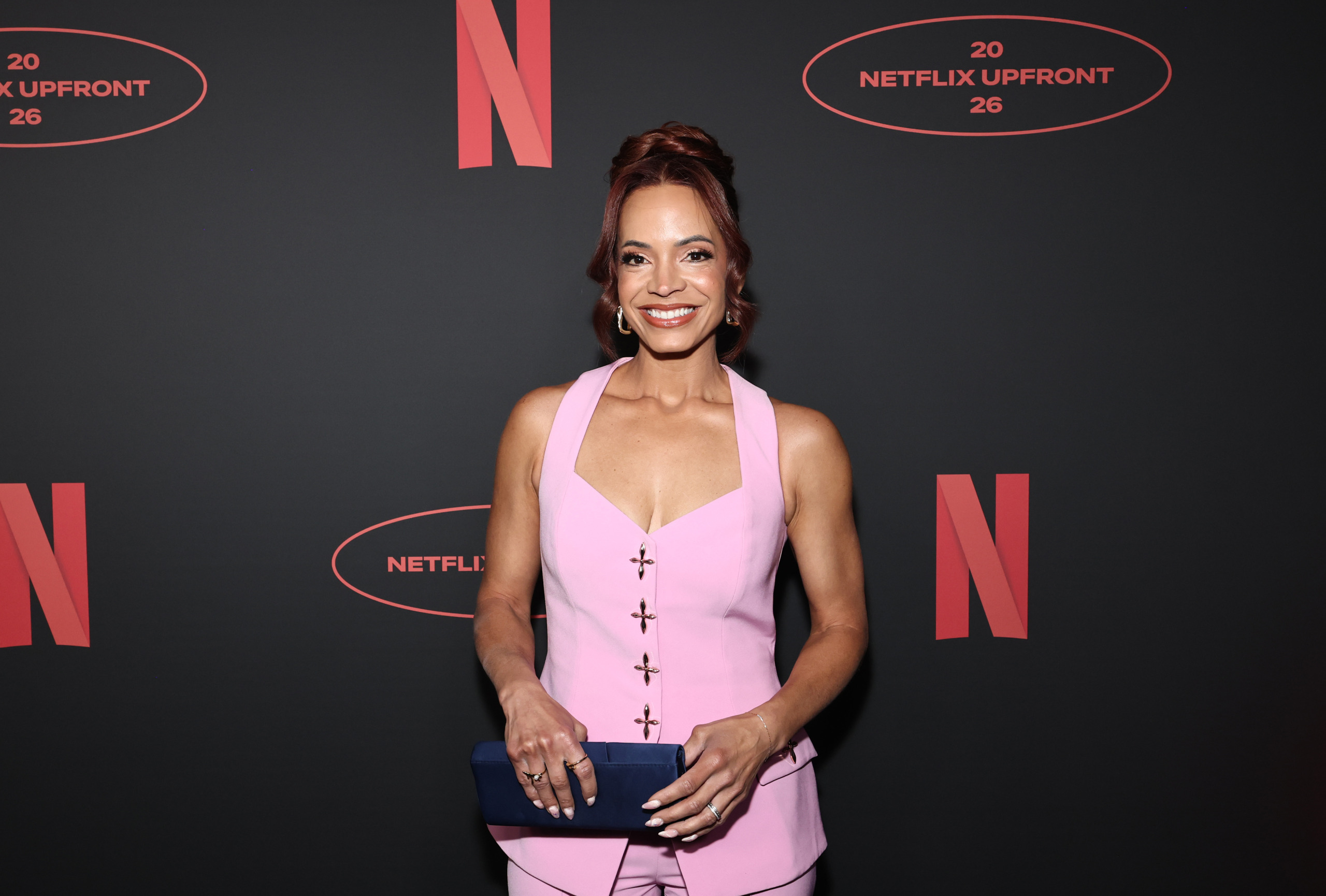
Elle Duncan has never been afraid to change the playbook. In the world of sports media, Duncan is the rare broadcaster who treats millions of viewers like friends at a sports bar, with undeniable energy, humor, authenticity and informed analysis that has made her a star.
After carving out a prominent niche at ESPN as a leading voice on SportsCenter and WNBA Countdown, the Atlanta native made a power move by transitioning to Netflix to lead the streaming giant’s live-event coverage while also anchoring USA Network’s WNBA package.
EBONY caught up with Duncan to break down the business of sports media shifting from cable to streaming, how she knew the timing was right to leave ESPN, and why Black women should always bet on themselves.
EBONY: While everyone today knows you for being one of the most beloved sports broadcasters, you began your career in media as a radio personality in Atlanta at a time when the city was the center of hip-hop. How was that experience?
Duncan: That feels like such a different life ago. I started my career in radio at 20 years old. It was so cool because I got to witness the rise of T.I., and so many more. Atlanta has always been the home of Outkast, but it certainly wasn’t the epicenter of hip-hop that it is now. It was definitely a time, man. I spent a lot of time at the club. I was actually just in Atlanta, and I was like, “Do people still go to the Compound? Is the Velvet Room still a thing?” It was a really cool start to my journey. Working with the legend Ryan Cameron was amazing. Radio is not a visual medium, and I think that my radio experience is why, within two years, I went from doing traffic on the radio to being at ESPN, because I had such a great background of building who I was and the voice and the narratives and all of those things I learned from radio.
EBONY: Many would have bet that you would have stayed at ESPN for years to come, so when you moved to Netflix, it was a surprising move. How did you come to your decision?
Duncan: It was really interesting. I had a boss at ESPN who was leaving for Netflix, and I jokingly said to her, “Don’t forget about me come contract time”. It was just like an offhanded remark. About seven months later, she called me and was like, “Let’s have lunch.” Then she brought up this idea of Netflix growing in live sports and live events, and asked if I was interested in leading its coverage. I was flattered, but I felt pretty good at ESPN. I was there for a long time, I really loved my coworkers, and the projects that I was doing. I was able to really do some deep introspection and asked myself if I was comfortable doing the same thing four years from now that I was already doing. The truth was that there were a lot of itches that I wanted to scratch creatively. Also, my life has dramatically changed since I started at ESPN. I have a family now, so I started asking myself what was going to give me the best opportunity to color outside of the lines and have more time at home. It felt like Netflix was a once-in-a-lifetime opportunity. Very few people come to you and say we want you to do bigger things and work less, and so I had to take it up. But it was a very difficult decision that I spent a lot of time weighing, contemplating, and talking to my family about.
EBONY: As a Black woman, why is owning your ambition so crucial in today’s sports media landscape?
Duncan: That’s a great question. I remember when I was leaving NESN, which is a regional sports network in Boston, before I got to ESPN. I was telling my boss that I would be leaving NESN. I remember him telling me, “It’s really tough for Black women to get roles in broadcasting. Are you sure you want to leave this position?” God, those words have stuck with me. I think that it is consistent with how a lot of women, but in particular Black women, feel, which is that we need to be so grateful for just having the opportunity that we cannot be audacious enough to ask for more and want more. We can redefine what success looks like for us. We can take big swings, especially in our 40s. So I hope, on a very small scale, that I can prove to women and particularly Black women, that it is okay to not only want a seat at the table but also want a voice at that table. Hell, to want to own the lumber company that the table was built from, right [Laughs]? You can dream big, and then you can change your dream.
EBONY: Recently, you said that Netflix is sports plus. Can you explain that?
Duncan: Netflix is for the sports curious, which is a term I keep using. We did the MLB opening, and if you’re a baseball purist, you’re going to watch that, no matter what it was on. But I think what Netflix gives is an opportunity for people who maybe weren’t going to watch baseball, who were turning on Netflix to watch Bridgerton, and then saw that baseball was on and were like, “All right, well, it’s on Netflix, so I’ll watch it.” I keep having to remind myself that there are 330 million subscribers across the world. Netflix tries to think outside the box, and they’re the leaders in content and creativity. They’re always saying, How do we put our own Netflix spin on a traditional sports broadcast?
EBONY: You made a big splash with your first Netflix event covering “Skyscraper Live” with Alex Honnold. How was that experience as your introduction to the world?
Duncan: When I signed with Netflix, I thought my first gig would be MLB opening day. A month after I signed, they told me that Alex Honnold was going to climb the tallest building in Taiwan. I was very aware of who Alex Honnold was, and Netflix asked whether I would be interested in hosting the event live. I thought to myself, this is something so different that I would have never conceived of doing in my entire career, and I get to do it right out of the gate. It became very popular in the, you know, sort of orbit of culture and pop culture, but it was a really cool chance to try something very different.
EBONY: Lastly, with all you have going on, how does Elle Duncan maintain her mental health?
Duncan: I have always been an incredibly introspective person. Sometimes that can be good and bad. Sometimes I live a lot in my head. I really want to be the best version of myself, which is what I’m always working on. I’ve been in therapy consistently for three years now, but I’ve done therapy at various points in my life. Before this last run of therapy, I was spiraling, and it was really affecting my health. I came as close to panic attacks as I’ve ever had in my life. I needed to unpack all of these things that I was feeling. Therapy is really about having tools because it doesn’t eliminate issues, but it gives you the tools in your kit, so that when they do come, you can handle them better, and you don’t have to ruminate.