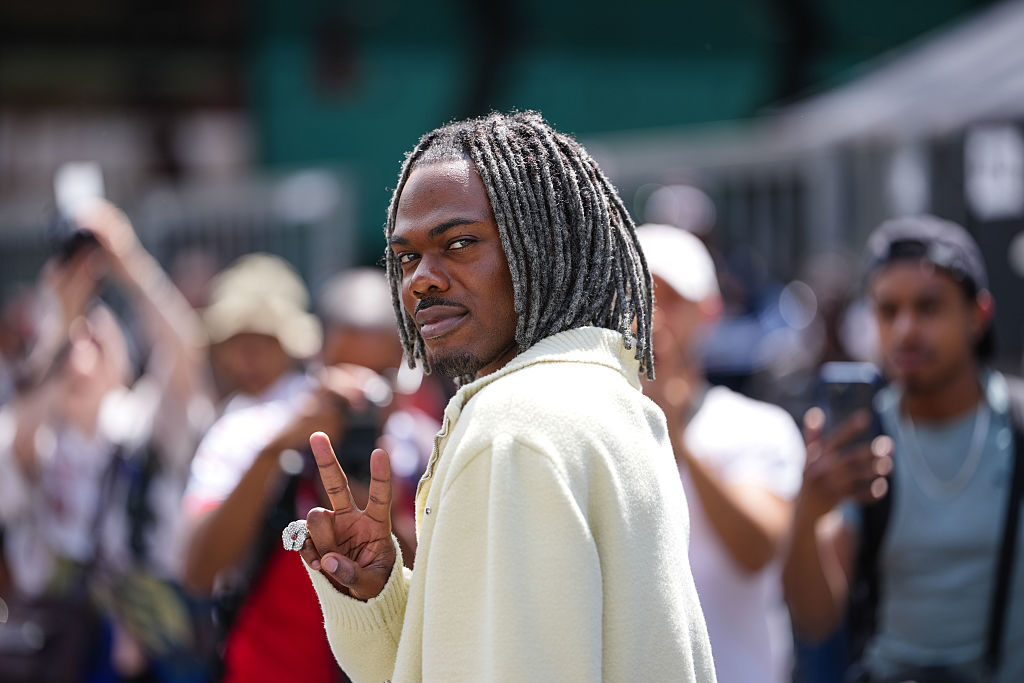
In a candid conversation with EBONY, CKay reflects on the heartbreak that sparked a new chapter, the Nigerian sounds shaping BANGER BOY and why his latest era is less about reinvention than refusing to let life stand in his way.
There comes a point in every artist’s journey when growth demands a little reinvention—not necessarily becoming someone new, but making room for all the versions of yourself that have been waiting to emerge. For Nigerian Afrobeats star CKay, that evolution means trading some of the familiar romance of his catalog for something louder, freer and unapologetically alive. His latest chapter is rooted in heartbreak, healing, self-discovery and, above all, the decision to keep moving forward.
Released August 7, 2026, BANGER BOY, his third studio album, is a 12-track exploration of that mindset, blending Afrobeats with house, electronic influences, rock and Nigeria’s emerging Mara sound. Featuring collaborations with Mavo, Kidd Carder, Phyno, Maleek Berry and King Promise, the project finds the global hitmaker looking beyond the love-song label that first made him a worldwide favorite—and asking listeners to experience every side of him.
EBONY: Before we get into the album, let’s talk Nigerian food. Can you actually cook jollof rice and egusi soup?
CKay: I can make jollof rice, but I cannot make egusi soup. I can’t make any soups. The soups are usually very intricate, you know? So I let the women in my life do the cooking of the soups. But the thing about jollof rice is, as a bachelor, every bachelor in Nigeria, I would say, knows something about making jollof rice. It’s not the hardest thing to make.
What about fufu?
Most Americans generalize everything as fufu, but they’re all different. I can make something called eba, which is made from garri, but it looks like fufu. Some people would call it fufu, but it’s actually not. They look the same.
I can also make pounded yam. In Africa, pounding yam is an activity that requires a lot of muscle. Usually, in a traditional African home, they call the men to pound the yam. Igbo women pound the yam too, like African women, but the man pounding the yam is like a sign of strength. So a lot of us are physically fit without really going to the gym because of stuff like that.
You’re often affectionately called ‘Africa’s Boyfriend.’ Do you think becoming ‘Africa’s Husband’ is somewhere in your future?
It would be impossible to marry a whole continent. But I’ll be a husband one day. I don’t know what day that’ll be, but one day. Right now, I’m Africa’s “Banger Boy” with this project. I’m exploring a very different side of my personality and artistry.
I feel like people have known me for a very long time to ‘make love songs.’ Some of my most popular records are related to love. But no human being is in love every single day of their lives. The same way nobody’s happy every single day of their lives.
You’re happy right now, but maybe yesterday you were not so happy. Life is like the ocean. It has currents, it has waves, and every current and every wave is different and special in its own right, and it’s still the ocean. It’s not something else. It’s still the same ocean.
That’s kind of how I see music. I basically just want people to be very open-minded and walk with me through this journey. I’m Africa’s Boyfriend right now, but Africa’s Boyfriend has to go through processes. His heart has to get broken. He has to have a hoe phase. He has to have all these things that happen in the life of a person. So that’s basically what it is with me. It’s a journey, and this chapter is called BANGER BOY.
You describe BANGER BOY as the beginning of a new chapter. What was happening in your life or career that made you feel it was time for that shift?
I went through a major breakup, first things first. I wouldn’t even say I reinvented myself. Maybe that’s what you would call it, but from my perspective, I just see it as I underwent growing pains. I was growing as a human being, and sometimes growth comes with changes. You have to shed some skin sometimes. You have to let go of certain things and embrace other things.
A large part of that was me cutting my hair. I just wanted a new start. I’d had my dreads for a good number of years, and I just wanted something different. I wanted to explore a different side of myself and a different side of my personality. All of that has been part of the healing process for me, and it’s a process that I’ve enjoyed. I’ve enjoyed confronting different parts of myself and embracing growth.
You’re still deeply involved in your music as a writer, composer and producer, as reflected in the project’s credits. Why is maintaining that level of creative control so important to you?
For me, I actually see it as a no-brainer. I see it as something that should even be a given, not something out of the norm. I say this all the time…I think music has become so much of a commercial thing that people forget that it’s art. I try to make sure the integrity of the art is upheld. It’s not just a bunch of songs put together.
It’s important to be true to the authenticity of it; I have to be involved in every process. I have to have some form of input in every process. Production is something I’ve been doing for years, from the very beginning of my career, and it’s not a skill that I can get rid of. I’ve always been producing my stuff from my very first EP.
My biggest records, I produced them. I usually do have co-producers that contribute to the production. I produced ‘Love Nwantiti,’ for instance, and ‘Emiliana,’ but they both had co-producers that made contributions. So I still embrace collaboration even on the production level. I’m not necessarily trying to do everything myself. I bring in people to contribute at specific points of interest where I feel their contributions will make a lot of sense.
Even as far as collaborating with artists goes, I embrace the spirit of collaboration a lot. I want to bring in people with different areas of expertise, different talents, different energy to just make an overall better work of art—a better song that people can listen to and enjoy. I feel like that’s something that has been lost lately. Some people collaborate with other artists because they’re the hottest artists right now or because they want to compete. I think it’s a crazy concept that people collaborate to compete. That goes against the whole concept of collaboration. I don’t collaborate to compete. I collaborate for the good of the record.
You have several collaborators across BANGER BOY. Did any collaboration surprise you creatively?
For the majority of the songs, I actually made it a point to have the artists in the studio because I used to always do the email thing before, especially during COVID. But on this album, I really wanted to have in-person sessions.
The notable ones were Mavo and Kidd Carder. They both came to the studio and recorded. But for King Promise and Maleek Berry, because we were over a distance, we had to do the collaboration via WhatsApp and email. We kept in close communication.
One very unusual song, “ZERO,” the one with King Promise, the process was actually very interesting because even the production was done over a distance. That’s the only time I had done something like that. I was in the U.S. at the time. I was in Houston, and my producer, Bola BMH, was in Lagos. I was going to be back in a few weeks, but I was impatient. I didn’t want to wait until I was back.
We had this thing where the producer could put the session on their system and someone over a distance could listen in on the session from their own speakers as if the producer was there. Not from the phone’s microphone. Not like an actual phone session where you put the phone in front of the speaker. You actually hear the thing from your speakers like the person was there. So we did that, and that’s how “ZERO” was made. The production was done over a distance. I think that’s a very interesting way to make music. I’d never done that before.
You incorporated Mara and electronic influences into the project. What drew you to those sounds?
Every time I draw inspiration from a genre, it’s always a fusion thing. I’m always fusing it with what I already have going on with my own natural sound. The thing about Mara is, I call it Africa’s house music—or Nigeria’s house music. Mara originated without even artists singing on the beats. It was usually just instrumentals that were mixed by DJs on the spot. It’s very crazy when the DJ plays it on the dance floor. People really dance. I spent a good number of years living on the mainland in Lagos, and on the mainland, street music is very popular. This sound was always something that’s been bubbling under in the streets and in the clubs for years. I just wanted to do something interesting with it.
For instance, “BODY,” which was the first single on the album featuring Mavo, was basically a fusion of Mara rhythms with rock music and a bit of house, EDM house. It’s a mixture of three different genres. We just made something really crazy, something very out of the box, something unexpected, something that nobody had ever done before. Every single time the DJ plays it, it always goes crazy.
I wanted to do something different that was not Amapiano, because Amapiano is the status quo in the club right now. I love Amapiano a lot. I actually have a couple Amapiano records myself. But I just felt like I wanted to hear something different in the club for a change. You know the saying, “Be the change you want to see in the world”? I wanted to just hear something else in the club, and I decided to make that something else. And BANGER BOY was born.
“E CLEAR” reveals a softer, more vulnerable side of you. What made it important for you to include that kind of emotional depth on an album titled BANGER BOY?
I wanted people to also kind of open their minds to understand that a banger must not necessarily be a fast song. On the album, there’s a variety of bangers. Everything is a banger, but it’s not all the same exact sound. There’s a Side A and a Side B. Side A is more for the very, very fast records, the high-tempo records, and Side B is more for the mid-tempo bangers that are still heavy and hard-hitting, but they’re not as fast as Side A.
Sometimes it’s so easy for people to just generalize things and say, “A banger must be fast.” I’ve had many mid-tempo bangers as well. “Love Nwantiti” is a banger. “Emiliana” is a banger. “Wahala” is a banger. But they’re not necessarily fast. “BODY” is also a banger. “AFRICAN GIRLS” is a banger. “SHEGE” is a banger. All these songs are bangers.
I just wanted to show people a bit of depth to what BANGER BOY means. “E CLEAR” is a very beautiful song. It’s vulnerable and it expresses emotions, but so does every other song as well. Every song I make expresses some form of emotion, whether it’s a fast one or a slow one. “E CLEAR” is no exception.
Beyond the music, what does being a “Banger Boy” actually mean to you?
Being a Banger Boy means being someone that approaches life with a Banger Boy mindset. The Banger Boy mindset is this: There is a rock in front of you. If you try to go under the rock and you can’t get under the rock, you try to bypass the rock on the left or on the right, and you can’t bypass the rock. You try to go up the rock, and you can’t go above the rock. The next thing to do is to just put a dynamite and destroy the rock, and then you can go through.
It’s a metaphor for the approach to life: refusing to be blocked by obstacles, refusing to let things get in your way, being determined at all times and just having an attitude of getting ahead and moving forward regardless of the negative experiences you have. I went through a series of very negative experiences, one of which being a breakup, but I refuse to let that weigh me down. That’s basically the mindset of being a Banger Boy.
It’s been seven years since CKay the First, which became the first African EP to surpass one billion Spotify streams. Did that level of success create more pressure, or has it given you more confidence?
It has given me a lot of confidence in the fact that people around the world, even though they are separated by distance, are still one human race. We all go through the same things. We all experience love. We all experience heartbreak. We all dance. We all party. We have times of celebration. I feel like, as obvious as that is, it’s not very obvious.
I feel that it’s very important to understand when you’re an artist because you can be true to who you are and your experience where you are, and people around the world can relate to it and resonate with it. That’s the one thing I would say above everything that I’ve really gained from that experience, and I’m grateful for the journey. I’m grateful for everyone who has supported me. I just want people to grow with me while I go through this journey.
If someone has never heard you before and you could play them one song from BANGER BOY to introduce them to this new era, which song are you choosing?
“NDA.” I feel like “NDA” is the premise upon which the whole album is built. It’s the moment where Banger Boy was born, in terms of the story and the mindset. A close second is “BODY” because “BODY” is like a second premise. After the bad experience, celebrating life and being free is my response to a bad situation.
You can respond to a bad situation in two ways. You can either let it weigh you down, you can cry, you can be sad, you can lock yourself in your house for days or weeks, or you can do the opposite, which is to live life even harder. So I would say “NDA” first and “BODY” second. I think once you listen to those two, you should get it.
Looking at everything you’ve accomplished—billions of streams, global recognition, making history—is there anything that still feels unfinished?
One collaboration I think would be very interesting would be CKay and Bad Bunny. I think that would be cool. CKay and Karol G would also be crazy. I wouldn’t necessarily say these are dream collaborations that are remaining for me. I wouldn’t put it like that. But I would say these are people that I think doing a collaboration would make me happy. And I think the world needs that as well. It will make millions of people happy, not just me.
One last one. Are you a football fan? Did you watch the World Cup?
Yes. I’m a football fan, but I can’t lie, I didn’t watch most of the World Cup because Nigeria didn’t qualify. I always make it a point to watch the finals. I did watch the finals, and it was a very interesting game. I was kind of rooting for Spain, so I was happy they won. Spain was kind of the underdog in that situation, and I kind of have a soft spot for the underdog—especially when I feel they are deserving. I thought it was a really good game.