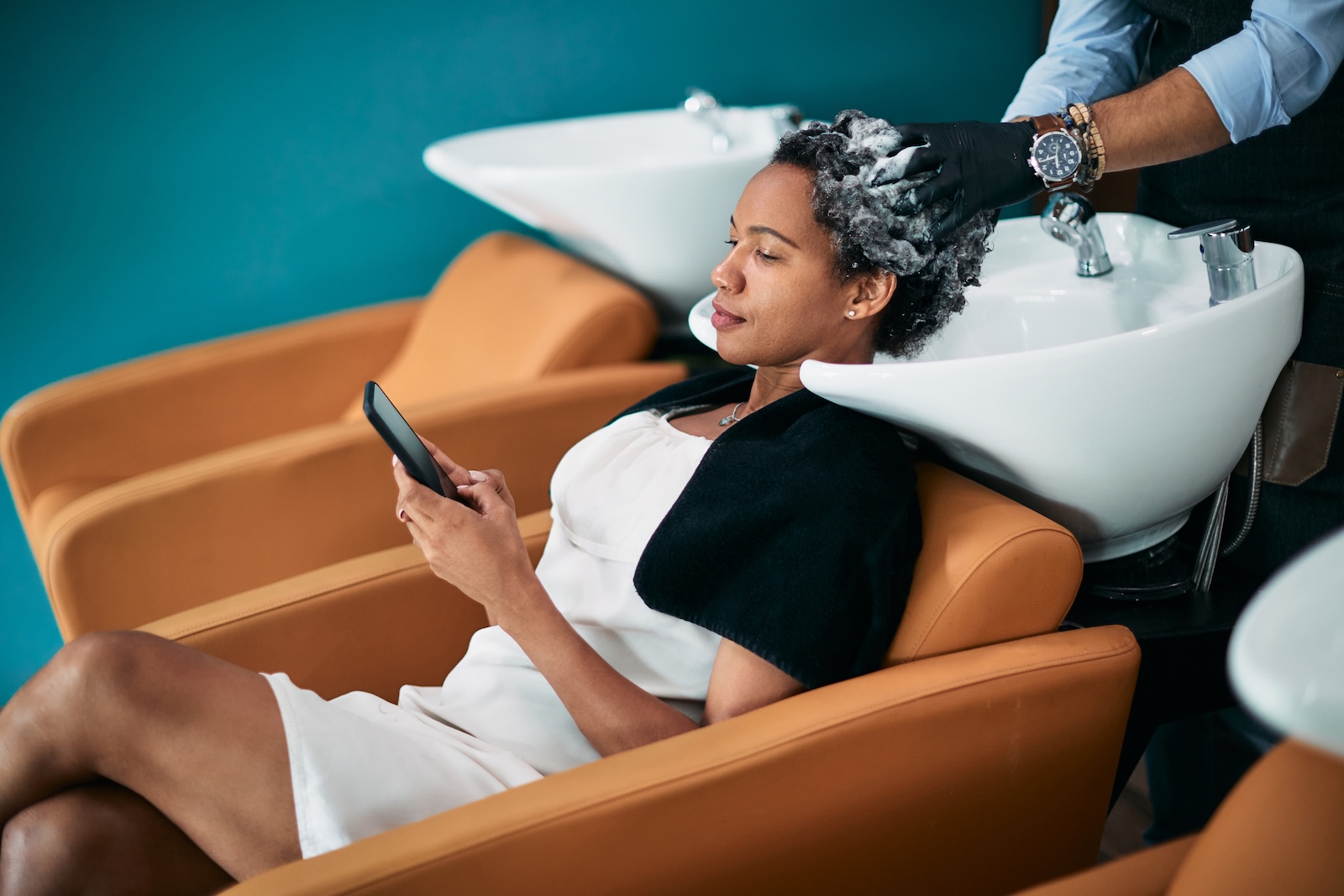
There’s a specific kind of silence that happens backstage when a Black model sits in a chair and the stylist hesitates. It’s subtle but it’s loud. You can feel it in the pause before hands touch hair, in the way tools get shuffled around and in the quiet scanning of the room for someone who might know what to do. That moment has existed for far too long in an industry that prides itself on polish and precision. So when Michaelle Solages co-authored legislation requiring cosmetology schools to properly teach textured hair, it didn’t just read as policy. It read as a correction and, more importantly, as protection.
This isn’t a new problem. It’s a documented, lived and widely shared experience across fashion, film and television. Black models have long traveled with their own kits not out of preference but necessity. Actors have learned to become their own hairstylists in trailers when the hired professionals didn’t have the skill set. Actresses have had to quietly undo damage, literal and reputational, before stepping on camera. And behind all of it sits a harder truth. It wasn’t always about lack of access to education. It was about an industry that never required people to learn and in many cases never expected them to care.
What this bill does is shift that expectation at the root. By making textured hair education a requirement rather than an elective, it eliminates the loophole that allowed professionals to move through their careers without ever understanding curls, coils, density, shrinkage or protective styling. It reframes textured hair not as a specialization but as foundational knowledge. That distinction matters because when something is treated as optional, it inevitably becomes excluded.
Think about what this would have changed if it had existed years ago. Backstage at fashion shows, there would be no last-minute improvisation, no rushed braiding sessions done under pressure, and no defaulting to heat damage because it’s the only technique someone knows. On film and television sets, continuity wouldn’t fall apart because the wrong hands were involved. Actors wouldn’t have to negotiate for their own hair health while trying to do their jobs. The emotional labor alone, the constant awareness, the quiet advocacy, and the need to double check would have been significantly reduced.
That’s why this moment feels important. Not because it solves everything overnight but because it establishes a new baseline. The beauty industry has spent years performing inclusivity in front of the camera but behind the scenes? The experience has remained inconsistent, often dependent on luck. This law begins to close that gap by embedding inclusion into the infrastructure itself.
There is still work to be done. There are licensed professionals already in the field who came up in systems that never required this knowledge, and that won’t change immediately. But for the next generation, the standard is different. The expectation is clear. You don’t get to opt out of understanding Black hair in an industry that continuously profits from Black culture.
And maybe that’s the real shift here. The next time a Black model, actor or actress sits in a chair, the goal is no longer relief that someone knows what they’re doing. It’s the expectation that they should.